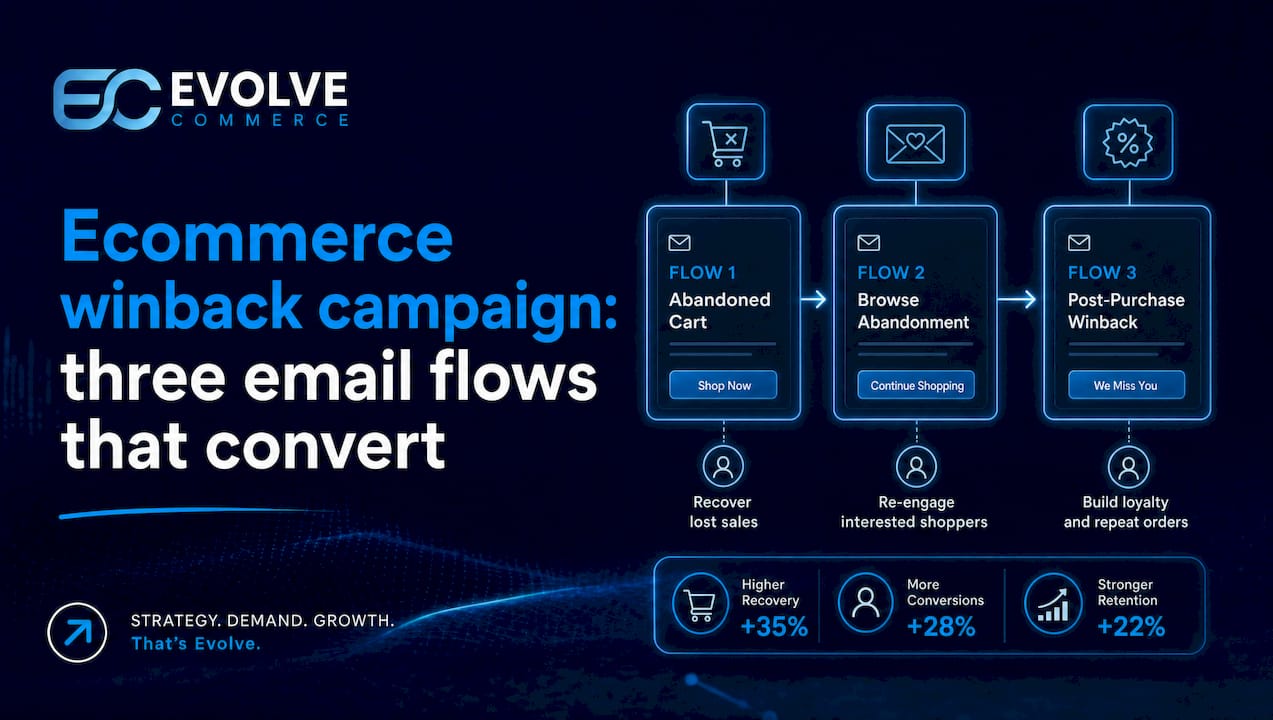
A winback campaign is a behaviour-triggered sequence that re-engages customers who were once active but have gone quiet. The best-practice approach is a three-email flow built on an offer ladder, starting with value and only turning to discounts as a last resort, with strict ejection logic so you never message someone who has already reordered. Success shows up as a lift in reactivation rate and a cleaner, more responsive list.
- Effective winback campaigns should be triggered at least 55 to 60 days after a customer’s typical repurchase window to avoid messaging during the mid-cycle.
- Segmentation based on recency, purchase history, and predicted customer lifetime value enables personalized offers, reducing waste and increasing reactivation efficiency.
- A three-email sequence starting with value, then proof with a soft offer, and finally a discount with clear opt-out, is proven to maximize reactivation and preserve margin.
- Key metrics to monitor include reactivation rate, revenue per recipient, and distinguishing genuine new revenue from sales that would have happened anyway through holdout tests.
- Proper timing, ejection logic, and avoiding excessive urgency in every message prevent list fatigue, improve open rates, and increase overall campaign ROI.
Table of Contents
- Why winback campaigns matter for ecommerce and CRM teams
- When to trigger a winback flow: timing, buying cycle and behaviour-based triggers
- Core elements of an effective winback sequence
- Segmentation and personalisation: who should receive which path
- Measurement, testing and KPIs for winback campaigns
- Practical examples and quick templates
- How an agency might build and optimise winback engines
- Editor’s perspective: common mistakes and the right trade-offs
- How an agency can help with your winback strategy
- Sources
Why winback campaigns matter for ecommerce and CRM teams
Retention economics make the case on their own. Acquiring a new customer typically costs five times more than retaining an existing one, which puts winback flows near the top of any lifecycle team’s priority list when budgets tighten. You already have the data, the purchase history, and the permission to email or text these people. That’s a shorter path to revenue than another round of prospecting ad spend.
The benchmarks back this up. Roughly 45% of recipients who open a re-engagement email go on to open subsequent messages from the brand, which suggests the first touch does more than generate a single sale. It resets the relationship.
Businesses with a genuine repeat-purchase pattern (beauty, supplements, pet food, apparel) see the strongest returns, because the flow can be timed against a real reorder rhythm. Long-cycle purchases, like furniture or one-off electronics, need a different playbook built more around brand recall and category upsells than tight timing windows.
Winback by the numbers: Many customers who reopen contact with a brand after a re-engagement email stay engaged for future sends, and retention typically costs less than new-customer acquisition. That combination is why winback flows consistently rank among the highest ROI automations in a CRM programme.
When to trigger a winback flow: timing, buying cycle and behaviour-based triggers
Timing is where most winback flows fail before they even launch. The trigger should be the Placed Order metric, with the initial delay set slightly longer than your customers’ typical repurchase interval, a structure Klaviyo recommends specifically to avoid firing while someone is still comfortably mid-cycle. If your average customer reorders every 45 days, don’t trigger at day 30. Give it 55 to 60.
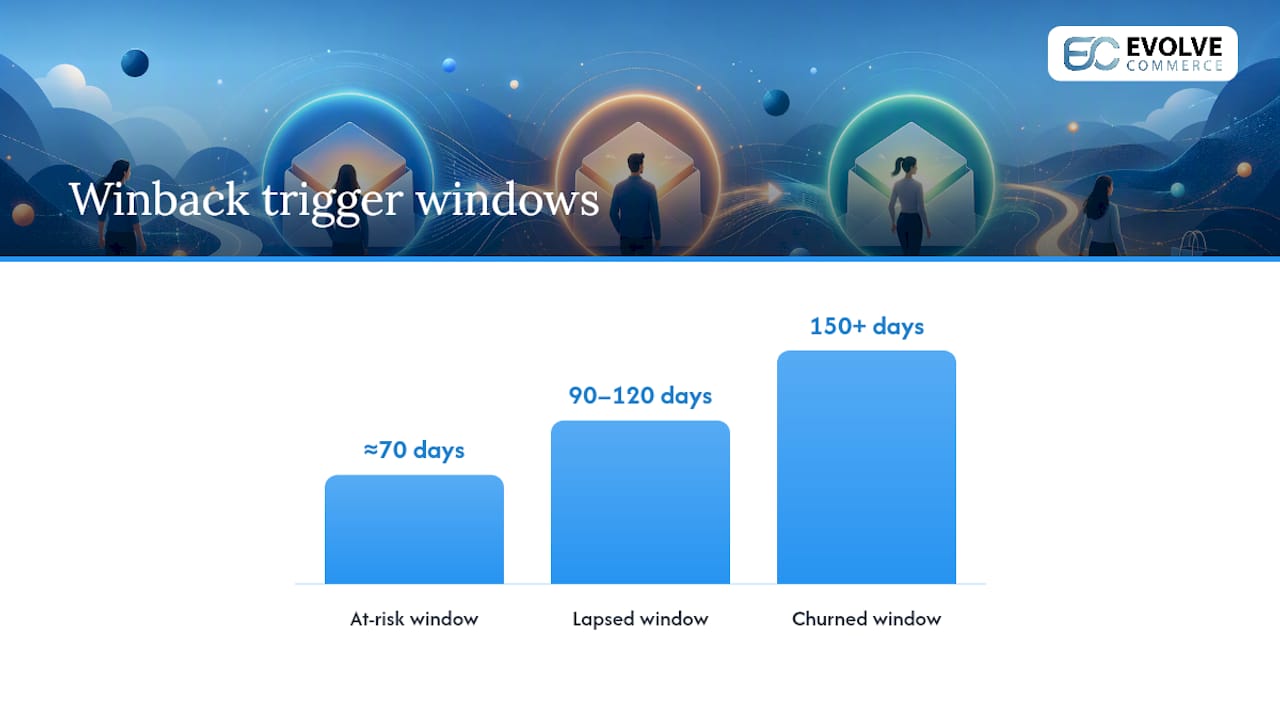
A three-tier framework handles the reality that “inactive” isn’t one bucket:
- At-risk: past due against their personal reorder window but not yet cold. Example: a skincare buyer who normally repurchases every 60 days hits day 70.
- Lapsed: well beyond the expected window, worth a value-led push. Example: day 90 to 120 for the same skincare buyer.
- Churned: past the point where standard nudges tend to work, and the point where a stronger offer or a final email becomes justified. Example: day 150 plus.
Where you have predicted next-order or churn-risk fields, use them to personalise the delay per customer rather than applying one fixed window across your whole list, an approach that reflects actual reorder behaviour rather than a calendar guess, as practitioner guidance on timing makes clear.
The single most important safeguard is ejection logic. Add the filter “Placed Order zero times since starting this flow” and recheck it before every send. Without it, you will promote discounts to people who reordered the day after entering the flow, which is both wasteful and mildly insulting to a customer you’re trying to win over.
Core elements of an effective winback sequence
The sequence that performs best follows a three-email pattern, each with a distinct job:
- Value-led opener. No discount. Remind them what they loved, share something new (a bestseller, a use case, a piece of content), and ask a soft question. This protects margin and tests whether attention alone brings them back.
- Reminder with proof and a soft offer. Add social proof (reviews, a specific product’s rating), a personalised recommendation, and a low-cost perk like free shipping or early access, not a percentage off.
- Last chance, with a clear opt-out. This is where a discount, if you’re using one, belongs. Make the urgency real and give an easy unsubscribe path, because a clean exit protects your sender reputation more than another forced open.
This escalation matches the offer ladder Shopify recommends: content first, service or perks second, discount only as the final lever. Leading with a discount trains customers to wait for one every time, which is the single most common way brands quietly erode their own margin.
Email carries the sequence. SMS earns its place only when email engagement has already failed, or for that final urgent nudge, since it’s a channel best reserved for high-impact, high-risk moments. Paid retargeting picks up the silent non-openers who never click through at all.
Subject lines should sound like a person, not a sale: “We miss you, [First Name]” or “Still thinking about [Product]?” work better than anything with an exclamation mark and a percentage sign.
Pro Tip: Keep the urgency in the last email only. If every message in the sequence sounds urgent, customers stop believing any of them, and open rates decay across the whole flow, not just the final send.
Segmentation and personalisation: who should receive which path
A single winback flow sent to your whole inactive list wastes both budget and goodwill. Segment before you build:
- RFM (recency, frequency, monetary value) splits separate one-time browsers from genuine lapsed regulars.
- Predicted CLV lets you escalate offers economically: high-value customers get curated service perks, low-value cohorts get modest, cheaper incentives.
- Purchase count and category determine whether someone sees a replenishment nudge or a broader “what’s new” message.
- Loyalty tier should route VIPs to a dedicated path that never leads with a discount they’d get anyway through their membership.
Build in exclusions for anyone currently in a welcome, cart-abandonment, or post-purchase flow, and recheck those filters before each promotional step, an operational detail that’s easy to overlook but prevents the same customer receiving two contradictory messages in one week. Have a fallback product feed ready for profiles with thin purchase history, so recommendations never default to something irrelevant. Personalisation tokens (first name, last product bought, predicted next category) work best alongside a single, specific piece of social proof, placed in email two, rather than a wall of testimonials in every message.
Measurement, testing and KPIs for winback campaigns
Four metrics matter more than the rest: reactivation rate, conversion rate, revenue per recipient, and the resulting uplift in customer lifetime value. Track all four rather than fixating on open rate alone, which tells you almost nothing about whether the flow paid for itself.
- Reactivation rate: the share of the flow’s entrants who place a qualifying order.
- Revenue per recipient: total flow revenue divided by everyone entered, not just openers.
- Complaint and unsubscribe rate: your early warning system for list fatigue or poor targeting.
- Spam trap hits: a signal your list hygiene needs attention before you send anything else.
The harder question is whether the flow creates genuinely new revenue or simply captures sales that would have happened anyway. That’s why holdout tests matter: hold back a control group, let the rest receive the flow, and compare outcomes to measure real incremental lift rather than trusting last-touch attribution on its own.
A useful benchmark to test against: with roughly 45% of recipients opening subsequent brand emails after a re-engagement send, any flow performing meaningfully below that on email two is worth a subject-line or segmentation review before you scale it. Report results monthly, and treat the first month as calibration, not a verdict.
Practical examples and quick templates
Three short templates to adapt directly:
- Email 1 – Subject: “We miss you, [First Name].” Body: a single new arrival or bestseller, no offer, one clear link.
- Email 2 – Subject: “Still thinking about [Product]?” Body: a star rating, a personalised recommendation, and free shipping on the next order.
- Email 3 – Subject: “Last chance to save your spot.” Body: a time-boxed discount and a visible unsubscribe link.
Preview text should extend the subject rather than repeat it: “Your favourites are still here” pairs well with email one; “This offer closes Friday” suits email three.
Escalate to SMS only after email two goes unopened, and to retargeting ads after the full sequence completes with no click.
One mid-sized apparel brand found its flow was firing too early, capturing customers who were still comfortably mid-cycle. Pushing the delay out past the actual repurchase interval, rather than a fixed 60-day default, lifted reactivation without adding a single extra email.
How an agency might build and optimise winback engines
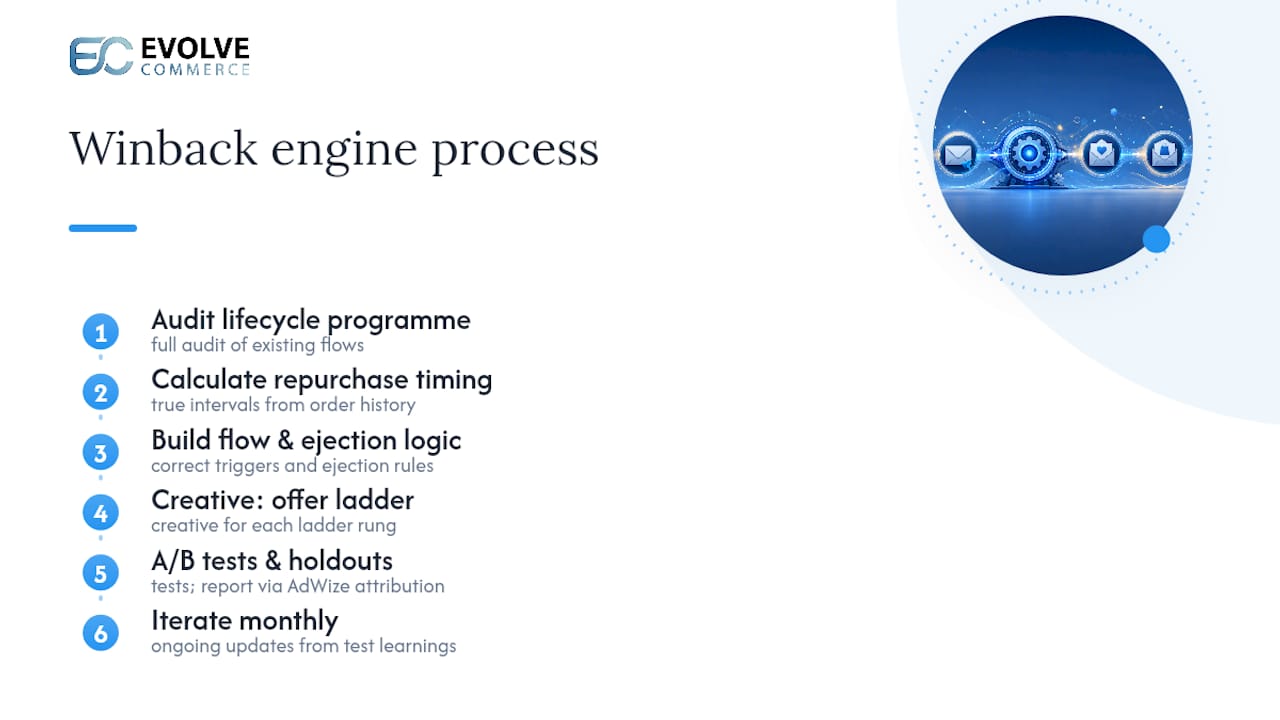
Evolve Commerce runs winback engines through a six-step process: audit the existing lifecycle programme, calculate true repurchase intervals from order history, build the flow with proper ejection logic, produce the creative for each rung of the offer ladder, run A/B tests and holdouts, then iterate monthly. Every step reports through AdWize, which tracks server-side attribution so incremental lift is measured against a genuine control group, not last-touch guesswork.
If you’re briefing an agency yourself, ask how they calculate timing (data-driven or default templates), whether they run holdout tests, and what happens in exclusions when a customer sits in multiple flows at once. A first 30 to 60 day engagement should include a full audit, one flow rebuilt with correct triggers, and an initial test already live.
Editor’s perspective: common mistakes and the right trade-offs
The most common failure isn’t a bad offer. It’s arbitrary timing paired with a discount fired too early, before anyone’s checked whether the customer already reordered. Ejection logic gets skipped more often than it should. Fix the data and the segmentation first; the creative can wait. A 30-day plan: audit your actual reorder intervals, launch one properly timed test with a holdout group, and only then touch the offer ladder.
How an agency can help with your winback strategy
An agency may offer services across every stage of this guide: a data audit to find real repurchase intervals, flow builds with correct triggers and ejection logic, creative for each offer-ladder rung, and measurement through analytics to prove incremental lift rather than guess at it. An initial scoping call typically covers current flow setup, repurchase data, and where the biggest reactivation gap sits.
If your winback flow is still running on a fixed 30-day discount trigger, you’re likely leaving reactivation revenue on the table that proper timing would recover. See how this plays out for real brands on the case studies page, then get in touch through the Evolve Commerce site to scope your own winback build.
Sources
- Customer Win-Back Campaigns: How to Get Previous Buyers Back on Track
- How to create a winback flow | Klaviyo Help Center
- Running winback campaigns (Shopify enterprise blog)
- Winback flow strategies: timing, segmentation and offers (Klaviyo community)