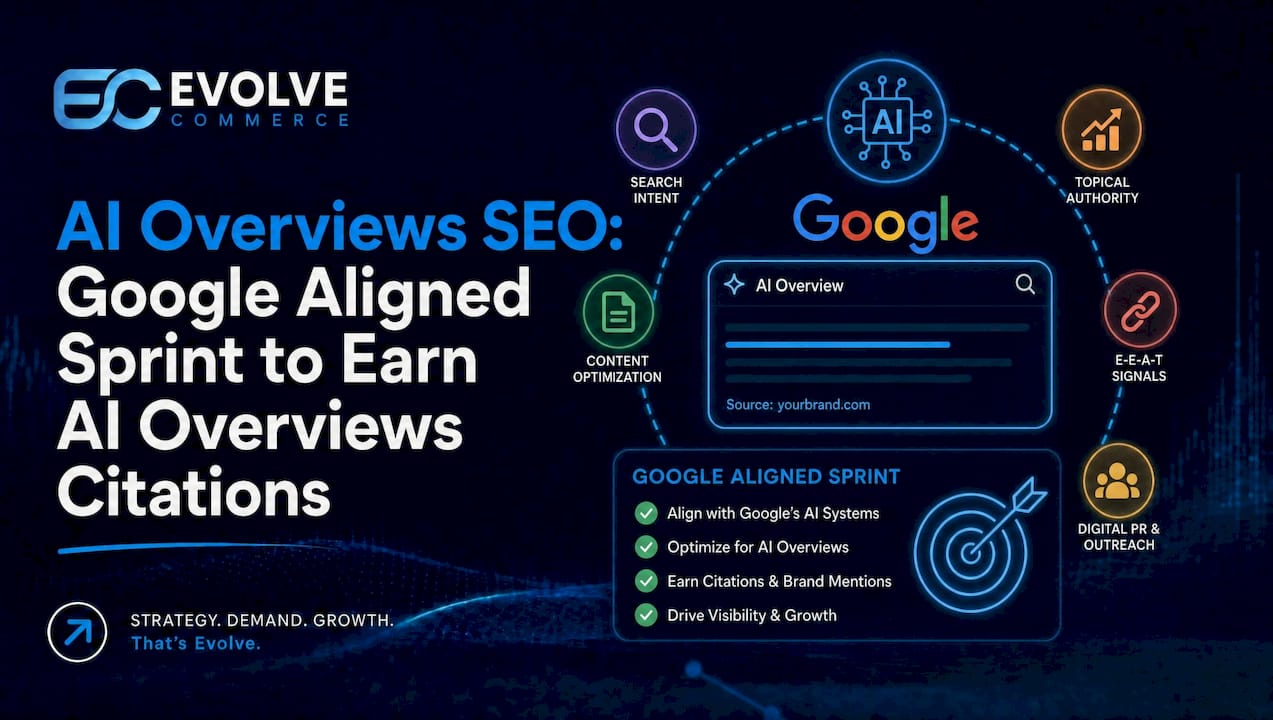
AI Overviews are Google’s generative summaries that sit above traditional results for many searches, pulling answers from multiple web sources rather than ranking a single page first. The single priority for SEOs is not a special AI hack: it is high-quality, crawlable, authoritative content that satisfies Google’s core ranking systems. Start by checking generative impressions in Search Console and confirming your key pages are indexable.
- High-quality, crawlable, and authoritative content remains essential, as AI Overviews cite multiple sources focusing on comprehensive, well-structured pages.
- Long-form, question-based, and multi-faceted queries in informational or research-related categories trigger AI Overviews more frequently than short or transactional searches.
- Content with diverse and credible sources, clear author signals, and proper attribution is more likely to be included in AI summaries, emphasizing the importance of linking primary sources.
- Demanding technical and structural optimization—such as verifying indexability and structured passages—helps ensure pages can be cited in AI Overviews and improve overall search visibility.
- Measuring success should shift from pure click volume to engagement, conversions, and downstream impact, as AI Overviews tend to reduce external click-through rates but can drive more qualified traffic.
Table of Contents
- How AI Overviews work: retrieval, grounding and query fan-out
- When AI Overviews appear and which queries trigger them
- How Google chooses sources and citation patterns in AI Overviews
- What Google recommends for generative features
- Technical checklist for indexability and readable passages
- How to measure generative appearances in Search Console
- Controls and opting content in or out of generative features
- Observed traffic effects and how to respond strategically
- Practical optimisation checklist for the next sprint
- Evolve Commerce perspective: what a managed implementation looks like
- What this means for the future of SEO
- Turning this checklist into results without adding headcount
- Sources
- FAQ
How AI Overviews work: retrieval, grounding and query fan-out
AI Overviews are built through a process called retrieval-augmented generation. Google’s systems retrieve relevant web content and use it to ground the generated summary, meaning the answer is tied back to real pages rather than produced from memory alone. This grounding is why Google’s Search Central guidance frames AI Overviews as an extension of core Search ranking systems, not a separate algorithm with its own rules.
A second mechanism, query fan-out, decomposes a complex question into several sub-queries before generating a response. A shopper asking about the best running shoes for flat feet on wet pavements might trigger separate retrieval passes covering arch support, grip and durability, each pulling from different sources.
This explains a pattern that confuses many SEOs:
- A page ranking outside the top three organic results can still be cited if it thoroughly answers one of the fanned-out sub-queries.
- Comprehensive coverage of adjacent sub-topics matters more than chasing the single highest-volume keyword.
- Multiple pages from the same domain can each contribute to different parts of one Overview.
The practical takeaway is that thin content optimised for one query rarely gets cited, while thorough pages that answer several related questions have more surface area to be pulled into a summary.
When AI Overviews appear and which queries trigger them
AI Overviews tend to surface most for long, multi-faceted questions and natural-language queries rather than short, transactional searches. A query like “what causes yellowing on hydrangea leaves and how do I fix it” invites a synthesised answer far more readily than a two-word product search.
For prioritisation, focus attention where the pattern is clearest:
- Informational queries with several implied sub-questions, such as comparisons, troubleshooting and “how” or “why” phrasing.
- Research-stage queries in categories like health, finance, technology and home improvement, where users typically want a summarised overview before clicking through.
- Queries with commercial intent but educational framing, such as buying guides, tend to trigger Overviews more than pure navigational or brand searches.
The prioritisation implication is straightforward: audit your long-form, question-led content first, since that is where generative visibility is most contested and most valuable.
How Google chooses sources and citation patterns in AI Overviews
Most AI Overviews cite several sources rather than one, spreading grounding across pages that each contribute a piece of the answer. Diversity and authority both play a part in that selection, which is why Google’s generative AI performance report exists: it gives site owners visibility into when their pages are being pulled into these summaries.
Authoritative, well-structured pages are consistently favoured for citation, according to Google’s Search Central guidance. That single principle should guide where you invest credibility work: clear sourcing, visible expertise and evidence that a page’s claims can be checked, rather than cosmetic formatting changes aimed at gaming a summary.
What Google recommends for generative features
Google’s own message is consistent: generative features draw on core ranking systems, so the same fundamentals that earn organic visibility also earn Overview citations. There is no separate “AI SEO” rulebook to learn.
- Keep every important page crawlable and indexable, with no accidental noindex tags or blocked resources.
- Write clearly, with direct answers near the top of each section, so both users and retrieval systems can extract meaning quickly.
- Build genuine E-E-A-T signals: named authors, credentials where relevant, and citations to primary sources.
- Structure pages so each section stands on its own, answering a specific sub-question rather than requiring the whole page to be read for context.
Semrush’s summary of Google’s May 2026 guide confirms Google explicitly rejects several tactics that had gained traction among AI-focused SEOs: publishing an llms.txt file, chopping content into micro-chunks for supposed machine readability, and adding AI-specific schema markup. None of these are required, and none replace genuine content quality.
Pro Tip: Before adding any “AI optimisation” tactic to your roadmap, ask whether Google’s own documentation recommends it. If it doesn’t appear in Search Central’s guidance, treat it as unproven.
Technical checklist for indexability and readable passages
Before a page can be cited, it has to be crawlable, indexed and structured well enough for a retrieval system to lift a clean passage from it.
- Confirm robots.txt, meta robots tags and canonical URLs are not accidentally excluding priority pages.
- Check Search Console’s index coverage report for crawl errors or “discovered, not indexed” status on key content.
- Use clear H2 and H3 headings that each introduce a self-contained passage addressing one sub-question.
- Add author and
sameAsmarkup from Schema where you have real author profiles to link, since it is useful context rather than a ranking requirement.
Pro Tip: Write the first two sentences under every heading as if they had to survive alone in a summary, because that is often exactly what happens.
How to measure generative appearances in Search Console
The generative AI performance report records impressions when your content appears within an AI Overview, but it does not yet break out granular click or query-level detail the way the standard Performance report does. Treat it as a directional signal, not a full attribution source.
To avoid double-counting, remember that a generative impression and a standard search impression can both fire for the same user session, so add them together only when you deliberately want a combined reach figure.
Track these alongside your usual rankings and traffic data:
- Generative impressions by page, watched for month-on-month trend rather than absolute volume.
- Citation frequency for your highest-priority long-form pages.
- Downstream engagement and conversion rates on sessions that follow a generative impression, using landing-page analytics.
Controls and opting content in or out of generative features
Search Console offers a dedicated Search generative AI control, separate from a blanket noindex tag, that lets you exclude specific content from generative features while still allowing it to rank normally in traditional results.
Reach for this control when content is sensitive, legally restricted, or simply not something you want summarised out of context, such as regulated financial disclosures or clinical guidance requiring a professional read. For most commercial and editorial content, exclusion removes potential visibility for no real benefit. Build a short sign-off step into your publishing workflow so legal or compliance teams flag anything that needs the control before it goes live, rather than after an Overview has already quoted it.
Observed traffic effects and how to respond strategically
Independent research gives SEOs a reason to change how they measure success. Pew Research’s analysis, widely covered in follow-up industry reporting, found that searches producing an AI summary saw markedly lower click-through rates to outside websites than searches without one, and that users rarely clicked the links embedded inside the summaries themselves.
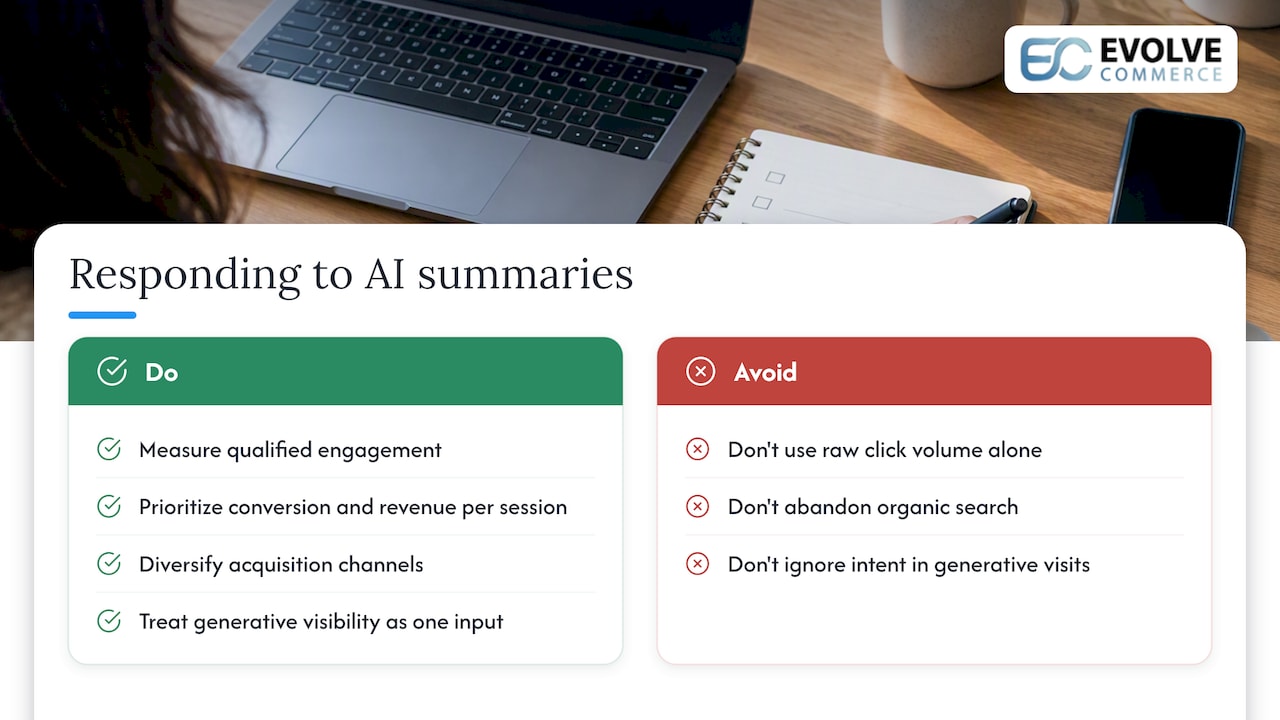
The strategic response is not to abandon organic search. It is to stop treating raw click volume as the only success metric. Shift measurement towards qualified engagement, on-site conversion rate and revenue per session for the traffic that does arrive, since Google itself has suggested that visits following generative features can carry more intent even when there are fewer of them. Diversify acquisition channels and treat generative visibility as one input among several, not the whole scoreboard.
Practical optimisation checklist for the next sprint
Pick priority pages using an impact-versus-effort view: long-form question pages with existing topical authority and moderate traffic sit in the highest-value quadrant, since they need less new content and more reinforcement.
- Run an index and crawlability check across your top 20 long-form pages.
- Add or verify author and citation signals on any page missing them.
- Strengthen evidence: link primary sources, add data where you have it, and remove unsupported claims.
- Update on-page calls to action so logged-in or returning visitors have a clear next step beyond reading.
- Launch a measurement experiment tracking generative impressions against citation counts and landing-page engagement over a full quarter.
| Sprint task | Primary metric tracked |
|---|---|
| Index and crawlability audit | Index coverage status |
| Author and citation signals added | Generative impressions |
| Evidence and sourcing strengthened | Citation frequency |
| CTA and conversion path updated | Session conversion rate |
Evolve Commerce perspective: what a managed implementation looks like
Evolve Commerce pairs content and technical audits with AdWize, its proprietary analytics platform, so generative impressions, downstream engagement and conversion data sit in one dashboard rather than several disconnected reports. That integration matters because Search Console’s generative report is directional on its own; it becomes actionable once tied to session-level conversion data.
When briefing an agency for this work, ask specifically how they combine indexability audits, author and citation improvements, and conversion tracking into one measurable programme, rather than treating AI Overview visibility as a standalone report.
What this means for the future of SEO
SEO has not become obsolete: it has become harder to measure with a single metric. Generative features change how answers are distributed, not whether quality content still wins. The teams that experiment quickly and tie generative impressions to actual commercial outcomes will outlast those still chasing “AI SEO” tactics that Google itself has already dismissed.
— Evolve Commerce
Turning this checklist into results without adding headcount
Running an index audit, adding author signals, strengthening citations and setting up conversion tracking is a lot to schedule alongside everyday marketing work. Evolve Commerce runs a 360° Marketing Audit that covers technical indexability, content structure and analytics setup in one pass, then turns the findings into a scheduled sprint rather than a document nobody actions.
The services that map most directly to this guide include:
- Search Engine Optimisation & GEO, for the technical and content work covered in the checklist above.
- AdWize Analytics, for tracking generative impressions against real engagement and revenue, available on Starter, Accelerator and Scale plans from £49 per month.
- Performance Creative Production and Email & SMS Marketing, for turning the qualified traffic this approach protects into repeat customers.
If you want a clear view of where your own pages stand before committing to a sprint, get in touch with Evolve Commerce to start with an audit.
Sources
- AI features and your website | Google Search Central
- Search generative AI control – Search Console Help
- Google publishes generative AI search guide | Semrush
FAQ
Is there an AI that can do SEO?
AI tools can support parts of SEO work, such as drafting content outlines, spotting technical issues at scale and summarising Search Console data, but none of them replace the judgement needed for strategy, sourcing and quality control. Treat AI as an assistant for research and drafting, not as a substitute for the fundamentals Google’s own guidance points back to.
Is SEO still worth it in 2026?
SEO is still worth it because AI Overviews are built on core ranking systems rather than a separate set of rules, so the same quality and crawlability work that earns organic rankings also earns generative citations. What has changed is measurement: success now includes generative impressions and engagement quality, not clicks alone.
What is AI SEO called now?
There is no official new name; terms like AEO (answer engine optimisation) and GEO (generative engine optimisation) have emerged in industry discussion, but Google frames these as shorthand for existing SEO principles rather than distinct disciplines. Chasing a “new” methodology under either label risks missing that the underlying guidance is unchanged.
Can ChatGPT do SEO?
ChatGPT and similar tools can help draft content, generate topic ideas and explain technical concepts, but they cannot audit your site’s crawlability, verify indexing status or guarantee citation in Google’s AI Overviews. Those tasks still require direct access to tools like Search Console and a working knowledge of Google’s published guidance.