Demand gen campaigns are full-funnel, multi-channel programmes that create tracked awareness, convert it into ecommerce revenue and lift lifetime value. They combine paid media, performance creative, lifecycle marketing and SEO under one measurement system, not a single ad account. This guide covers the components, the channel roles and exactly how to brief and select an agency.
- Full-funnel demand generation campaigns track the complete customer journey to accurately attribute revenue across channels and improve ROI.
- Agencies must own or coordinate functions like paid media, creative, lifecycle marketing, SEO, commerce integrations, and analytics to avoid blind spots.
- Each channel should have a specific primary role, such as discovery, validation, conversion, or retention, and be measured with job-specific KPIs.
- Measuring full-funnel ROI requires blended metrics, server-side attribution, and a unified data dashboard to overcome platform overreporting and tracking gaps.
- The first 90 days should focus on a full tracking audit, testing plan, scheduled creative experiments, clear data ownership, and weekly strategic reviews.
Table of Contents
- What is a full-funnel demand generation campaign?
- What should sit inside your agency’s scope?
- Which channel should own which job?
- How do you fix the full-funnel measurement gap?
- How do you brief and select a demand gen agency?
- What should the first 90 days look like?
- Evolve Commerce’s take: demand gen as one revenue system, not five vendors
- Ready to build a demand gen programme that actually reports back?
- Sources
What is a full-funnel demand generation campaign?
A full-funnel demand generation campaign is a coordinated programme that moves a shopper through awareness, consideration, conversion and repeat purchase, with every stage measured against the same set of numbers. That distinction matters because most brands run channels in isolation: a Meta account chasing its own return on ad spend, an email programme judged only on open rates, an SEO retainer nobody connects to revenue. None of it talks to the others.
Ecommerce buying rarely happens in one sitting. Someone sees a video ad, forgets the brand for three weeks, searches for it after a friend mentions it, abandons a cart, then converts off a winback email. A siloed campaign credits the wrong channel for that sale, or misses it altogether. A full-funnel programme tracks the whole path and attributes value across it.
The evidence for this approach is not theoretical. Nielsen’s analysis, summarised by Channelsight, found that brands pairing upper-funnel brand activity with lower-funnel performance advertising generate higher ROI and incremental sales than single-stage strategies alone. That is the case for treating awareness spend and conversion spend as one system rather than two competing budgets.
What should sit inside your agency’s scope?
A capable agency doesn’t just “run ads.” It owns or coordinates a set of interlocking functions, each with its own outputs and its own accountability line back to revenue.
- Paid media across prospecting and retargeting on Google, Meta, TikTok, Microsoft, Snapchat and Reddit, with distinct creative and bidding strategy for cold audiences versus warm ones.
- Performance creative production, including short-form video, user-generated content and a structured testing calendar that retires losing assets on a schedule, not on a hunch.
- Lifecycle marketing through email and SMS, covering acquisition flows, abandoned cart recovery, post-purchase sequences and winback campaigns, typically built on a platform like Klaviyo.
- SEO and content to capture consideration-stage search demand that paid media can’t reach cost-effectively at scale.
- Commerce integrations, meaning inventory sync, product feed health and marketplace connectivity, so ads never point at a sold-out product.
- Analytics and instrumentation, including server-side tagging, a data warehouse or customer data platform, and a unified dashboard that all other functions report into.
Miss any one of these and the programme develops a blind spot. Skip commerce integrations, for example, and you’ll pay to advertise stock you don’t have. Skip lifecycle and you’ll spend heavily to acquire customers you then fail to retain. Unified commerce data that connects inventory, orders and customer records lets automation pause underperforming feed listings and sharpen retention metrics without manual intervention.
Which channel should own which job?
Every channel in a demand gen programme has one primary job. The mistake most brand owners make is judging every channel by the same conversion metric, when only some channels are built for conversion.
Paid social prospecting and video generally own discovery: introducing the brand to people who have never heard of it. Search and shopping campaigns tend to own validation: capturing demand from people already deciding between options. Retargeting and site-optimised paid media own conversion: closing out shoppers who’ve shown clear intent. Email, SMS and loyalty programmes own retention: extending customer lifetime value after the first purchase. Shopify’s multi-channel guidance makes the same point: assign each channel a discrete job and measure it against job-specific KPIs, rather than trying to be everywhere with the same success metric.
That means discovery channels get judged on cost per new-to-brand visitor and video completion rate, not immediate purchase. Validation channels get judged on click-through rate and assisted conversions. Conversion channels get judged on return on ad spend and cost per acquisition. Retention channels get judged on repeat purchase rate and revenue per email sent.

Phase your investment the same way you’d phase any test: trial a channel with a contained budget, evaluate against its job-specific KPI after a defined window, then scale the ones that clear the bar. Cut, or at least deprioritise, any channel showing low purchase intent alongside high acquisition cost. Lifecycle flows such as abandoned cart recovery are a useful benchmark here. They consistently rank among the highest-ROI levers in a demand gen programme, which makes an underperforming paid channel easy to spot by comparison.
How do you fix the full-funnel measurement gap?
Nearly two-thirds of marketers say measuring full-funnel ROI is extremely or very important to them, yet only about half feel confident they can actually measure it correctly. That gap is why so many demand gen programmes look successful on a platform dashboard and still can’t explain their real return.
Platform-reported ROAS overstates performance because each platform claims credit for conversions other channels helped produce. A blended metric such as marketing efficiency ratio (MER), total revenue divided by total spend, strips out that inflation and gives you one number every channel has to answer to. Server-side attribution, which tracks events from your own servers rather than relying solely on browser pixels, closes much of the tracking loss caused by ad blockers and privacy restrictions.
Insist your agency captures, at minimum:
- Product page views, add-to-cart events and checkout starts, not just completed purchases.
- Channel-level spend against blended MER, reported weekly.
- Customer retention and repeat purchase rate by acquisition channel.
- Incrementality test results, not just modelled attribution.
A pragmatic stack pairs GA4 with server-side tagging, a commerce analytics layer or customer data platform, and a single dashboard everyone reports into, an approach Channelsight’s instrumentation guidance recommends for exactly this reason. Evolve Commerce’s own AdWize dashboard was built around that same principle: one source of truth, not five platform logins.
Your contract should specify reporting cadence, guarantee you a raw data feed you own, and commit the agency to incrementality testing rather than modelled guesswork alone.
Pro Tip: Require a full data audit within the first 30 days of any engagement. Ask the agency to show you exactly what’s tracked, what’s missing and what it will cost to fix. An agency that resists this request is telling you something about what your current numbers actually mean.
How do you brief and select a demand gen agency?
A brief that’s vague about scope produces a proposal that’s vague about accountability. Structure the request for proposal (RFP) around these steps:
- Define scope precisely. List every channel, plus creative production, lifecycle marketing, analytics and commerce integrations you expect covered.
- Set deliverables and cadence. Specify reporting frequency, service-level agreements for creative turnaround, and who owns dashboard access.
- Propose a KPI framework and pricing model. Most agencies work on a retainer plus a performance-based fee; ask how each is calculated.
- Interview on specifics, not generalities. Ask for case studies with real revenue figures, and speak to at least one existing client directly.
- Watch for contract red flags. No documented measurement plan, no data ownership clause, or a “proprietary” reporting method you can’t audit are all reasons to walk away.
Outsourcing to a specialist agency gives you access to skills and creative capacity that would take years to build in-house, but only if the scope and KPIs are locked down before you sign.
What should the first 90 days look like?
The opening quarter of any engagement should follow a tight, checkable sequence:
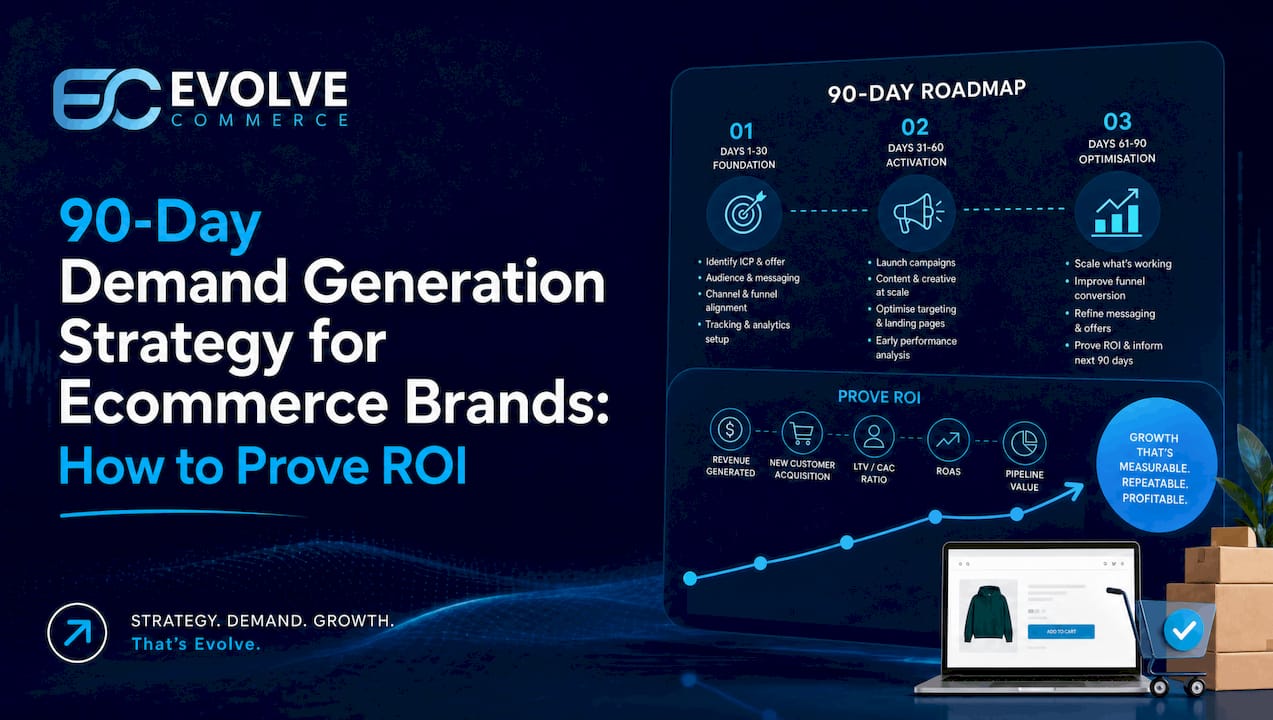
- Weeks 1 to 4: Full tracking audit and remediation of any gaps found.
- Weeks 2 to 6: Initial test plan launched with clear gating criteria before scaling budget.
- Ongoing from week 4: Creative testing on a fixed schedule, measured against defined success thresholds.
- From day one: Full dashboard access and a written data ownership agreement.
- Throughout: Weekly tactical check-ins and a monthly strategic review scoring every agreed KPI.
Evolve Commerce’s take: demand gen as one revenue system, not five vendors
We built Evolve Commerce around the belief that paid media, creative, lifecycle and analytics only work when they report into the same system. Expect weekly visibility into your numbers, not a monthly summary you have to take on faith. Full case study detail is available for brands weighing up the switch.
— Evolve Commerce
Ready to build a demand gen programme that actually reports back?
If your current setup means logging into four ad platforms and guessing how they add up, that’s the exact problem a properly built demand gen programme solves. Evolve Commerce runs paid media, performance creative, lifecycle marketing and SEO as one connected system, reported through the AdWize dashboard with server-side attribution built in, so you see one number that actually reflects what’s working.
If you want to see what a properly instrumented, full-funnel programme could do for your brand, get in touch with Evolve Commerce to request a case study review or a tracking audit for your current setup.
Sources
- Crisis of confidence: the race for full‑funnel ROI measurement — The Drum
- Full‑Funnel Analytics: How to optimize marketing performance in eCommerce — Channelsight
- Multi‑channel marketing: definition and strategy guide — Shopify (Enterprise)