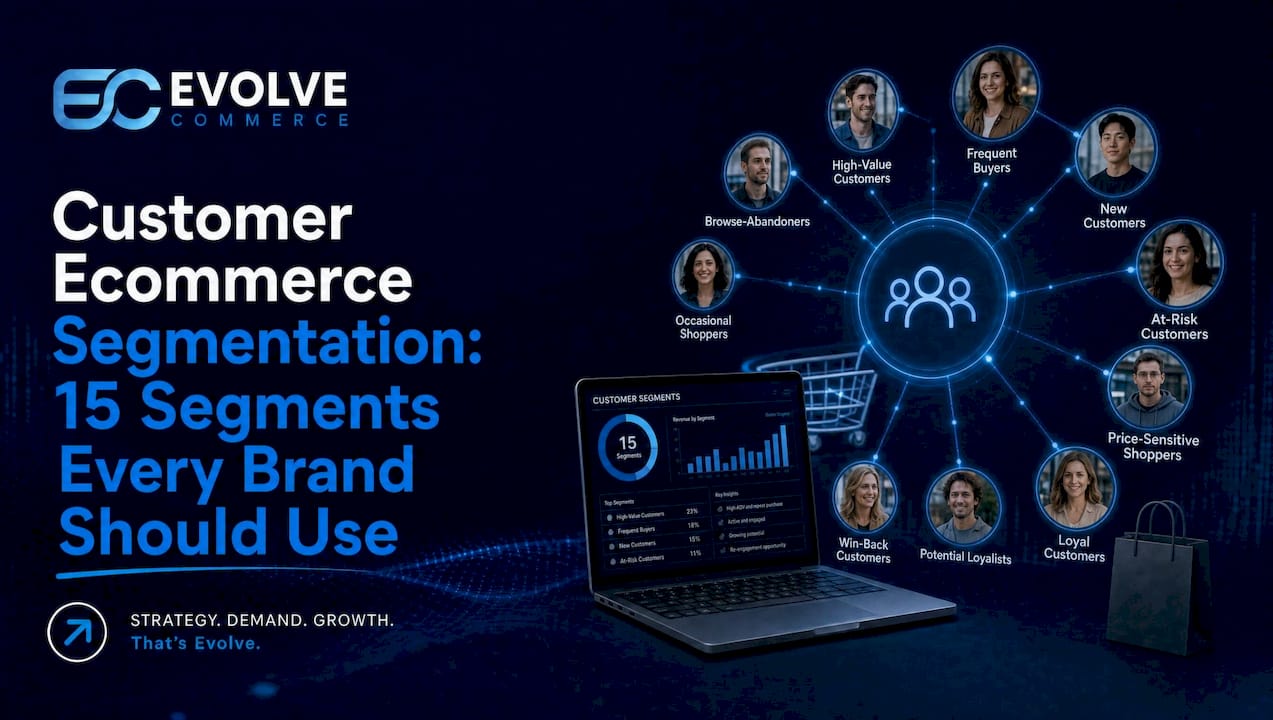
Customer segmentation in ecommerce means dividing shoppers into groups based on shared traits, such as purchase behaviour, spending level or lifecycle stage, so that marketing speaks to each group’s actual needs. Done well, it lifts conversion rates and repeat purchases because every message becomes more relevant to the person receiving it. The practical next step for most stores is to pick one method, such as RFM scoring, and run a focused test before scaling further.
- Combining behavioral and lifecycle data enhances targeting accuracy, especially when identifying high-value customers who have gone inactive for months.
- Accurate segmentation depends on linking anonymous browsing data with known customer profiles through reliable identity resolution, ideally starting with email.
- Basic RFM models are quick to implement and effective for initial tests, but clustering and predictive scoring require more data discipline and ongoing validation.
- Campaign activation should be channel-specific, with email, onsite personalization, paid media, and SMS tailored to segment stage and customer intent.
- Measuring segmentation success involves tracking incremental revenue and retention for each segment, using holdout groups to ensure results are due to targeting efforts.
Table of Contents
- 1. Types of segmentation ecommerce teams use
- 2. Data and signals to build practical ecommerce segments
- 3. Methods and models: RFM, clustering, cohorts and predictive scoring
- 4. Step-by-step process to build and operationalise segments
- 5. Activating segments across channels: email, site, paid and SMS
- 6. Measuring success: which KPIs matter and how to run uplift tests
- 7. UK compliance and privacy: profiling, transparency and ICO guidance
- 8. Evolve Commerce perspective and practical examples
- 9. When to DIY and when to hire specialist help
- 10. How Evolve Commerce can help you activate segments
- Sources
- FAQ
1. Types of segmentation ecommerce teams use
Most ecommerce businesses draw on six segmentation types, often blending two or more for sharper targeting. Demographic segmentation groups shoppers by age, gender, income or occupation, useful for broad product line decisions. Geographic segmentation adjusts messaging and offers by region or climate, handy for seasonal stock or shipping promotions. Psychographic segmentation looks at values, interests and lifestyle, which shapes brand tone and creative direction more than it shapes discounting.
Behavioural segmentation, built from browsing and purchase history, tends to deliver the fastest wins because it is grounded in what customers actually did rather than who they are. Lifecycle or engagement segmentation tracks where a customer sits, from first-time buyer to lapsed customer, and drives obvious campaign triggers such as win-back offers for shoppers who have gone quiet. Technographic segmentation, based on device, browser or app usage, matters more for stores with a heavy mobile or app-first audience.
Combining types generally beats using one alone. Audience segmentation works best when demographic, behavioural, psychographic and geographic data are combined to build campaigns that genuinely reflect who the customer is and what they do, and case examples cited by GWI point to a significant boost in inbound leads for a luxury brand that applied strategic segmentation to a defined audience.
- Demographic: age, income or occupation groups, useful for product range decisions.
- Geographic: region-based offers, suited to seasonal or shipping-sensitive promotions.
- Psychographic: values and lifestyle, shaping tone and creative rather than discounts.
- Behavioural: purchase and browsing history, the fastest route to a working segment.
- Lifecycle or engagement: stage-based triggers, such as win-back campaigns for lapsed shoppers.
- Technographic: device and platform usage, most relevant for mobile-heavy or app-first stores.
Pairing behavioural data with lifecycle stage, for instance flagging high-frequency buyers who have not purchased in 60 days, tends to produce more precise targeting than either type used alone.
2. Data and signals to build practical ecommerce segments
Segmentation is only as good as the data feeding it, and most stores already hold more useful signals than they realise. Transactional data, order value, frequency and product categories, forms the backbone of behavioural segments. CRM data adds context such as support tickets, loyalty tier or email engagement, while platform audiences from Google, Meta or TikTok bring in intent signals gathered outside your own site.
The harder part is joining these sources together. Anonymous browsing sessions rarely match up with known customer records automatically, which is where identity resolution and stitching come in: linking a device or cookie ID to an email address once a customer logs in or checks out, so behaviour before and after that moment sits under one profile.
- Audit your data sources and list what you already capture across your ecommerce platform, CRM and ad accounts.
- Stitch anonymous and known profiles using login events, email captures or loyalty sign-ups as the joining point.
- Align timestamps across systems so a purchase logged in your store platform matches the same event in your CRM or ad platform.
- Run a data quality check for duplicate customer records, missing order values and inconsistent category tagging before building any segment.
Getting this right matters because ecommerce customer analytics depends on a full-funnel view: identity resolution, predictive models and activation back into marketing systems are the core capabilities needed to measure real revenue and lifetime value gains from segmentation.
Pro Tip: Start identity resolution with a single reliable join key, usually email, before attempting to stitch device or cookie-level data; a shaky first join undermines every segment built on top of it.
3. Methods and models: RFM, clustering, cohorts and predictive scoring
Choosing a method comes down to how much data discipline and technical skill your team already has. Rule-based segmentation, the simplest approach, sorts customers into groups using fixed thresholds, such as “spent over £100 in 90 days.” RFM, which scores customers on Recency, Frequency and Monetary value, is the most common starting point because it needs only order history and produces segments marketers can act on immediately, such as isolating top-spending recent buyers for a VIP offer.
Unsupervised clustering, using algorithms like K-means or Gaussian Mixture Models, groups customers based on patterns the data reveals rather than rules you set in advance. This suits larger catalogues or customer bases where manual thresholds miss nuance, though it needs validation to confirm the clusters make business sense rather than just fitting the numbers. Extended RFM models that add repurchase time, average order value and interpurchase time produce richer behavioural segments, and when combined with clustering and validation indices such as Silhouette or Davies-Bouldin scores, they yield groups that hold up to scrutiny rather than just looking tidy on a chart.
Predictive scoring goes a step further, using supervised models to forecast churn risk or likely lifetime value for each customer, which is worth the investment once you have enough historical data and a clear use case, such as prioritising retention spend on customers most likely to lapse.
- Rule-based and RFM: fast to build, needs only order history, best for a first test.
- Unsupervised clustering: finds patterns rules miss, needs validation before you trust the groups.
- Predictive scoring: forecasts churn or CLV, justified once you have enough historical volume and a clear decision it will inform.
- Cohort analysis: tracks how a group behaves over time from a shared starting point, useful for measuring whether a segmentation change actually improved retention.
Academic work on extended RFM and predictive segmentation recommends combining easy RFM-based segments for fast wins with one predictive pilot aimed at a high-value outcome, which reduces early complexity while still proving the approach works before wider investment. Retraining cadence matters too: a clustering model built on six-month-old data will drift as buying patterns shift, so plan to refresh at least quarterly.
4. Step-by-step process to build and operationalise segments
Building a segment that actually changes marketing outcomes follows a fairly consistent sequence, regardless of which method you pick.
- Define the objective first. Decide whether the segment exists to lift retention, grow average order value or reduce churn, since the goal determines which data and method you need.
- Extract and clean the data. Pull order history, engagement events and CRM fields, then remove duplicates and fix missing values before any modelling starts.
- Engineer features. Build an extended RFM table adding fields like average order value, interpurchase time and category mix, which gives clustering or scoring models more to work with than raw recency and frequency alone.
- Choose your method and validate it. Test rule-based thresholds against a clustering pass on the same data, checking that resulting groups differ meaningfully in size and behaviour, not just on paper.
- Label and size each segment so marketing can act on them, for example “lapsed high-value” or “new frequent browser.”
- Deploy to your activation channels and run a controlled test against a holdout group before rolling a campaign out fully.
- Set a refresh cadence, typically monthly for behavioural segments and quarterly for clustering models, so segments do not go stale as buying patterns shift.
Pro Tip: Build your first segment around a single, obvious business question, such as “who are our top 10% spenders in the last 90 days”, rather than trying to model your entire customer base at once.
5. Activating segments across channels: email, site, paid and SMS
A segment only earns its keep once it reaches the right channel with the right message. Email lifecycle mapping is usually the fastest to activate: welcome flows for new subscribers, replenishment reminders for repeat-purchase categories, and win-back sequences for lapsed customers. Onsite personalisation can adjust homepage banners, product recommendations or pop-up offers based on a visitor’s segment, without needing a full email send. Paid media benefits from segment-based audience strategies too, such as building lookalike audiences from top-CLV customers or excluding recent purchasers from acquisition campaigns to avoid wasted spend.
- Email: map lifecycle stage to flow type, welcome, replenishment or win-back.
- Onsite: adjust banners and recommendations dynamically by segment.
- Paid media: build lookalikes from high-value segments and exclude recent buyers from prospecting.
- SMS: reserve for time-sensitive, high-intent segments given its higher intrusion level.
Consent and frequency rules differ by channel, and email or SMS marketing in particular needs a clear opt-in trail, which matters both for deliverability and for compliance. The other guardrail worth setting early is avoiding message overlap: a customer who gets a win-back email and a retargeting ad for the same product on the same day reads as clumsy rather than clever. Evolve Commerce’s approach to marketplace selling touches on how segmentation feeds retention and campaign performance once activated correctly across channels.
6. Measuring success: which KPIs matter and how to run uplift tests
The KPIs that matter most are incremental revenue, customer lifetime value, retention rate, conversion rate and average order value, tracked by segment rather than as one blended store-wide number. Retention deserves particular weight: research on customer value shows that focusing on retaining the right customers and their lifetime value is often more profitable than broadly acquiring low-value ones, which is exactly the case segmentation makes easier to act on.
- Incremental revenue: the lift a segment-targeted campaign produces over a holdout group, not just total revenue from the segment.
- Retention rate: the share of a segment still purchasing after a set period, tracked separately for treated and control groups.
- Conversion rate and AOV: compared between the segmented campaign and a generic control to isolate the segment’s effect.
A properly designed uplift test holds back a control group that receives no segment-specific treatment, then compares outcomes between test and control after a fixed window; without this holdout, any lift you see could simply reflect normal seasonal or promotional noise rather than the segmentation itself. A common trap is ending a test too early, before the holdout group has had a fair chance to convert on its own timeline, which skews results toward the treated group.
7. UK compliance and privacy: profiling, transparency and ICO guidance
Segmentation that uses personal data for marketing sits squarely under UK GDPR and PECR, and getting the basics wrong carries real regulatory risk. ICO guidance on automated decision-making and profiling confirms that profiling for marketing is not forbidden, but it does require fairness and transparency, and individuals have a right to object to profiling used for direct marketing. Special category inferences, anything touching health, sexuality or similar sensitive attributes, need explicit consent, and a Data Protection Impact Assessment is often triggered when profiling is extensive or high-risk.
- Keep profiling explanations separate and clear in your privacy notice rather than buried in general terms.
- Document DPIA decisions whenever a segmentation model infers sensitive attributes, even indirectly,.
- Avoid direct marketing based on sensitive inferences unless you hold explicit consent and a strong legitimate basis.
- Clarify controller roles when using platform audience tools, since advertiser and platform may be joint controllers under direct marketing guidance.
Pro Tip: Treat your privacy notice as a working document: update it whenever you add a new segmentation signal, not just once a year.
8. Evolve Commerce perspective and practical examples
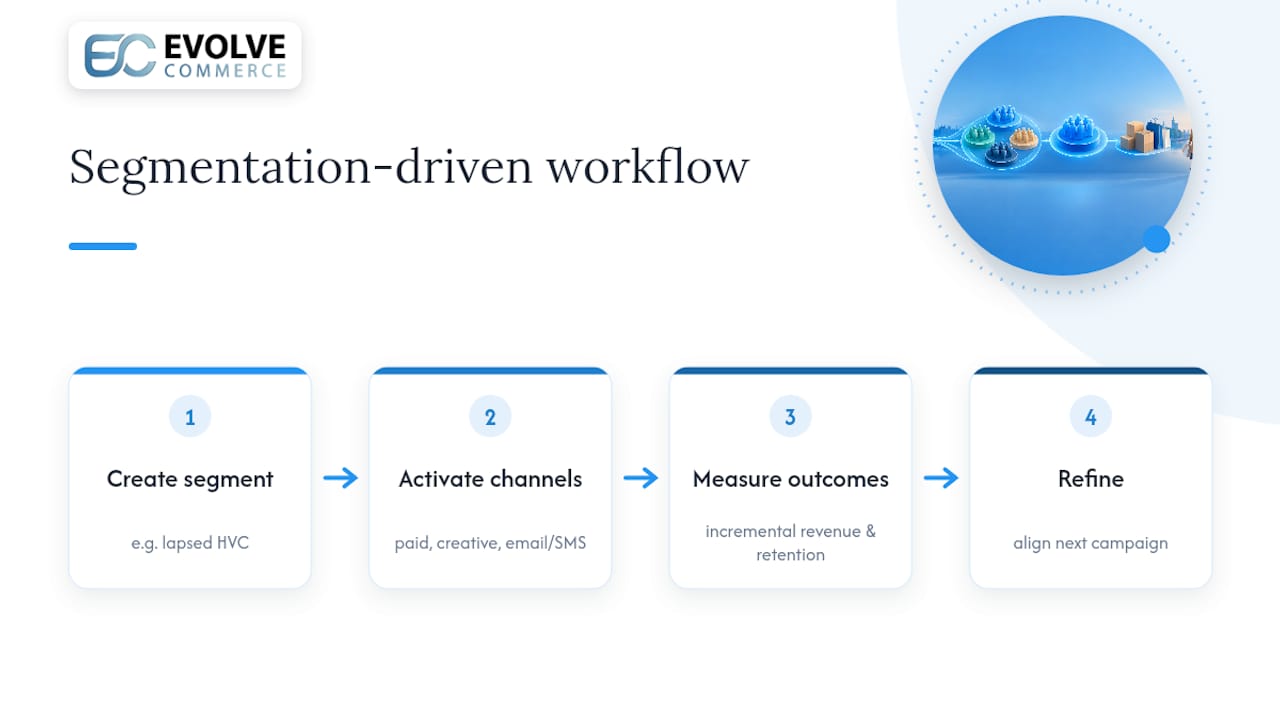
At Evolve Commerce, segmentation is not treated as a standalone analytics exercise, it is built into how paid media, performance creative and lifecycle email and SMS marketing are planned from the outset. A segment identifying lapsed high-value customers, for example, informs both the win-back email sequence and the paid retargeting audience built around it, so the two channels reinforce rather than duplicate each other. Measurement runs on the same cadence as the campaigns themselves, checked against incremental revenue and retention rather than vanity engagement numbers, which keeps the focus on outcomes that show up in actual store revenue.
9. When to DIY and when to hire specialist help
The honest diagnostic is data readiness, not budget. If your order history is clean, your team can build an RFM table in a spreadsheet, and your email platform supports segment-based flows, a DIY first test is entirely achievable. If data sits scattered across platforms, nobody owns the analytics, or campaigns need to launch faster than an internal build allows, a managed partner tends to be the quicker route to a working segment and a measurable result.
— Evolve Commerce
10. How Evolve Commerce can help you activate segments
Turning a segment into revenue takes more than a spreadsheet: it needs paid media, creative and lifecycle email and SMS marketing working from the same data. Evolve Commerce connects these channels through its AdWize analytics platform, giving ecommerce brands one place to track segment performance and act on it quickly.
| Plan | Monthly price |
|---|---|
| Starter | £49 |
| Accelerator | £149 |
| Scale | £249 |
Check AdWize plans and pricing to see which tier fits your current data and campaign volume.
Sources
For readers who want to go deeper, the ICO’s guidance on profiling and automated decision-making covers the legal detail behind marketing profiling. The extended RFM and clustering research published via Springer explains the technical validation methods referenced above, while LatentView’s write-up on ecommerce analytics covers the full-funnel view needed to measure results reliably.
- Automated decision making and profiling — ICO
- What is audience segmentation? — GWI
- Customer analytics for ecommerce — LatentView
- The value of keeping the right customers — HBR
FAQ
What is customer segmentation in ecommerce?
Customer segmentation in ecommerce is the practice of grouping shoppers by shared traits, such as purchase behaviour, spending or lifecycle stage, so marketing can be tailored to each group. It matters because targeted messaging tends to convert better than one generic campaign sent to everyone.
What are the five customer segments most stores use?
Most ecommerce teams work with demographic, geographic, psychographic, behavioural and lifecycle or engagement segments, sometimes adding technographic as a sixth. Behavioural and lifecycle segments tend to drive the most direct campaign action, such as win-back offers for lapsed shoppers.
What are the 7 types of market segmentation?
Definitions vary across sources, but a common version extends the core groups (demographic, geographic, psychographic, behavioural) with lifecycle or engagement, technographic and firmographic segmentation, the last being more relevant to B2B than ecommerce. Ecommerce teams typically focus on the first five or six of these.
How do I measure whether segmentation is actually working?
Track incremental revenue, retention rate, conversion rate and average order value by segment, ideally against a holdout group that receives no segment-specific treatment. Comparing treated and control groups over a fixed period shows whether the lift came from the segmentation itself rather than normal seasonal variation.
Is customer segmentation compliant with data protection rules?
Segmentation is allowed under UK GDPR provided it is transparent and fair, and customers retain the right to object to profiling used for direct marketing. Inferences about sensitive attributes need explicit consent, and a Data Protection Impact Assessment may be required for more extensive profiling, as set out in ICO guidance.