
Cross-channel attribution is the method marketers use to assign conversion credit across the touchpoints that led to a sale. The most defensible approach available now is not a single model but experiment-anchored calibration: running small randomised tests to correct the biases baked into observational data, then applying that corrected model across every channel you cannot test directly.
- Accurate-cross channel attribution relies on calibration experiments to correct biases in observational data and improve the reliability of your results.
- Calibrated hybrid models from platforms like Amazon and LinkedIn combine randomized trials with machine learning to produce more causally grounded insights.
- Establish clear data collection strategies with deterministic and probabilistic matching, and validate models regularly against experimental results to prevent drift.
- Privacy rules require explicit user consent for online tracking, and using server-side data processing does not eliminate consent obligations.
- Always pair attribution shares with incrementality tests before making budget decisions to avoid overvaluing channels that may demand demand that would occur anyway.
Table of Contents
- What cross-channel attribution is and why teams need it
- Common attribution models and what each actually tells you
- Why cross-channel attribution remains hard in practice
- Modern, defensible approaches: experiment calibration, probabilistic matching and hybrid systems
- How to implement cross-channel attribution in your stack
- Privacy and compliance: what UK rules mean for attribution
- How to interpret attribution outputs and avoid common misuses
- How Evolve Commerce approaches attribution for e-commerce clients
- Get a clearer view of your own attribution with Evolve Commerce
- Sources
- FAQ
What cross-channel attribution is and why teams need it
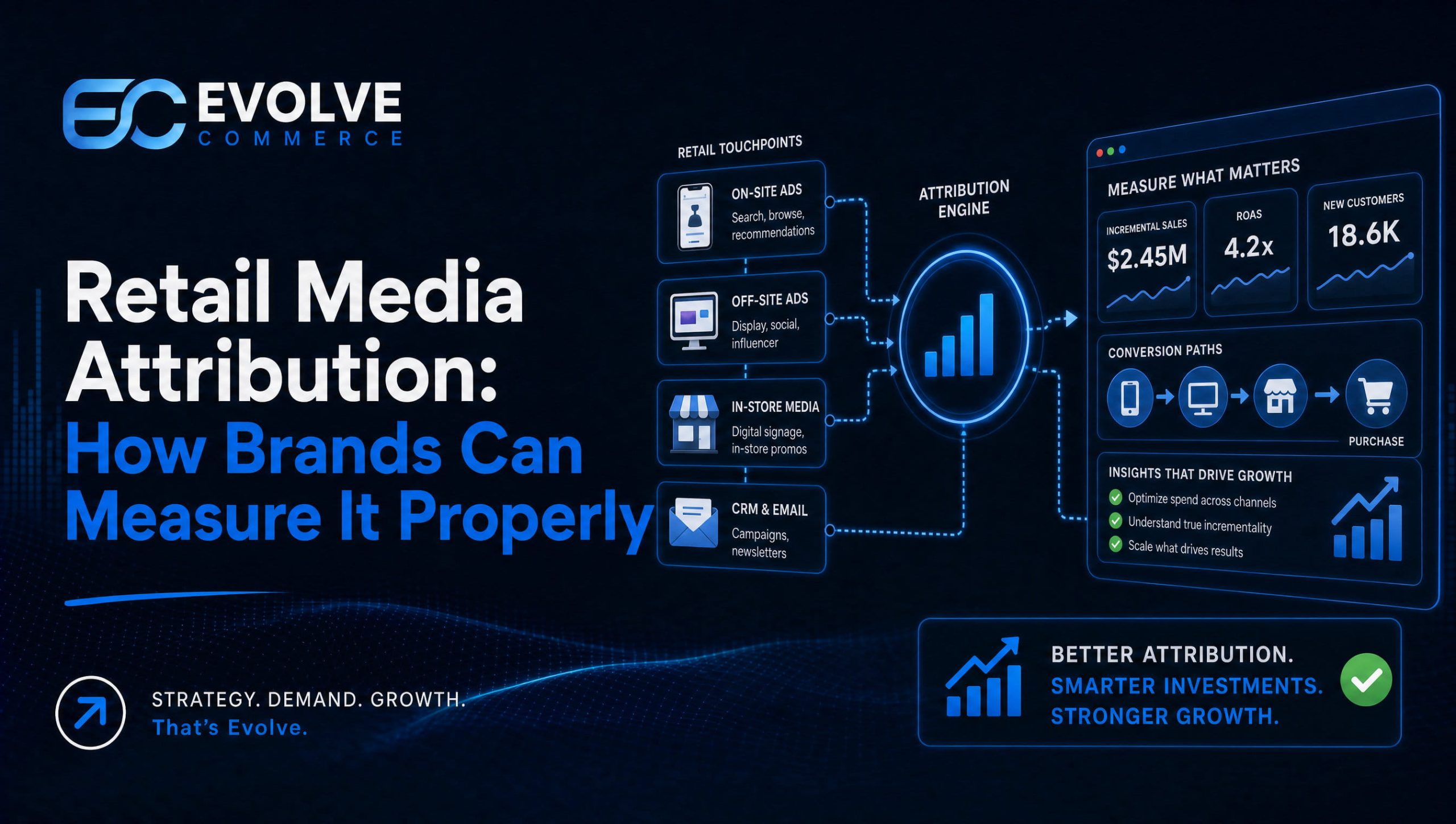
Cross-channel attribution assigns credit for a conversion across every touchpoint a customer encountered, from a paid social ad to a branded search click to an email reminder. Get this right and you know where to shift budget, which creative earns its place, and which parts of the funnel are quietly losing customers.
It delivers three outcomes that matter to anyone managing a media budget:
- Clearer ROI reporting across channels that would otherwise compete for credit in separate dashboards
- Better channel mix decisions, because spend follows contribution rather than whichever platform reports the most conversions
- Sharper creative and funnel optimisation, since you can see which messages perform at which stage
Attribution is not the same as incrementality or elasticity, and conflating them causes expensive mistakes. Attribution describes how credit was distributed among touchpoints that occurred. Incrementality measures whether the campaign caused conversions that would not have happened anyway. Elasticity measures how sensitive conversions are to spend changes. A channel can hold a large attribution share and still be delivering close to zero incremental value.
Common attribution models and what each actually tells you
Every attribution model trades off simplicity against accuracy, and none of them tells the whole story on its own.
- First-touch and last-touch (single-touch) are easy to set up and instantly readable, but they systematically overvalue whichever channel happens to sit at the start or end of the journey, usually branded search or direct traffic.
- Heuristic multi-touch models (linear, time-decay, U-shaped, W-shaped) spread credit across the journey using fixed rules rather than data. They are a reasonable upgrade from single-touch when you lack the volume for anything statistical.
- Data-driven attribution (DDA/MTA) uses machine learning to weight touchpoints based on observed patterns in your own conversion data. It needs meaningful data volume, and without external calibration it inherits whatever bias sits in the observational data it was trained on.
- Media mix modelling (MMM) works top-down from aggregate spend and sales, making it the only practical way to include channels that resist individual tracking, such as television, out-of-home, or podcast sponsorships, alongside seasonality effects.
Academic and industry reviews of multitouch attribution in the customer purchase journey note that results are highly sensitive to model choice and data quality, and that simple heuristics paired with validation experiments are often adequate for smaller teams that don’t have the volume to support a full data-driven model.
Why cross-channel attribution remains hard in practice
Identifier loss is the biggest structural problem. Cookie deprecation, app tracking restrictions, and cross-device gaps mean a growing share of journeys simply cannot be stitched together at the user level, and platform-reported conversions often disagree sharply with what an independent measurement would show.
Nearly every observational model has this same weakness baked in: research into experiment-grounded ad measurement shows that traditional last-click and user-level MTA increasingly diverge from causal, experiment-based results as tracking limitations grow, because the underlying data was never designed to answer a causal question.
Other recurring obstacles include:
- Data silos between martech platforms, ad networks, and CRM systems that were never built to share a common customer key
- Observational bias in ML-only models, which learn correlations in your existing data rather than cause and effect
- Platform self-reporting, where each ad platform has a structural incentive to claim more credit than it earned
- Organisational friction, where marketing, sales, and finance disagree on which KPI attribution should even be optimising for
None of these problems disappear with a better dashboard. They require a different measurement design.
Modern, defensible approaches: experiment calibration, probabilistic matching and hybrid systems
The most credible fix on the market right now is calibration: using randomised controlled trials to teach an observational model where it is wrong, then trusting the corrected model to scale across campaigns you can’t individually test. This is the logic behind Predicted Incrementality by Experimentation (PIE), which uses sparse RCT results to calibrate observational attribution so it can be applied more broadly without running an experiment on every single campaign.

Large platforms have already operationalised this. Amazon’s multi-touch attribution work combines randomised trials with machine learning to allocate touchpoint credit, producing a hybrid model that is more causally grounded than pure observational attribution alone. A similar principle drives LinkedIn’s LiDDA system, which reconciles fine-grained data-driven attribution with top-down media mix modelling through calibration and probabilistic imputation, so path-level detail and channel-level incrementality stop contradicting each other.
A few practical points worth holding onto:
- Deterministic identity stitching should always come first; probabilistic matching fills the gaps it cannot reach.
- Training-time calibration between DDA and MMM beats bolting a correction on afterwards, because it preserves both granularity and accuracy.
- Small RCTs cost money and take time to run cleanly, and results from tiny samples can be noisy, so they need to be designed carefully rather than treated as a box-ticking exercise.
Pro Tip: Don’t scatter your experiment budget thinly across every campaign. Pick a handful of campaigns that typify your main objectives and audiences, calibrate against those, and apply the correction more broadly.
How to implement cross-channel attribution in your stack
- Inventory every signal source. List online events, offline data such as in-store purchases and call centre logs, and note which fields (timestamp, channel, customer ID) each one actually captures.
- Choose your identity strategy. Start with deterministic stitching wherever login data or hashed emails allow it, add probabilistic matching for the gaps, and weigh up server-side tracking for platforms tightening client-side data.
- Plan your model mix. Begin with a heuristic model if your data volume is thin, schedule a small set of RCTs or holdout tests for calibration, and fix your conversion lookback window before you start comparing results.
- Build the pipeline. ETL every source into a warehouse with a consistent schema, and automate reporting so results update on a schedule rather than needing manual pulls.
- Validate continuously. Check model outputs against RCT outcomes and MMM channel shares regularly, not just at launch, because attribution drifts as platforms change tracking behaviour.
Pro Tip: Fix your conversion window and channel groupings before you run your first calibration test. Changing definitions midway makes every subsequent comparison worthless.
Guides on planning an effective social advertising strategy are a useful companion here, since campaign structure decisions upstream directly affect how cleanly attribution data can be read downstream.
Privacy and compliance: what UK rules mean for attribution
Under UK rules, ICO guidance on storage and access technologies states that using storage and access technologies for online advertising measurement generally requires clear, prior consent. A narrow exception exists for strictly statistical analytics, but it does not cover broad advertising tracking.
The test hinges on purpose, not method. ICO guidance on online advertising makes clear that measurement carried out for advertising purposes is treated as part of that advertising purpose, meaning consent obligations follow the data through the whole chain, including any third parties it’s shared with. Moving your tracking server-side doesn’t remove this obligation; it changes where the data is processed, not why it’s collected.
Practical steps for staying compliant:
- Refresh consent banners so advertising measurement is described clearly, not buried under generic “improve your experience” language.
- Treat aggregated or contextual measurement as your fallback for users who decline consent, rather than quietly tracking them anyway.
- Design experiments (holdouts, geo-tests) that work without individual-level tracking, since they sidestep much of the consent burden entirely.
How to interpret attribution outputs and avoid common misuses
Attribution shares are not causal proof, and treating them as such is the single most common mistake analysts make. A channel with a 40% attribution share might be capturing demand that would have converted anyway.
- Pair attribution outputs with incrementality or elasticity testing before making a budget decision, not after.
- Run periodic holdout tests to check whether a channel’s reported contribution survives when you actually remove it.
- Cross-check DDA outputs against your MMM channel shares; large, persistent gaps usually mean one of the two models has a calibration problem.
- Keep attribution KPIs aligned with the business metrics finance actually cares about, or the model becomes an internal reporting exercise nobody trusts.
How Evolve Commerce approaches attribution for e-commerce clients
We build measurement the way this article recommends: server-side tracking feeding into AdWize, paired with structured optimizations to calibrate what the data is telling us rather than accepting platform-reported numbers at face value. If you already have the internal capability to run RCTs and reconcile DDA with MMM, build it in house. Most retailers don’t, and that gap is exactly where an agency earns its keep.
— Evolve Commerce
Get a clearer view of your own attribution with Evolve Commerce
Evolve Commerce is the alternative to guessing which channel actually earns its budget: our AdWize analytics platform combines server-side tracking with AI-powered performance insights, reconciling data-driven attribution against media mix results so you’re not relying on a single platform’s self-reported numbers.

A first engagement typically starts with a 360° Marketing Audit, mapping your current signal sources and identity gaps, followed by a pilot experiment designed to optimize your existing attribution against real incrementality. From there, our paid media and performance creative teams work from a measurement model you can actually trust. AdWize is available from a monthly subscription; current prices and plan details are on the AdWize page. Book an audit through the AdWize page and see where your current attribution is quietly misleading you.
Sources
- Predicted Incrementality by Experimentation (PIE) for Ad Measurement
- What are storage and access technologies? | ICO
- Multitouch attribution in the customer purchase journey (AMA overview)
FAQ
What does “cross-channel” mean in marketing attribution?
“Cross-channel” means tracking and connecting a customer’s activity across multiple marketing channels, such as paid social, email, and search, rather than looking at each one in isolation. Cross-channel attribution then assigns conversion credit across that connected journey.
Can you give an example of cross-channel marketing?
A customer sees a Meta ad, later clicks a branded search result, then converts after opening an SMS reminder about an abandoned basket. Each touchpoint is a different channel, and a cross-channel attribution model works out how much credit each one deserves for the eventual sale.
What’s the difference between cross-channel and omnichannel?
Cross-channel focuses on connecting data and credit across separate channels for measurement purposes. Omnichannel describes a customer experience designed to feel consistent and unified no matter which channel someone uses, which is a broader strategic goal rather than a measurement technique.
What is the definition of channel attribution?
Channel attribution is the process of assigning credit for a conversion to the specific marketing channel, or channels, that contributed to it. Models range from simple single-touch rules to data-driven approaches calibrated with experiments, and the right choice depends on your data volume and the accuracy you need.
How much does attribution software from Evolve Commerce cost?
Evolve Commerce’s AdWize analytics platform starts at £49 a month on the Starter plan, rising to £149 for Accelerator and £249 for Scale. Full pricing details and feature breakdowns are available on the AdWize page.