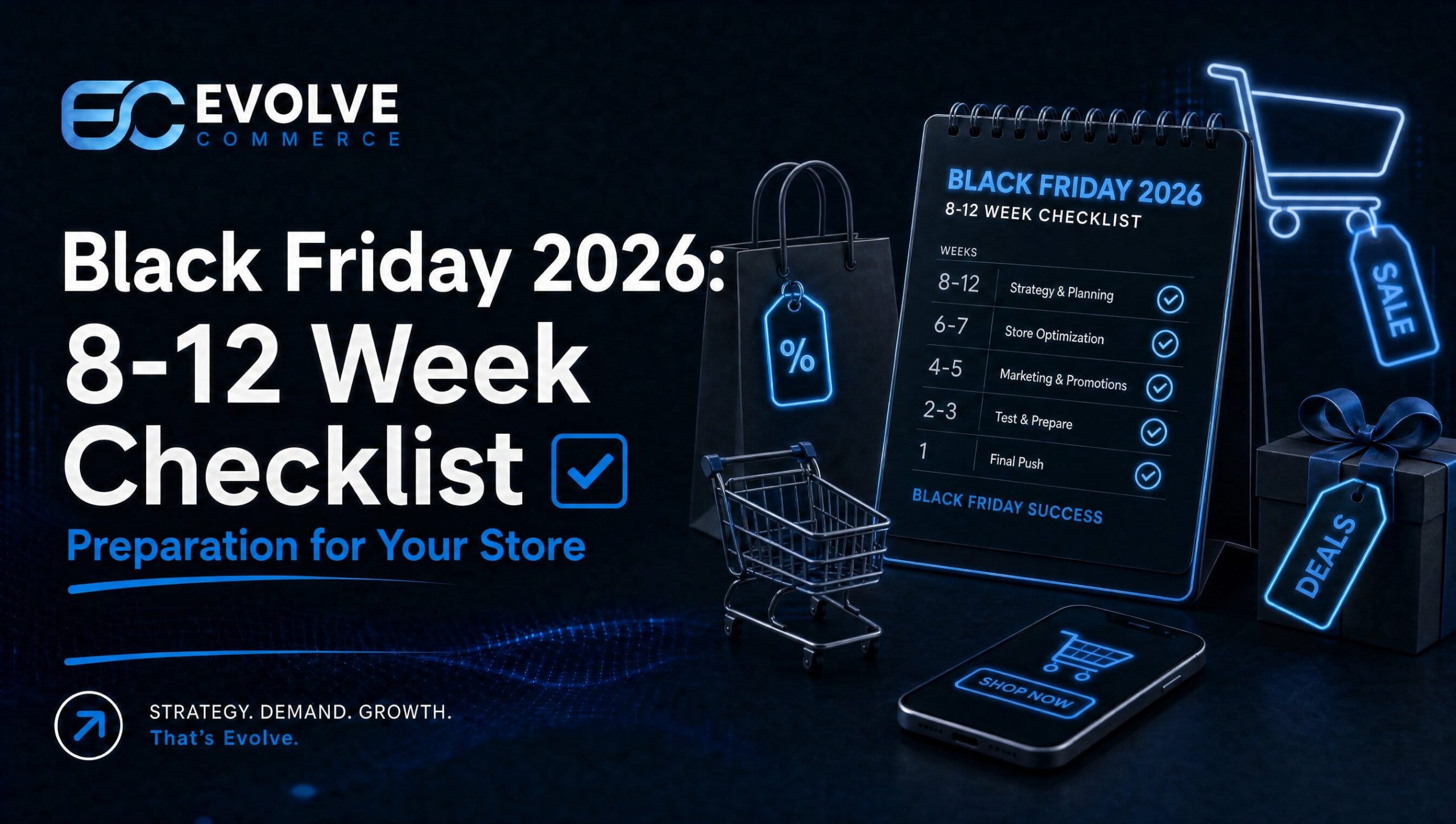
Black Friday 2026 preparation is now underway, and the brands that perform best rarely leave the critical work until November. Three factors can have a major impact on results: having enough inventory to meet demand, ensuring your mobile landing experience is ready to convert, and building segmented email flows before the Black Friday promotion begins. Starting 8–12 weeks ahead gives you time to test, fix and optimise before demand peaks. A good place to start is by reviewing your SKU velocity and identifying your top 20 sellers — because these products should shape much of your Black Friday strategy.
- Secure a stock buffer based on high-demand SKUs, using real sales data and lead times to avoid stockouts during peak sales periods.
- Build and test all landing pages, checkout flows, and tracking before launch, and freeze creative assets at least a week in advance.
- Segment email lists and prepare creative variations, subject-line tests, and post-purchase sequences to maximize engagement and repeat sales.
- Confirm marketplace listings, social campaigns, and paid media creative are ready and compliant, with teaser content scheduled at least two weeks before sales begin.
- Focus on limiting deep discounts to loss-leader SKUs and using margin-protected bundles to maximize revenue without eroding profit margins.
Table of Contents
- The prioritised Black Friday checklist
- Your week-by-week execution timeline
- Channel-ready checklist: email, paid, social and marketplaces
- Inventory, fulfilment and customer service readiness
- How to design offers, bundles and discount rules without killing margin
- What to build and freeze: landing pages and creative assets
- Pre-launch and peak-day tests to run now
- Immediate post-sale flows and how to measure success
- Evolve Commerce proof points and editorial credibility
- A strategist’s view on last-minute Black Friday scrambles
- A practical starting point if you need extra hands
- FAQ
- Sources
The prioritised Black Friday checklist
Group tasks by theme and assign an owner to each one this week. Mark anything flagged “critical” as non-negotiable; “recommended” items boost performance but will not break the sale if delayed.
- Review last year’s Black Friday data (critical, 2 hours): pull conversion rate, AOV and return rate by channel.
- Run competitor and market scans (recommended, 3 hours): note pricing moves and promotional timing.
- Set margin-safe discount tiers (critical, half a day): decide which SKUs can discount and by how much.
- Calculate stock buffers for top 20 SKUs (critical, half a day).
- Build and freeze landing pages (critical, 2 days).
- Segment your email list (critical, 1 day).
- Brief paid media creative (critical, 2 days).
- Plan organic and influencer teaser content (recommended, 2 days).
- Confirm marketplace listing readiness (recommended, half a day).
- Test checkout end-to-end (critical, 1 day).
- Validate tracking and pixels (critical, half a day).
- Agree stock freeze and campaign budget sign-off dates (critical, 1 hour).
- Draft post-purchase email sequences (recommended, half a day).
- Set up customer service scripts and escalation paths (recommended, 1 day).
A bundle built from two slow-moving SKUs paired with a bestseller often lifts average order value while protecting margin better than a blanket percentage discount; a simple “buy one, get the second half price” rule on complementary items can do the same without eroding the headline price.
Your week-by-week execution timeline
Work backwards from Black Friday itself and treat each milestone as a checkpoint, not a suggestion.
- 12 weeks out: finalise offer strategy, agree stock buffers and brief creative.
- 8 weeks out: build landing pages, start email segmentation, confirm supplier delivery dates.
- 6 weeks out: stock freeze decision, first round of paid creative approved.
- 4 weeks out: creative freeze, tease campaigns live, marketplace listings updated.
- 2 weeks out: full checkout and tracking tests complete, budget sign-off locked.
- 1 week out: final QA pass, customer service team briefed, contingency triggers confirmed.
- Contingency trigger: sell-through above 20% on any top SKU in the first 48 hours should prompt immediate stock reallocation or a pause on further discounting that SKU.
Internet retail sales in the UK spike sharply every November, with November 2025 reaching £3,433.8 million, which is exactly why stock and fulfilment decisions need to be locked in well before the month starts rather than adjusted on the fly.
Channel-ready checklist: email, paid, social and marketplaces
Each channel needs its own pre-launch list because a gap in one undermines the others.
- Email: segment by purchase history and engagement, prepare three creative variations per send, map your cadence from tease to last-chance, and run subject-line A/B tests on your warm-up sends.
- Paid: build creative templates for each placement, refresh audience lists, set budget pacing rules so spend does not front-load too early, agree a consistent UTM structure, and test pixels before launch day.
- Social: schedule an organic teaser calendar, brief any influencers early, and set a content approval timetable so nothing goes live unchecked. Partner guidance on social commerce outlines how product tagging and shoppable posts can shorten the path from post to purchase.
- Marketplaces: check images, descriptions, delivery promises and fulfilment settings are all current; a retail-readiness checklist is a useful reference for sellers managing multiple listings.
Pro Tip: Tease the sale at least two weeks before launch; DHL’s small-business guidance lists this among the highest-leverage Black Friday actions brands routinely leave too late.
Inventory, fulfilment and customer service readiness
A stock buffer only works if it is based on real numbers, not guesswork. Take average daily sales for each top SKU, multiply by an expected uplift factor, then multiply by lead time in days to get a safety stock figure. Run this calculation for your top 20 SKUs first; they typically drive most of the Black Friday revenue.
- Fulfilment: decide now whether a 3PL or temporary labour is needed, and test courier service levels before peak rather than during it.
- Courier capacity: confirm cut-off times and have a backup carrier agreed, a step DHL specifically flags as commonly left too late.
- Customer service: write clear returns policy copy, prepare scripted responses for common queries, and define an escalation path for delayed orders.
How to design offers, bundles and discount rules without killing margin
Not every SKU should carry the same discount. A small set of loss-leader products can drive traffic and basket size, while the bulk of your catalogue sits in margin-protected bundles that look generous without cutting deep into profit.
- Test discounts on a small segment first before rolling out site-wide, so you can see real elasticity rather than assuming it.
- Set promo code rules and MAP protection so resellers and affiliates cannot undercut your own campaign.
- Calculate net impact properly, factoring in shipping costs and expected return rates, not just the headline discount percentage.
A margin-protected bundle (full-price bestseller plus a half-price accessory) often outperforms a blanket 20% site-wide discount on both revenue and profit, because the discount is contained to a lower-cost item rather than applied across your highest-margin products.
What to build and freeze: landing pages and creative assets
Your Black Friday landing page needs to do a lot of work in a few seconds of attention. Build it early, test it, then freeze it so nobody is making last-minute changes while traffic is live.
- Hero message and offer clarity: the discount and deadline should be visible without scrolling.
- Stock warnings and countdown timers to create urgency without overstating scarcity.
- Trust elements: reviews, delivery promises and secure payment badges near the buy button.
- Mobile checks: guest checkout enabled, wallet payments available, images compressed and lazy loading switched on, since DHL’s guidance treats mobile optimisation as a baseline requirement, not an extra.
- Asset freeze: final video cuts, hero images, social-sized crops and approved user-generated content rights all locked at least a week out.
Pre-launch and peak-day tests to run now
- Run a full checkout and returns test across at least three devices and two payment methods.
- Validate tracking end to end, checking server-side events, pixels and UTM parameters all report consistently.
- Load test your site at the traffic level you expect, and keep a simple rollback checklist ready in case the platform struggles.
A broken pixel or a mismatched UTM parameter on launch day means days of unreliable reporting afterwards, which is a harder problem to fix retroactively than to test for in advance.
Immediate post-sale flows and how to measure success
The sale does not end at checkout. A short, well-timed post-purchase sequence protects the relationship and sets up repeat business.
- Immediate post-purchase emails: delivery expectations, a relevant cross-sell, and a review request timed after the product has likely arrived.
- KPI checklist: ROAS, AOV, conversion rate, return rate and fulfilment SLA adherence, reviewed daily during the sale and weekly for 30 days after.
- Reconcile reporting sources: ad platform numbers and server-side analytics rarely match exactly; agree which source is your source of truth before the sale starts, not during the reconciliation argument afterwards.
November is reliably the strongest month for UK internet retail sales, with 2025 data showing £3,433.8 million in internet retail turnover, which is the scale of demand your fulfilment and reporting need to be ready for.
Evolve Commerce proof points and editorial credibility
Some clients of a full-funnel growth marketing agency have reported significant annual revenue growth rates through engagements covering paid media, creative production, email and SMS, and analytics.
- Paid media and creative map directly to the channels and campaigns checklist above.
- Email & SMS marketing supports the segmentation and post-purchase sequences covered earlier.
- AdWize analytics supports the tracking validation and reporting reconciliation steps.
Readers wanting direct examples can review case studies of peak-season engagements.
A strategist’s view on last-minute Black Friday scrambles
Most Black Friday failures are not creative problems, they are timeline problems. A brand that leaves stock buffers until the week before is already choosing between stockouts and discounting products it cannot afford to discount. Assign an owner and a date to each checklist item today, before the next task on your list pushes it back another week.
— Evolve Commerce
A practical starting point if you need extra hands
Preparing for Black Friday 2026 properly means running audits, building creative, setting up campaigns and getting analytics right, often all inside the same few weeks as your regular workload. These services can be delivered as short, focused engagements including marketing audits, creative packs for key channels, and campaign setup across paid media and email.
For brands wanting clearer attribution going into peak season, the AdWize platform starts at £49 a month on the Starter plan, with Accelerator at £149 a month and Scale at £249 a month, each adding more depth to campaign tracking and reporting. A short engagement typically runs a few weeks from audit to launch-ready assets. Get in touch through the Evolve Commerce services page to scope what fits your timeline.
FAQ
When should you start preparing for Black Friday 2026?
Most of the checklist above works best starting 8 to 12 weeks before Black Friday, giving enough time for stock buffers, creative production and email segmentation to be finished rather than rushed. Starting later is possible but increases the risk of stockouts and untested checkout flows.
How much extra stock should you hold for Black Friday?
A practical method multiplies average daily sales by an expected uplift factor, then by your lead time in days, applied to your top 20 SKUs by revenue. This gives a working safety stock figure rather than a guess based on last year’s feeling.
What is the single most common Black Friday mistake?
Leaving mobile optimisation and landing page testing until the final week is a recurring issue, since DHL’s guidance lists both among the highest-leverage, most commonly delayed tasks for small businesses.
How do you protect margin while still offering strong discounts?
Limit deep discounts to a small set of loss-leader SKUs and build bundles elsewhere that look generous without cutting into your best-margin products. Testing discounts on a small segment before a full rollout also shows real elasticity before you commit to it site-wide.
What should happen immediately after a Black Friday sale?
Post-purchase emails covering delivery expectations, cross-sells and timed review requests should go out within the first few days, while KPI reporting on ROAS, AOV, conversion rate and return rate should be reviewed daily during the sale and weekly for 30 days after.
Sources
- Internet retail sales, £ millions. All retailing – Office for National Statistics
- 10 E-commerce tips & strategies to prepare for Black Friday | DHL Global