
An abandoned cart flow is an automated email (and often SMS) sequence triggered when a shopper leaves items unpurchased, designed to bring them back to checkout. The best-performing setups send a first message within 2 to 4 hours, follow up around the 24 hour mark, and close with a final nudge at 48 to 72 hours. Done properly, that cadence recovers a meaningful share of otherwise lost revenue, and the templates and benchmarks below show exactly how to build it.
- Sending the first abandoned cart email within 2 to 4 hours captures high purchase intent without interrupting browsing.
- Triggering separate flows for “Started Checkout” and “Added to Cart” avoids wasting messaging on low-intent shoppers.
- Using personalized subject lines that include the product name and cart details significantly increases open and conversion rates.
- Incorporating SMS messages around 1 to 2 hours after abandonment can improve recovery rates but requires explicit customer opt-in.
- Proper flow filters must exclude completed purchases, zero-quantity carts, and stock-out items to prevent duplicate or irrelevant emails.
Table of Contents
- What triggers an abandoned cart flow?
- When should you send each abandoned cart email?
- What should go in an abandoned cart email?
- How do you personalise an abandoned cart flow?
- Does SMS improve abandoned cart recovery?
- What flow filters and QA checks prevent duplicate sends?
- What metrics matter for abandoned cart flows?
- Abandoned cart email and SMS templates you can copy
- How Evolve Commerce approaches abandoned cart recovery
- How do you segment beyond cart value?
- Where abandoned cart flows fit in the bigger picture
- Get your abandoned cart flow built and tested properly
- Sources
What triggers an abandoned cart flow?
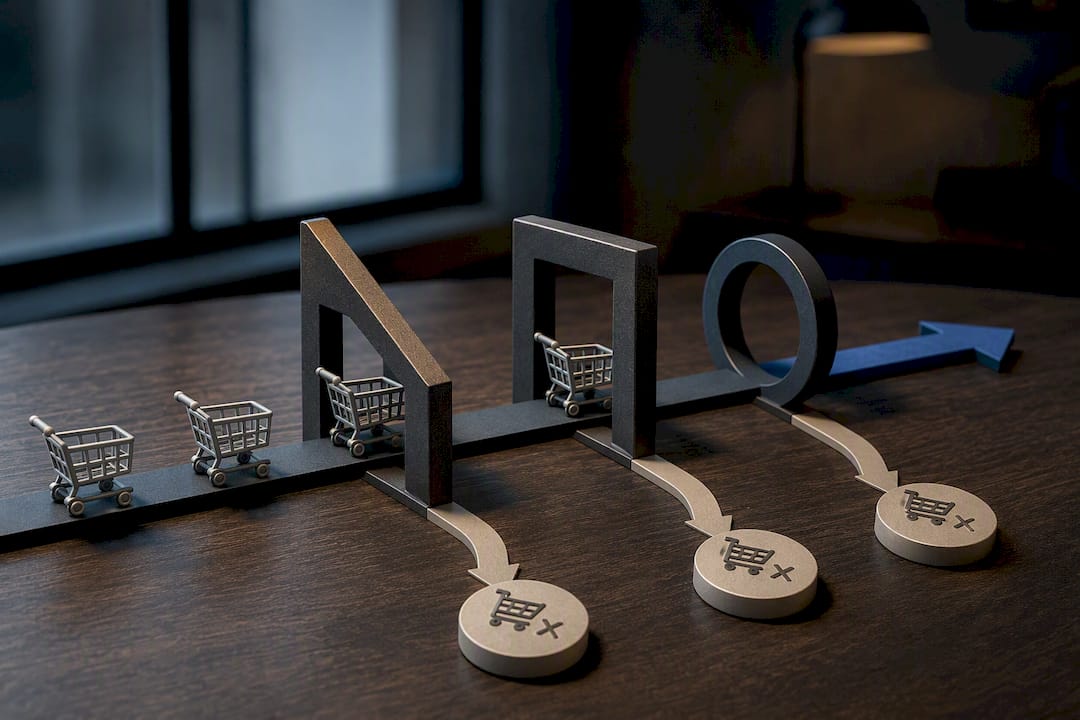
Two events start most abandoned cart flows, and mixing them up is the most common setup mistake we see: Started Checkout and Added to Cart. They capture different levels of intent, and treating them the same wastes send volume on shoppers who were never close to buying.
Started Checkout fires once a customer has entered contact or shipping details on the checkout page. That is high-intent behaviour. They gave you information, they were seconds from paying, and something (a shipping cost, a distraction, a failed card) got in the way. Added to Cart fires much earlier, the moment a product lands in the basket, often while someone is still browsing three other tabs. Intent here is far softer, so messaging needs to acknowledge that rather than push a hard “complete your order” line.
Klaviyo’s setup documentation recommends running both triggers as separate flows rather than merging them, because the content and urgency of each message should differ.
Before either flow goes live, run through this integration checklist:
- Confirm your ecommerce platform is passing checkout and cart events to your email service provider in real time, not on a delay.
- Check that behaviour tracking is enabled on both desktop and mobile, since a large share of abandonment happens on phones.
- Verify product data (image, price, variant) flows through cleanly, so the email doesn’t show a blank thumbnail or the wrong size.
- Test with a dummy order to confirm the trigger fires and the flow filter correctly excludes it once “purchased.”
A simple rule of thumb: if your store sells considered, mid-to-high price items, run both flows, because Added to Cart shoppers often need a gentler nudge before Started Checkout urgency makes sense. If you sell low-cost, impulse-driven products, Started Checkout alone usually covers most of the recoverable revenue, since browsers rarely convert regardless of what you send them.
Trigger-filter logic matters just as much as the trigger itself. Exclude gift cards, since they don’t map to a physical “cart” in the way customers expect. Exclude zero-quantity carts, which usually indicate a technical glitch rather than genuine abandonment. And exclude any cart where the customer has already completed a purchase within your flow’s time window, something covered in more detail in the flow hygiene section below.
When should you send each abandoned cart email?
Timing decides more of your recovery rate than copy or design ever will. Send too early and you interrupt someone still comparing options; send too late and the intent has cooled or a competitor has already closed the sale.
The industry-standard cadence, backed by both Klaviyo and Shopify, looks like this:
- First email: 2 to 4 hours after abandonment. Klaviyo’s own pre-built flow defaults to a 4 hour delay. This window catches people while the purchase is still front of mind, without feeling like you’re watching them shop.
- Second email: 24 hours later. This is where you can introduce a reason to come back, a bestseller callout, a stock warning, or social proof, without leaning on a discount yet.
- Third email: 48 to 72 hours after abandonment. This is your last real chance, and where an incentive (if you use one at all) tends to do the most work.
The overwhelming majority of cart recoveries happen inside the first 72 hours, which is why Klaviyo’s guidance treats that window as the one worth testing hardest, rather than adding a fourth or fifth email further out.
Adjust that baseline for your own catalogue. High average order value (AOV) stores selling considered purchases, furniture, jewellery, or technical equipment, often benefit from stretching the final send to 5 or 7 days, because the decision cycle is longer and a rushed discount can look desperate rather than helpful. International shipping adds its own wrinkle: if a customer is checking delivery costs to another country, a same-day third email pushing urgency will land oddly if they’re still waiting on a shipping quote from customer service.
To find your actual optimal cadence rather than guessing from a generic playbook, run incremental A/B tests one variable at a time. Test the first-send delay (2 hours vs 4 hours) before touching anything else, then move to the second email’s timing once that’s settled. Keep a small holdout group that receives no abandoned cart messages at all, since that’s the only way to measure true incremental lift rather than crediting the flow for sales that would have happened anyway.
Compress the cadence for low-price, fast-moving products where intent decays within hours. Expand it for high-AOV or B2B-style purchases where a week-long consideration period is normal.
What should go in an abandoned cart email?
Every high-performing abandoned cart email shares the same structural bones, regardless of industry. Shopify’s best-practice guide recommends a single-column, mobile-first layout with one clear action, and that discipline is worth following closely.
- A product image block that mirrors the actual cart. Show the exact item, variant, and colour the customer left behind, not a generic “you might like” carousel at the top. Recognition drives the click far more than persuasion does.
- Product name and price, clearly stated. Don’t make the customer click through to remember what they were buying or how much it cost.
- One CTA button, above the fold. “Complete Your Order” or “Return to Cart” outperforms pages with multiple competing buttons, because every extra choice is a chance to lose the click.
- Supporting content below the fold only. Reviews, related products, or a size guide can sit further down, but they should never compete with the primary action.
Subject lines carry more weight than most marketers assume, since they decide whether the rest of your careful design ever gets seen. Keep them short, specific, and personal:
- “You left something in your cart, [Name]”
- “Still thinking it over? Your cart’s waiting”
- “[Product name] is still available, but not for long”
Including the word “cart” or the actual product name consistently outperforms vague curiosity-driven lines like “Don’t miss out”, because it tells the reader exactly what’s waiting for them before they even open the email.
Incentives need discipline. Research on abandonment drivers suggests free shipping often outperforms a percentage discount when unexpected delivery costs are the reason someone left checkout in the first place, simply because it removes the actual objection rather than papering over it with a different saving. Reserve discounts for the final email in the sequence, and never lead with one in the first send.
Pro Tip: Test a version with no incentive at all against your standard discount email. Plenty of stores discover a meaningful share of “at risk” customers convert on product reminder alone, and every voucher you don’t send protects margin.
Mobile design isn’t optional at this point. A large share of cart abandonment originates on phones, so test every email on a small screen before launch: buttons need to be thumb-sized, images need to load fast, and the CTA needs to appear without scrolling.
How do you personalise an abandoned cart flow?
A single generic email sent to everyone who abandons a cart leaves real revenue on the table, because a £15 abandoned cart and a £400 abandoned cart deserve completely different treatment.
Cart-value splits are the simplest place to start. A workable band structure looks like this:
- Low value (under £50): Standard three-email sequence, lighter tone, product-focused rather than urgent.
- Mid value (£50 to £150): Add a trust-building element in email two, such as a review or a returns-policy reminder, since hesitation here is often about confidence, not price.
- High value (£150+): Route to a slower, longer flow with a more personal tone, and consider a manual follow-up call or live chat prompt rather than relying purely on automation.
New versus returning customer paths matter almost as much. A first-time visitor who abandoned checkout hasn’t built trust in your brand yet, so their emails should lean on social proof, guarantees, and clear return policies. A returning customer already trusts you; their emails can skip the reassurance and go straight to the product and a reason to finish.
Loyalty members and subscription products need their own branch entirely. A loyalty member abandoning a cart might respond better to a points reminder (“You’re 40 points from your next reward”) than a discount. Subscription products, meanwhile, should never use the standard urgency-driven copy designed for one-off purchases, since the buying decision is fundamentally different when someone is committing to a recurring charge rather than a single transaction.
Klaviyo’s guidance on message components points to dynamic product blocks as the practical mechanism behind all of this: instead of building five separate emails for five segments, one template pulls in conditional content based on cart value, customer status, or product category. Most modern email service providers support this through conditional content blocks, so the technical lift is smaller than it sounds. Set the branching logic once, and the flow adapts automatically as new shoppers pass through it.
Does SMS improve abandoned cart recovery?
Email alone leaves recovery on the table for high-intent shoppers who don’t check their inbox for hours. Twilio’s guidance on multichannel recovery recommends layering SMS onto email precisely because text messages get read within minutes, not hours, which matters most for carts where speed decides whether the sale happens at all.
Recommended SMS timing sits earlier and tighter than email. A single text around 1 to 2 hours after abandonment, timed to land after the first email but before the second, tends to work well. Keep the message short:
“Hey [Name], you left [Product] in your cart. Complete your order here: [link]. Reply STOP to opt out.”
Consent is not optional. Under UK rules, customers must have explicitly opted in to receive marketing texts, separately from email consent, and every message needs a clear, working way to unsubscribe. Keep the compliance line short but always present, and never bundle SMS opt-in into a pre-ticked checkbox at checkout.
Frequency capping protects the relationship you’re trying to build. A sensible rule: no more than one SMS per cart abandonment sequence, and never send SMS and email within the same hour, since that reads as pressure rather than helpfulness. Coordinate the two channels through your flow logic so a customer who clicks the email link doesn’t also receive the text.
- SMS costs more per send than email, so reserve it for high-intent triggers (Started Checkout) or carts above a value threshold where the recovered revenue clearly justifies the spend.
- Twilio notes that SMS carries a higher unsubscribe risk than email, so overuse damages a channel that’s genuinely valuable when used sparingly.
- For low-value, browse-only Added to Cart abandons, email alone is usually the more cost-effective route.
The cost-per-recovery math looks very different at £30 carts versus £300 carts.*
What flow filters and QA checks prevent duplicate sends?
Nothing damages customer trust faster than an abandoned cart email arriving after someone has already paid. It looks careless, and it’s entirely preventable with the right filters.
The essential filter, non-negotiable in every flow, is: Placed Order = 0 since flow entry. Klaviyo’s setup documentation specifically recommends this exclusion so anyone who completes checkout mid-flow drops out immediately, rather than receiving a “did you forget something?” email an hour after paying.
Beyond that baseline, build in these checks:
- Order-status verification at each send step, not just at flow entry, since a customer could complete the purchase between email one and email two.
- A time-window condition that exits anyone still in the flow after your final send, so stale carts don’t linger indefinitely in the automation.
- A payment-timeout check that distinguishes a genuinely abandoned cart from a payment that’s still processing, since these look identical at the point of abandonment but need different handling.
- A stock-change condition that pulls a product from the email if it’s since sold out, replacing it with an “in stock” alternative rather than promoting something the customer can no longer buy.
QA before launch matters more than most teams give it credit for. Create a test customer profile, add a real product to cart, abandon it deliberately, and then walk through the entire sequence yourself on both desktop and mobile. Simulate an order completion partway through to confirm the flow filter actually removes you. This single test catches the majority of pre-launch mistakes.
Once live, set up a simple monitoring alert for send volume spikes, since a sudden jump often signals a broken filter rather than a genuine surge in abandonment. If duplicate sends do occur, the fix is almost always the same: the “placed order” filter is checking at flow entry only, rather than re-checking before every individual email in the sequence.
What metrics matter for abandoned cart flows?
Four numbers tell you almost everything about whether an abandoned cart flow is working: recovery rate, revenue per recipient, open and click rates, and unsubscribe rate. Track all four together, because a high open rate with a low recovery rate usually means your subject lines work but your offer or landing experience doesn’t.
- Recovery rate: the percentage of abandoned carts that convert after entering the flow. This is your headline number.
- Revenue per recipient: total recovered revenue divided by everyone who entered the flow, a more honest measure than recovery rate alone since it accounts for cart value, not just conversion count.
- Open and click rates: diagnostic metrics that tell you whether the problem sits with the subject line, the content, or the offer.
- Unsubscribe rate: your early warning system for sending too frequently or too aggressively.
Industry benchmarks put average checkout abandonment at roughly 70%, with well-run recovery flows converting a single-digit percentage of those abandoned carts back into sales, and top performers reaching notably higher. If your recovery rate sits well below that range, timing, subject lines, or your filter setup are the first places to check.
To attribute recovered revenue cleanly, run a holdout group that never enters the flow and compare their conversion rate against the group that does. The difference between the two is your true incremental lift, not the vanity number of “total revenue from flow emails,” which double-counts customers who would have returned anyway. Platforms like Adwize are built specifically to separate that genuine lift from revenue that simply would have happened without the flow.
A practical 8-week roadmap, adapted from Shopify’s own optimisation sequence, looks like this: weeks 1 to 2 focus on QA and establishing baseline metrics, weeks 3 to 4 test subject lines, weeks 5 to 6 test timing and incentive structure, and weeks 7 to 8 layer in segmentation and channel expansion. Trying to test all four variables simultaneously in week one is the single most common reason teams end up with data they can’t actually interpret.
Abandoned cart email and SMS templates you can copy
A working three-email sequence doesn’t need to be complicated. Here’s a structure you can adapt directly, based on the cadence and content principles covered above.
- Email one (2 to 4 hours): Subject: “You left [Product] in your cart” or “Still thinking about [Product]?” Content: product image, name, price, single CTA. No discount, no urgency language, just a clean reminder.
- Email two (24 hours): Subject: “[Product] is still waiting for you” or “Quick reminder: your cart is about to expire” Content: add one trust element, a review snippet, a returns policy line, or a low-stock note if genuinely true.
- Email three (48 to 72 hours): Subject: “Last chance to get [Product]” or “Free shipping if you complete your order today” Content: this is where an incentive, if you’re using one, belongs.
SMS template, sent roughly 1 to 2 hours after abandonment: “Hi [Name], your [Product] is still in your basket. Finish your order here: [link].” Keep it under 160 characters and skip the discount unless the cart value justifies the cost of the message.
For high-AOV carts, stretch this sequence rather than compress it. A four or five-day cadence, with the incentive delayed until email three or four, suits considered purchases better than a rapid three-email burst, since rushing a £500 decision tends to read as pushy rather than helpful.
If you sell into multiple regions, localise more than just the language. Currency, delivery estimates, and even tone need adjusting; a cheerful, urgency-driven subject line that works for a UK audience can land oddly translated word-for-word elsewhere. Test tone by market rather than assuming one template travels everywhere unchanged.
How Evolve Commerce approaches abandoned cart recovery
Evolve Commerce builds abandoned cart flows as one piece of a wider lifecycle system, not as a standalone email someone sets up once and forgets. Client work spanning brands like Hunter Boots, Juicy Couture, Light Mirrors, and FILA has contributed to annual revenue growth rates between 130% and 450%, and recovery flows are consistently one of the fastest-moving levers inside that growth.
The managed approach covers the full stack rather than a single email template. That means integration work to confirm platform triggers fire correctly, creative production for the product imagery and layout that actually gets clicked, SMS sequencing that coordinates with email rather than competing against it, and structured A/B testing that isolates what’s genuinely driving lift versus what would have converted anyway. Attribution runs through the Adwize analytics platform, which separates recovered revenue from baseline conversion so the numbers a client sees reflect real, incremental performance.
A typical pilot follows a familiar shape: audit the existing setup and flow filters, rebuild the trigger logic and message sequence around the cadence principles above, layer in SMS for high-intent segments, and run a four to six week testing window before scaling changes across the full customer base. Case-specific figures and client testimonials sit on Evolve Commerce’s own case study pages, where results vary by starting point, catalogue, and market.
How do you segment beyond cart value?
Cart value and new-versus-returning status cover the basics, but the more sophisticated flows layer in customer lifetime value (CLV) and browsing behaviour on top.
A high-CLV customer who abandons a cart deserves different treatment than a first-time visitor doing the same thing, even if the cart values match. Someone who has spent £2,000 with you over two years has already proven they trust the brand; the abandoned cart email can skip reassurance entirely and focus purely on the product, perhaps with a small loyalty acknowledgment rather than a generic discount that undervalues the relationship.
Browsing behaviour before abandonment adds another layer. A customer who viewed the same product five times over three days before adding it to cart is signalling something different from someone who added it once and left within a minute. Research into abandonment causes groups these behaviours into distinct root causes, price sensitivity, indecision between similar products, or simple distraction, each of which responds better to a different message than a one-size-fits-all reminder.
Practical segmentation rules worth building into your flow: split customers by number of previous purchases, by whether they’ve engaged with a specific product category repeatedly, and by whether they’ve abandoned before (a repeat abandoner often needs a different lever than a first-time one, since whatever you sent last time clearly didn’t work). None of this requires rebuilding your flow from scratch, since most of it runs through the same conditional content logic used for cart-value splits, just with a wider set of inputs feeding the decision.
Where abandoned cart flows fit in the bigger picture
Abandoned cart flows earn their reputation as one of the highest-return moves in ecommerce marketing because the audience is already warm. You’re not persuading a stranger; you’re reminding someone who has already made most of the decision.
That’s exactly why they shouldn’t operate in isolation. A strong cart flow sits downstream of paid acquisition, catching the leakage from campaigns that are already working, and upstream of retention, since a well-timed recovery email is often someone’s first real trust-building interaction with your brand after the ad click. Treat it as a bolt-on and you’ll under-invest in the timing and personalisation work that actually moves the recovery rate.
The mistake we see most often isn’t poor timing or weak copy. It’s discount dependency. Once shoppers learn that abandoning a cart reliably produces a voucher within 48 hours, they start abandoning on purpose, and margin erodes quietly across the entire customer base. Test incentives properly, measure against a genuine holdout, and resist the temptation to lead every flow with a discount just because it’s the easiest lever to pull.
— Evolve Commerce
Get your abandoned cart flow built and tested properly
Evolve Commerce is the alternative to piecing this together from generic templates and hoping the timing holds. Where a DIY setup means guessing at trigger logic, writing subject lines without a testing plan, and manually checking whether your flow filters are actually excluding buyers, a managed build gets the integration, creative, and measurement handled together from day one.
The service covers what this guide has walked through end to end: platform integration and trigger verification, the three-email sequence and its filters, SMS layering for high-intent carts, structured A/B testing across timing and incentives, and attribution through Adwize so recovered revenue is measured against a real holdout rather than guesswork.
A simple way to decide: if your store has the internal resource to build, QA, and continuously test a flow across email and SMS, DIY can work well. If cart abandonment is costing you meaningful revenue every month and nobody on the team has the time to run structured tests on it, that’s the point to bring in help. The agency has taken multiple brands through exactly this process. Visit the Evolve Commerce site to see how a managed build could work for your store, or check the case studies for a closer look at results across different catalogues and markets.
Sources
The setup steps, timing recommendations, and templates in this guide draw on the following references, worth bookmarking for anyone building or refining a flow:
- How to create an abandoned cart flow | Klaviyo Help Center
- Abandoned cart emails: getting started and best practices, with 7 examples
- Abandoned Cart Emails: Best Practices & Examples (2026) – Shopify
- Abandoned cart recovery strategies — Twilio