
Full-funnel marketing links brand-building and performance activity so that every channel contributes to compounding growth rather than isolated clicks. We find that a thoughtful full-funnel strategy can increase marketing ROI by approximately 15-20% compared with performance-only spending. It suits marketing leaders and growth teams who want sustainable acquisition, not just short-term wins.
- Combining brand-building and performance tactics increases marketing ROI by 15-20% compared to relying solely on performance channels.
- A full-funnel strategy requires shared KPIs, coordinated creative, deliberate channel sequencing, and ongoing testing for each stage of the customer journey.
- Measurement should incorporate mix modelling, lift tests, and multi-touch attribution to accurately capture upper-funnel impact and guide budget decisions.
- Fragmented execution across channels hampers full-funnel success; synchronized creative, clear channel roles, and disciplined sequencing are essential.
- Technologies like chatbots and augmented reality extend funnel capabilities but must be integrated into a cohesive strategy to deliver measurable results.
Table of Contents
- What full-funnel marketing is and why it matters
- The funnel stages: awareness, consideration, conversion and retention
- Why full-funnel marketing matters: benefits and common business outcomes
- How to build an effective full-funnel strategy: a practical playbook
- Measurement and attribution: building a suite of truth
- Channel and platform orchestration: coordinating creative across the funnel
- Budgeting and media-mix guidance for full-funnel programmes
- Real results and case evidence from full-funnel programmes
- Content marketing and storytelling across the funnel
- The role of customer data platforms in full-funnel optimisation
- Automation and AI in personalising funnel stages
- Aligning sales and marketing teams in a full-funnel approach
- Emerging technologies reshaping full-funnel marketing
- Author perspective: leading full-funnel transformation
- How Evolve Commerce can help you build a full-funnel engine
- FAQ
- Sources
What full-funnel marketing is and why it matters
Full-funnel marketing treats the customer journey as one connected system rather than a set of disconnected campaigns. It spans paid, owned and earned channels, working together from the first brand impression through to repeat purchase. Rather than choosing between brand advertising and performance marketing, we build both into the same plan, because each strengthens the other over time.
The strategic logic is straightforward: long-term demand creation (brand awareness, category entry points, emotional associations) fuels short-term capture (search, retargeting, conversion-focused offers). Without the upper-funnel work, performance channels eventually run out of warm audiences to convert. Without the lower-funnel discipline, brand spend never turns into measurable revenue.
This is not simply theory. McKinsey’s analysis found that businesses combining brand and performance marketing under unified measurement saw stronger returns than those running performance-only strategies.
A full-funnel approach typically requires:
- Shared KPIs that connect brand metrics (reach, consideration) to business outcomes (revenue, retention)
- Creative built for each stage of the journey, not one asset repurposed everywhere
- Media planning that sequences channels deliberately, rather than running them in parallel with no coordination
- Measurement that captures both immediate and delayed effects of spend
The funnel stages: awareness, consideration, conversion and retention
Each stage of the funnel has a distinct job, a different set of metrics and a role in feeding the next stage.
- Awareness: the objective is reach and recall. Video, social content and display campaigns introduce the brand to new audiences, measured through impressions, reach and brand lift.
- Consideration: the objective is engagement and intent-building. Content marketing, retargeting and social proof (reviews, influencer content) move prospects towards a decision, measured through engagement rate, time on site and add-to-cart actions.
- Conversion: the objective is the transaction itself. Search ads, shopping feeds and conversion-optimised landing pages close the sale, measured through conversion rate, cost per acquisition and return on ad spend.
- Retention and loyalty: the objective is repeat value. Email and SMS lifecycle flows, loyalty programmes and personalised offers extend customer lifetime value, measured through repeat purchase rate and churn.
Each stage hands off to the next: an awareness campaign builds the retargeting pool that consideration activity nurtures, which in turn feeds the audience that conversion campaigns close. Retention then feeds brand advocacy back into awareness, closing the loop.
Why full-funnel marketing matters: benefits and common business outcomes
The business case for full-funnel investment rests on a few consistent outcomes we see across ecommerce and retail brands.
- Incremental sales and better marginal returns: spreading investment across the funnel, rather than concentrating it on last-click conversion channels, tends to improve the marginal return on each additional pound of spend.
- Broader reach and durable demand: upper-funnel activity builds the pool of future buyers, reducing a brand’s dependence on an ever-shrinking retargeting audience.
- Stronger brand equity: businesses with established brand recognition typically see lower acquisition costs over time, because prospects arrive with existing trust rather than needing to be convinced from zero.
Together, these outcomes explain why brand and performance teams increasingly report into the same growth function rather than operating as separate budgets.
How to build an effective full-funnel strategy: a practical playbook
Building a joined-up full-funnel programme is a sequence of deliberate decisions, not a single campaign launch.
- Set unified objectives and KPIs. Agree metrics that connect brand indicators (reach, consideration) to business indicators (revenue, retention) before any media is booked, so brand and performance teams are optimising towards the same outcome.
- Map audiences and intent by stage. Segment prospects by where they sit in the journey, and match creative and offer accordingly; a cold audience needs a different message from a cart abandoner.
- Build creative around Super Touchpoints. The IPA’s analysis of synchronised creative and media combinations, what it calls Super Touchpoints, found that aligning high-impact creative with the right channel and moment produces disproportionately strong business effects compared with running the same asset everywhere.
- Plan channel roles and sequencing. Decide which channels carry awareness, which carry consideration, and which close the sale, then sequence activation so each stage has an audience ready to receive it.
- Set a test-and-learn roadmap. Define experiments, timelines and governance upfront: what you are testing, how long it runs, and who reviews the results.
Pro Tip: Treat your upper-funnel creative with the same testing rigour as your conversion ads: rotate variants, measure lift, and retire what underperforms rather than running one brand film for a year.
McKinsey recommends extending the rapid test-and-learn habits of performance marketing into brand and upper-funnel teams, so creative becomes as optimisable and accountable as a search ad. That shift, more than any single tactic, is what separates full-funnel programmes that compound from those that stay siloed.
Governance matters as much as tactics: a shared roadmap, agreed review cadence and clear ownership between brand and performance teams prevent the strategy from drifting back into disconnected campaigns within a quarter.
Measurement and attribution: building a suite of truth
Single-touch attribution consistently undercounts upper-funnel impact, because it only credits the last click before conversion. The fix recommended across the industry is to combine several measurement methods rather than relying on one.
- Marketing mix modelling (MMM) captures the aggregate, longer-term effect of spend across channels, including offline and upper-funnel activity that click-based tools miss.
- Conversion lift and controlled experiments isolate the true incremental effect of a specific campaign by comparing exposed and unexposed groups.
- Calibrated multi-touch attribution fills the gap between the two, giving near-real-time read while being corrected against the more rigorous MMM and lift results.
A suite of truth, built by combining these three methods, is the approach recommended by the IAB UK’s measurement whitepaper to avoid the biases of single-touch attribution. Incrementality, not raw attributed ROAS, should be the metric that guides budget decisions: run single-cell conversion lift tests to calibrate marginal returns across publishers, then use multi-cell tests when validating a new channel or strategy.
Consent and cookieless measurement add a further layer of complexity. Google’s documentation on consent mode explains that an advanced implementation, where tags load with defaults set to denied and send cookieless pings, preserves more usable data for modelling than simply blocking tags until consent is granted. Getting this right affects how much signal reaches both MTA and MMM.
Once the suite of truth is in place, budget decisions follow naturally: MMM identifies where the aggregate return is strongest, lift tests confirm the incremental effect, and calibrated attribution flags which channels need investigation before the next planning cycle.
Channel and platform orchestration: coordinating creative across the funnel
Fragmented execution, where each platform runs its own creative and its own measurement, is one of the most common reasons full-funnel strategies underdeliver. Assigning each channel a clear role avoids this.
- Awareness channels (video, social, display) carry reach and brand-building creative, judged on attention and recall rather than last-click conversions.
- Intent-capture channels (search, shopping) carry conversion-focused creative aimed at prospects already close to a decision.
- Retail media and addressable channels increasingly serve both roles at once. IAB UK’s analysis of the retail media sector notes its expansion into display, video and off-site formats, making it a closed-loop environment that supports brand and performance objectives simultaneously where measurement allows.
- Creative synchronisation across these roles, rather than one asset repurposed across every placement, is the practical application of the Super Touchpoint concept at channel level.
Sequencing and frequency discipline matter too: a prospect who has already seen the awareness film should not be shown it again at the conversion stage, and frequency caps need to flex by funnel position rather than applying one rule across every channel.
Budgeting and media-mix guidance for full-funnel programmes
Budget allocation across the funnel works best as an ongoing marginal-return exercise rather than a fixed split decided once a year.
- Ask where the next pound goes, not just where the last one went. Marginal return analysis, a practice highlighted in IPA commentary on full-funnel effectiveness, identifies which channel delivers the highest incremental return for additional spend, which is often not the channel with the highest historical ROAS.
- Rebalance quarterly, scaling upper-funnel investment when lower-funnel channels show diminishing returns on additional spend.
- Watch for lower-funnel saturation: if conversion campaigns are absorbing an increasing share of budget without proportional revenue growth, that is a signal to shift spend upward in the funnel.
- Revisit the mix monthly for performance checks, quarterly for structural rebalancing, keeping short-term optimisation separate from longer-term strategic shifts.
Real results and case evidence from full-funnel programmes
Across the ecommerce and retail brands we work with, full-funnel programmes that combine paid media, performance creative and integrated analytics consistently outperform channel-by-channel approaches.
- Integrated creative production across video, paid social and lifecycle email keeps messaging consistent from first impression to repeat purchase.
- Our AdWize analytics dashboard brings server-side attribution and AI-powered performance insights into one view, so budget decisions are based on a consolidated read of channel performance rather than fragmented platform reports.
- The consistent lesson across these engagements: brands that unify measurement and creative across channels scale faster than those running paid media, creative and email as separate workstreams.
The results we have seen come from treating paid media, creative production and lifecycle marketing as one connected system rather than three separate budgets.
Further detail on these outcomes sits in our case studies.
Content marketing and storytelling across the funnel
Content and storytelling are not a separate workstream from paid media, they are the connective tissue that makes full-funnel creative coherent. At the awareness stage, brand storytelling (founder narratives, product origin stories, values-led content) builds the emotional association that paid reach alone cannot deliver. At consideration, long-form content such as buying guides, comparison pieces and user-generated reviews answers the questions a prospect is asking before they are ready to buy.
By conversion, storytelling narrows to proof: specific product benefits, social proof and urgency-driven messaging that supports the decision rather than introducing new narrative. At retention, content shifts again, towards usage tips, loyalty messaging and community content that keeps existing customers engaged between purchases.
The practical discipline is consistency of voice and theme across this arc. A brand story introduced in a video ad should echo in the product page copy, the retargeting creative and the post-purchase email sequence, so the customer experiences one coherent narrative rather than four unrelated messages. Our guidance on content marketing covers how this consistency translates into measurable engagement gains across channels.
The role of customer data platforms in full-funnel optimisation
A customer data platform (CDP) unifies behavioural, transactional and engagement data from every channel into a single customer record, which is what makes stage-appropriate targeting possible at scale. Without this unification, a brand might retarget someone with a cold-audience awareness ad after they have already purchased, simply because the paid media platform and the email system do not share data.
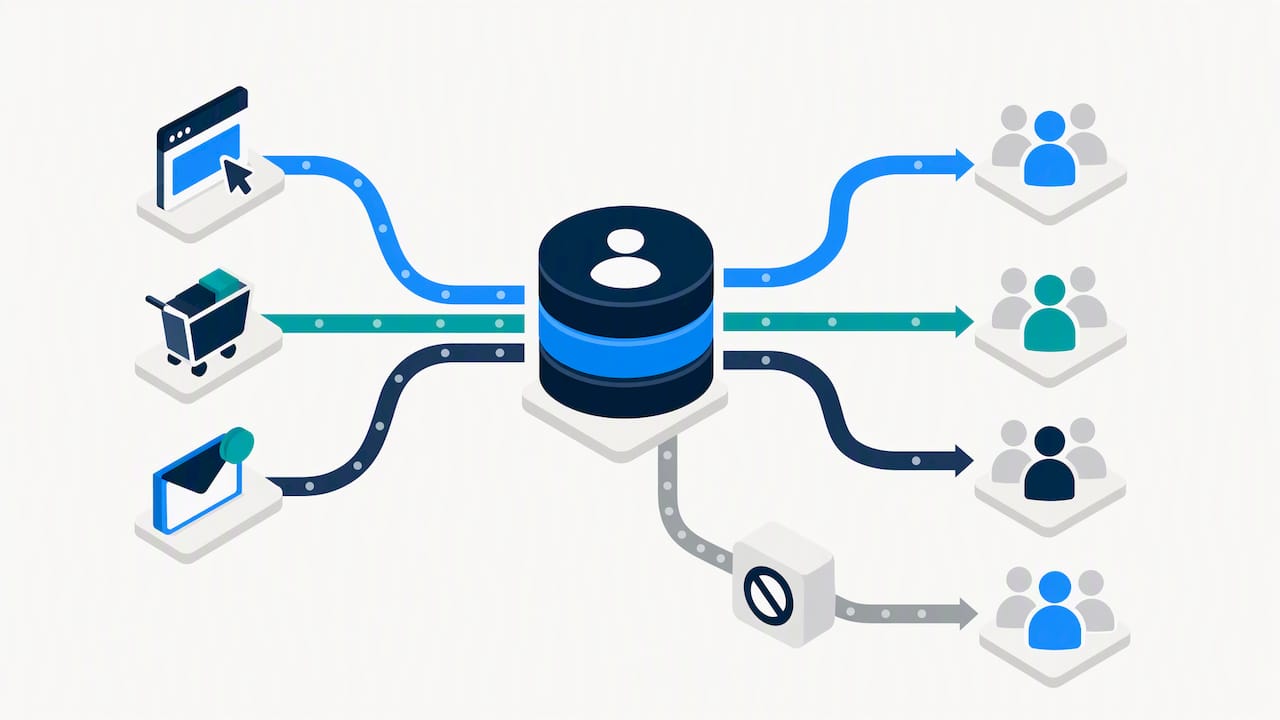
A well-implemented CDP lets marketing teams build audience segments based on actual funnel position (new visitor, engaged browser, repeat purchaser) rather than platform-specific proxies that rarely align across channels. This is also the foundation for coordinating frequency and sequencing: if the CDP flags that a customer has already converted, that signal should suppress conversion-stage ads and surface retention-stage content instead.
Data management discipline matters as much as the platform itself. Clean, deduplicated, correctly tagged data determines whether segmentation and personalisation actually work, or whether they quietly degrade into guesswork. For ecommerce brands running paid media, email and SMS simultaneously, the CDP (or an equivalent unified data layer) is typically the single highest-leverage investment for making full-funnel targeting precise rather than approximate.
Automation and AI in personalising funnel stages
Automation and AI have changed how quickly a full-funnel programme can personalise messaging by stage, audience and even individual behaviour. Lifecycle email and SMS platforms such as Klaviyo now support automated flows that trigger based on funnel position: a browse-abandonment flow at consideration, a cart-recovery sequence at conversion, a win-back flow at the retention stage, each running without manual intervention once set up.
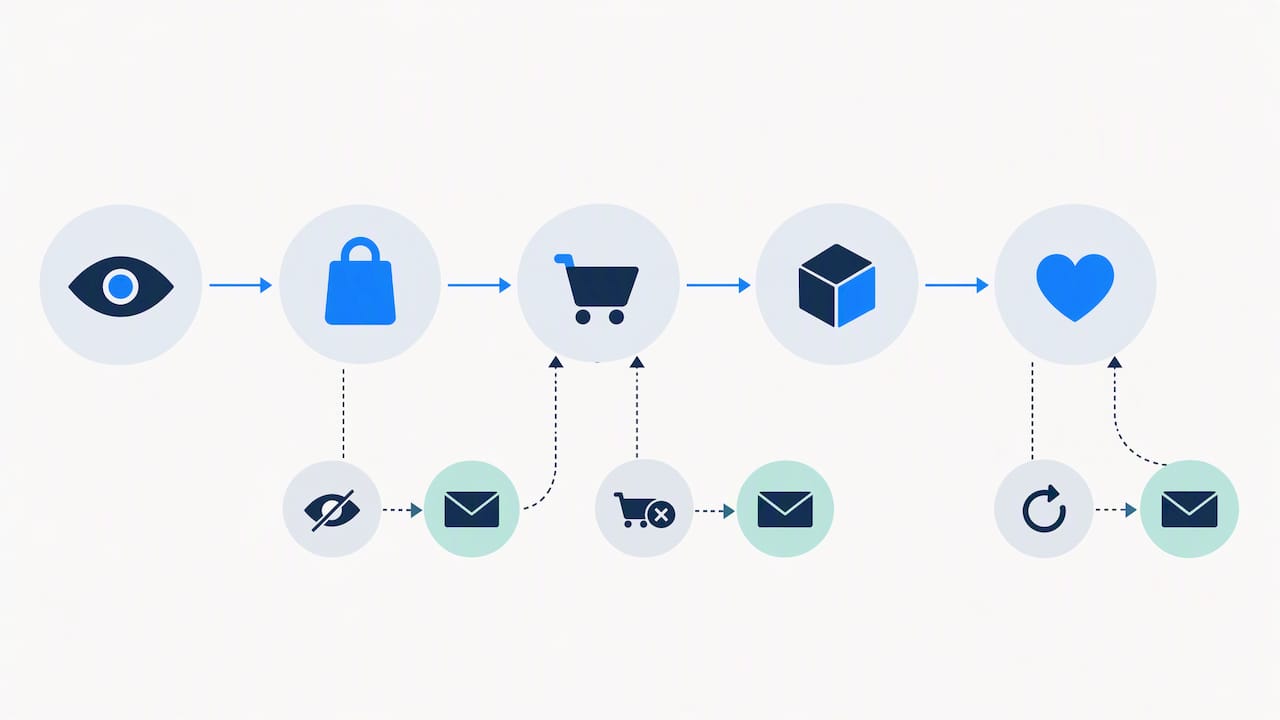
AI-powered creative tools extend this further, generating and testing ad variants at a pace manual production cannot match, which supports the kind of rapid creative testing that upper-funnel teams have historically lacked compared with performance marketers. AI-powered segmentation also improves targeting precision, identifying patterns in purchase behaviour that inform which audience should see which message at which stage.
The caution here is that automation should sit on top of a clear funnel strategy, not replace one. An automated flow sending the wrong message to the wrong stage simply scales a mistake faster. Used well, AI and automation are what make personalised, stage-appropriate messaging operationally feasible across thousands of customers rather than a handful of manually managed segments.
Aligning sales and marketing teams in a full-funnel approach
Full-funnel marketing breaks down when sales and marketing operate on different definitions of a qualified lead or a successful outcome. If marketing is measured on awareness metrics while sales is measured purely on closed revenue, neither team has an incentive to coordinate on the stages in between.
The fix starts with shared definitions: what counts as a marketing-qualified lead, what counts as sales-ready, and which team owns each handoff. For ecommerce specifically, this often translates into shared ownership of post-purchase retention, where marketing’s lifecycle email and SMS work directly supports the repeat revenue that commercial teams are accountable for.
Regular joint reviews of funnel performance, rather than separate marketing and sales reporting lines, keep both teams accountable to the same outcomes. IPA’s Marketing Effectiveness Roadmap found that a dedicated approach to Focus, Process, People and Data, including cross-functional ownership and shared data access, measurably improves perceived marketing effectiveness. Full-funnel programmes that succeed tend to have this kind of structural alignment rather than relying on goodwill between departments.
Emerging technologies reshaping full-funnel marketing
Chatbots have moved from a basic customer-service tool to an active consideration-stage asset, answering product questions in real time and guiding undecided visitors towards a purchase decision without waiting for a human response. This shortens the gap between consideration and conversion, particularly for higher-consideration purchases where a shopper has specific questions a static product page cannot answer.
Augmented reality is making a similar shift at the consideration stage for categories like furniture, beauty and fashion, letting shoppers visualise a product before buying, which reduces the uncertainty that often stalls a purchase decision. Virtual reality remains more niche in ecommerce but is being tested for immersive brand experiences at the awareness stage, particularly by larger retail brands.
None of these technologies replace the fundamentals of a full-funnel strategy, clear stage objectives, synchronised creative and credible measurement. They extend what is possible within each stage: a chatbot still needs to be fed the right messaging for where a customer sits in the journey, and an AR tool still needs to connect back to the same conversion tracking as every other channel. Treated as isolated gadgets, they add complexity without return; integrated into an existing funnel strategy, they can meaningfully shorten the path from consideration to purchase.
Author perspective: leading full-funnel transformation
The hardest part of full-funnel transformation is rarely the media plan, it is governance. Brand and performance teams need shared incentives before shared budgets mean anything. Bring finance into the conversation early, because marginal-return thinking only works if budget holders trust the measurement behind it. Start capability investment with three things: a consolidated analytics view, a creative testing process for upper-funnel assets, and a clear review cadence that holds both sides accountable to the same number.
How Evolve Commerce can help you build a full-funnel engine
If the gap in your current marketing is coordination rather than effort, that is exactly what we are built to close. We run paid media, performance creative production, email and SMS marketing, and search visibility as one connected system, measured through our own AdWize analytics dashboard rather than four disconnected platform reports.
- Paid media across Google, Meta, TikTok and other platforms, planned by funnel stage rather than channel in isolation.
- Performance creative production, including video and AI-powered editing, built for Super Touchpoint-style synchronisation across placements.
- Email and SMS marketing on Klaviyo, automating the retention stage that most full-funnel plans underinvest in.
- AdWize analytics, giving you server-side attribution and AI-powered performance insights in one dashboard instead of five.
If you want a structured read on where your current funnel is leaking value, our AdWize plans start at £49 per month and scale up to £149 and £249 per month depending on the depth of analytics and support you need.
FAQ
What is a full marketing funnel?
A full marketing funnel is a connected model of the customer journey from first brand awareness through to repeat purchase, spanning paid, owned and earned channels. It treats brand-building and performance marketing as parts of one system rather than separate budgets, so upper-funnel activity feeds the audiences that lower-funnel campaigns convert.
What are the stages of the marketing funnel?
The core stages are awareness, consideration, conversion and retention or loyalty. Awareness builds reach and recall, consideration nurtures intent through content and engagement, conversion closes the transaction, and retention drives repeat purchase and long-term customer value.
What is the 3-3-3 rule in marketing?
Definitions of the 3-3-3 rule vary across marketing sources and it is not a standardised industry framework. It is typically used informally to describe testing three audiences, three creative variants and three messaging angles, rather than referring to a specific, agreed methodology.
What is full-funnel advertising and how does it work?
Full-funnel advertising coordinates paid media across every stage of the customer journey, using awareness-focused formats like video and display, consideration-stage retargeting and content, and conversion-focused search and shopping ads. It works by sequencing these so each stage builds the audience the next stage converts, measured through a combination of marketing mix modelling, conversion lift tests and calibrated attribution rather than last-click reporting alone, as recommended in the IAB UK’s measurement guidance.
Sources
- Unlock effectiveness across the customer journey
- Why every business needs a full-funnel marketing strategy
- Measurement 360: Building a suite of truth
- About consent mode