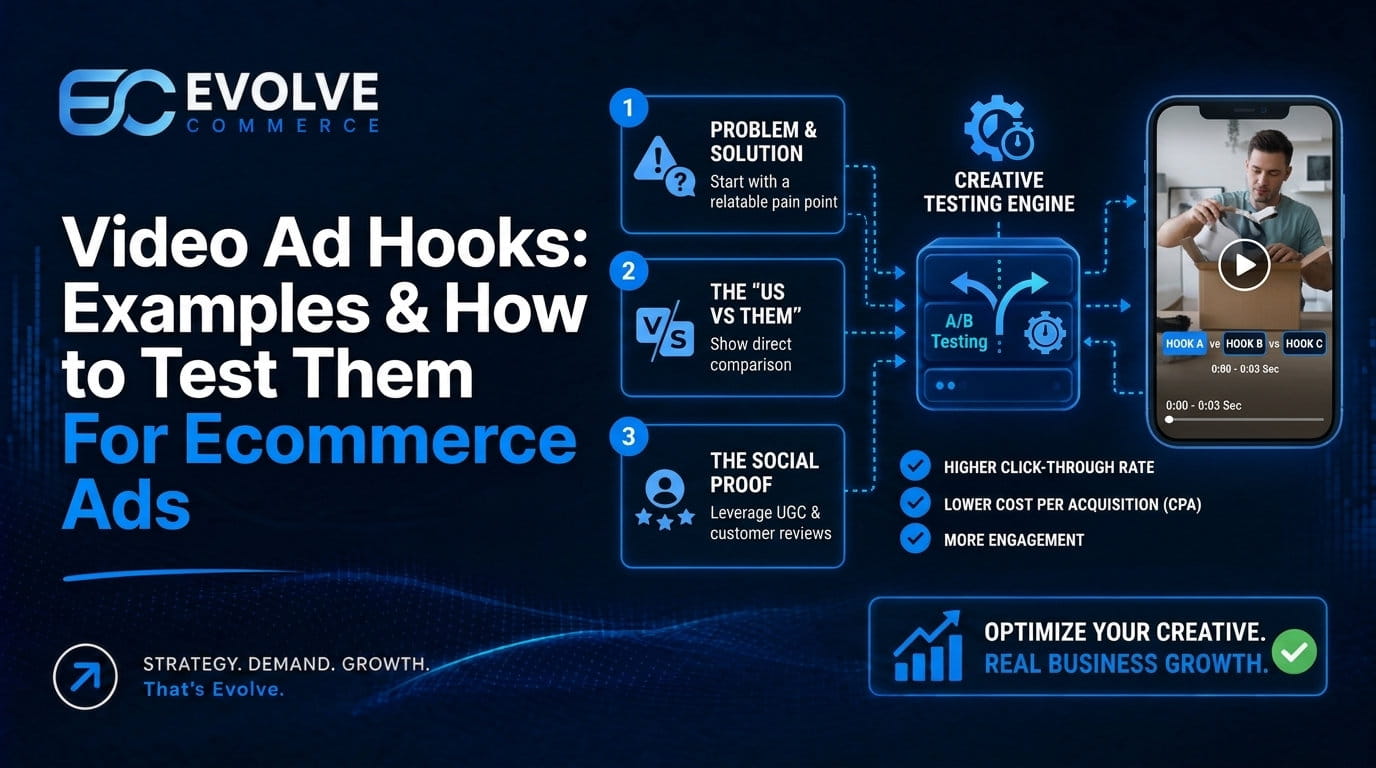
A video ad hook is the opening moment of an ad, the first line, image or action that makes someone stop scrolling and keep watching. The brands that get the most from video ads treat hooks as a testing programme, not a creative guess: they build several distinct openings, run them under identical conditions and judge them on the right metrics in the right order. This guide gives you the hook types worth trying for ecommerce, examples you can adapt, and a test design that produces a result you can trust.
- Most of an ad’s impact is decided early: a TikTok study of 150 ads found 90% of total ad recall is captured within the first 6 seconds.
- Build hooks from six families (problem, curiosity, proof, comparison, audience call-out, offer) and change only the opening between variants.
- Test fairly: same audience, placement, budget, landing page and start time, with the winning metric chosen before launch.
- Read metrics in order: early attention first, then retention and clicks, then cost per purchase as the decider.
- A strong hook only pays back if the rest of the ad delivers what it promised.
Table of Contents
- What a hook has to do
- Six video ad hook types for ecommerce
- Hooks you can shoot with creators
- How to choose which hooks to build first
- How to test video ad hooks fairly
- Common hook mistakes
- Producing hooks at volume
- Where Evolve Commerce fits
- Our perspective
- FAQ
- Sources
What a hook has to do
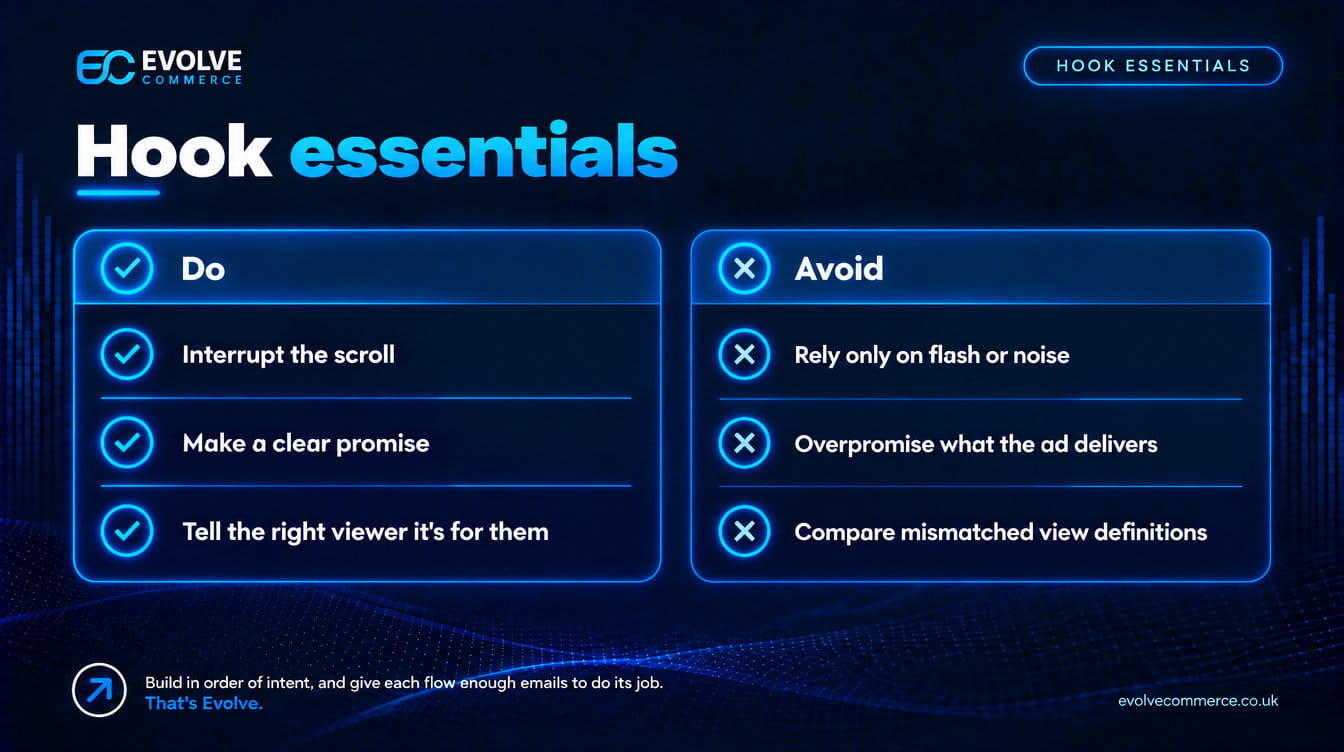
A hook has three jobs in a very short window. It interrupts the scroll, it makes a clear promise about what the viewer will get, and it tells the right person the ad is for them. An opening that does only the first job, a flashy transition or a loud noise, tends to earn views from people who never buy.
The promise matters as much as the interruption. The same Toluna research found that when the rest of an ad exceeds the expectation the hook set, viewers showed 1.9 times more brand love and credibility and twice the purchase intent. A hook that over-promises borrows attention you then pay back in lost trust.
It helps to separate two ideas that are often blurred. The hook is the creative opening. The hook rate is a metric. In this guide we define hook rate as three-second video views divided by impressions, and we always record that definition, because platforms and tools label similar numbers differently. If you compare your figures with someone else’s, check the numerator, denominator and time threshold match.
Six video ad hook types for ecommerce
Most hooks that work for online retailers fall into a handful of families. The examples below are templates written for a fictional collapsible water bottle. Swap in your own product, customer language and proof.
1. Problem hooks
Name a frustration the buyer already feels, in their words.
“If your water bottle takes up half your carry-on, watch this.”
Why it works: the viewer recognises themselves before they have thought about whether they are interested. It suits products that solve an everyday annoyance. Show the problem on screen in the first second, not just in the voiceover.
2. Curiosity hooks
Open a question the viewer wants answered.
“I bought this as a joke. Now I own three.”
Why it works: an unfinished story is hard to leave. The catch is that the video has to pay the question off quickly, otherwise the curiosity turns into irritation. Omniconvert’s review of UK ecommerce ads for September 2026 found curiosity-gap openings in 17.6% of the ads it analysed, so this is a familiar pattern to your audience. Familiarity is a reason to make your version specific, not a reason to avoid it.
3. Proof and demo hooks
Start with the result.
“Watch what happens when I drop it full of water.”
Why it works: the benefit is visible and needs no explanation. This is the natural choice for tactile or visual categories such as fashion, beauty, homeware and food, where seeing the product in use does the persuading. Begin on the action, not on a logo or an establishing shot.
4. Comparison hooks
Place the product against a generic alternative.
“Standard plastic bottle versus a collapsible one in a packed backpack.”
Why it works: it frames the buying decision for the viewer. Compare against a category or an old habit rather than a named brand, which keeps the ad cleaner and avoids claims you would have to substantiate about a specific competitor.
5. Audience call-out hooks
Tell a defined group the ad is for them.
“If you only ever travel with hand luggage, this is for you.”
Why it works: it qualifies the viewer in the first line, which tends to raise the quality of the clicks even if it narrows the reach. Omniconvert flagged identity-led angles in 21.9% of UK ads in its September 2026 sample, and suggests testing an ad written for one named shopper, such as the ‘Created for little dreamers’ line it cites from a children’s brand.
6. Offer hooks
Lead with the deal, the price or what is included.
“Everything you get for £35.”
Why it works: for warm audiences and retargeting, the offer is the message. Use it with a real date or a real quantity limit. Omniconvert suggests testing an offer line that carries a real calendar date against vague wording such as “limited time”, and invented scarcity is a claim you do not want to defend.
Hooks you can shoot with creators
If you produce creator-style content, hooks are often cheaper to shoot than to storyboard. Steve Hutt of Ecommerce Fastlane argues that a hook has to earn attention and permission: attention to stop the scroll, and permission to continue the story. His guide lists five triggers (curiosity, relatability, visual novelty, credibility and momentum) and five formats that ecommerce teams can shoot quickly:
- Disarming humour: a “POV” line that admits you promised yourself you would stop buying a certain kind of product.
- An unusual camera angle: the camera inside a gym bag as the zip opens.
- Handwriting on screen: a hand-written list such as “3 reasons I ditched my old brand”.
- A comment reply: answering “Does it actually work for this?” with the short answer and the proof.
- An honest opener: acknowledging the video is sponsored and saying what surprised the creator.
Creator formats carry weight with viewers. In the Toluna study, ads featuring creators were 1.7 times more likely to hook a viewer than ads featuring celebrities, and showing creators from the outset lifted ad recall by 32%. The same research links a logo at top-centre during the hook to a 24% lift in brand awareness, and text overlays in the first five seconds to a 26% lift in brand love. These are findings from TikTok tests across several countries including the UK, so treat them as strong starting hypotheses for your own tests rather than guarantees.
For a deeper look at running creator content as a repeatable system, see our guide to a UGC ads strategy that tests, learns and scales.
How to choose which hooks to build first
Do not start with twenty hooks. Start with a short list chosen on evidence you already have.
- Read your customer language. Reviews, support tickets and returns reasons contain the problems and phrases that make the best problem and audience hooks.
- Match the category. A visual product suits a demo opening. A product with a hidden benefit may suit curiosity or comparison.
- Pick three to five hooks from different families. Testing five versions of the same problem line tells you little. Testing a problem, a proof and an offer opening tells you what kind of message your audience responds to.
- Keep everything after the opening identical. The body, call to action, offer and landing page stay fixed so the hook is the only variable.
Across the UK sample, many ads settle into the same few formats, such as short vertical montages of four to five clips. If everyone in your category opens the same way, a convention-breaking variant is usually the most informative test you can run.
How to test video ad hooks fairly
Hook testing is where most teams lose the value of good creative. The failure is rarely the idea. It is a test where one variant ran on a Tuesday and another during a sale week, or where the winner was picked on whichever number looked best afterwards.
Set the conditions before launch
NerdBot’s guide to hook testing sets out the discipline well. Across variants, keep the same audience definition, geography, placement mix, optimisation event, bid strategy and measurement window, launch them at the same time, and leave your tracking parameters and landing page unchanged during the test. A weekday hook compared with a promotion-week hook is confounded: you cannot tell whether the opening or the week made the difference.
A practical checklist:
- One hook test per audience at a time, so variants do not contaminate each other.
- Equal budget split across variants.
- Same placements, so a variant is not judged on cheaper inventory.
- A test window long enough to include both weekdays and a weekend.
- A written note of the creative files, audience, spend and dates, so you can explain the result later.
Decide the metric hierarchy in advance
Choose your primary metric, your guardrails and your decider before you see any data. A sensible hierarchy for ecommerce:
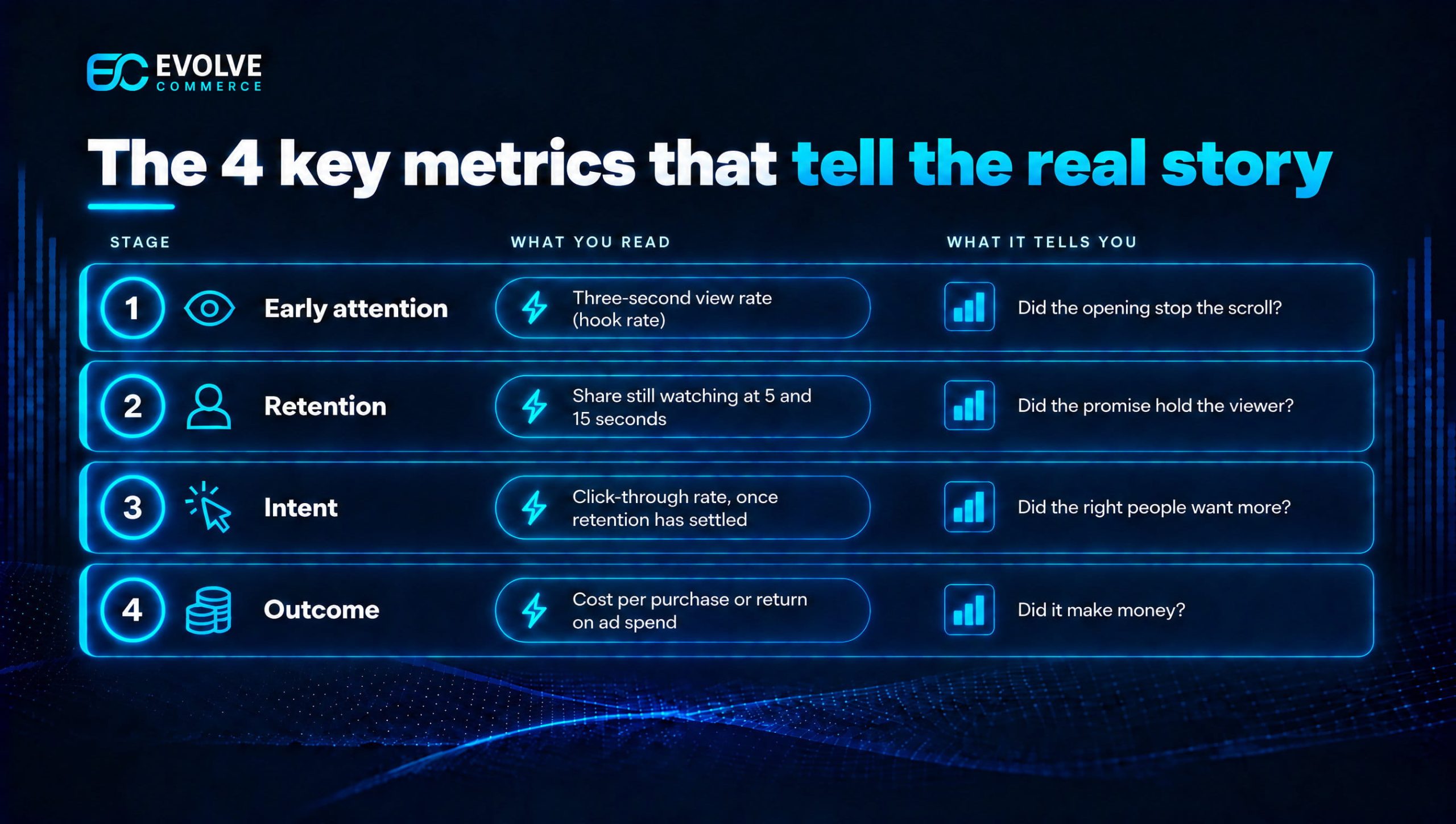
Read the table top to bottom. Cost per purchase is the decider, but in a short window auction randomness can flatter or punish a hook, so it is the last thing to judge, not the first. If one hook wins attention but loses qualified clicks, report that trade-off. Do not switch to whichever metric favours the creative you preferred.
Give each hook enough volume
There is no universal sample size. The right amount depends on your baseline rates and your spend. What matters is that you set a minimum number of impressions per variant and a minimum duration in advance, and that you do not stop the moment a variant pulls ahead. Early peeking inflates false positives. The only good reasons to stop early are operational ones: a broken landing page, an incorrect claim or a brand-safety problem.
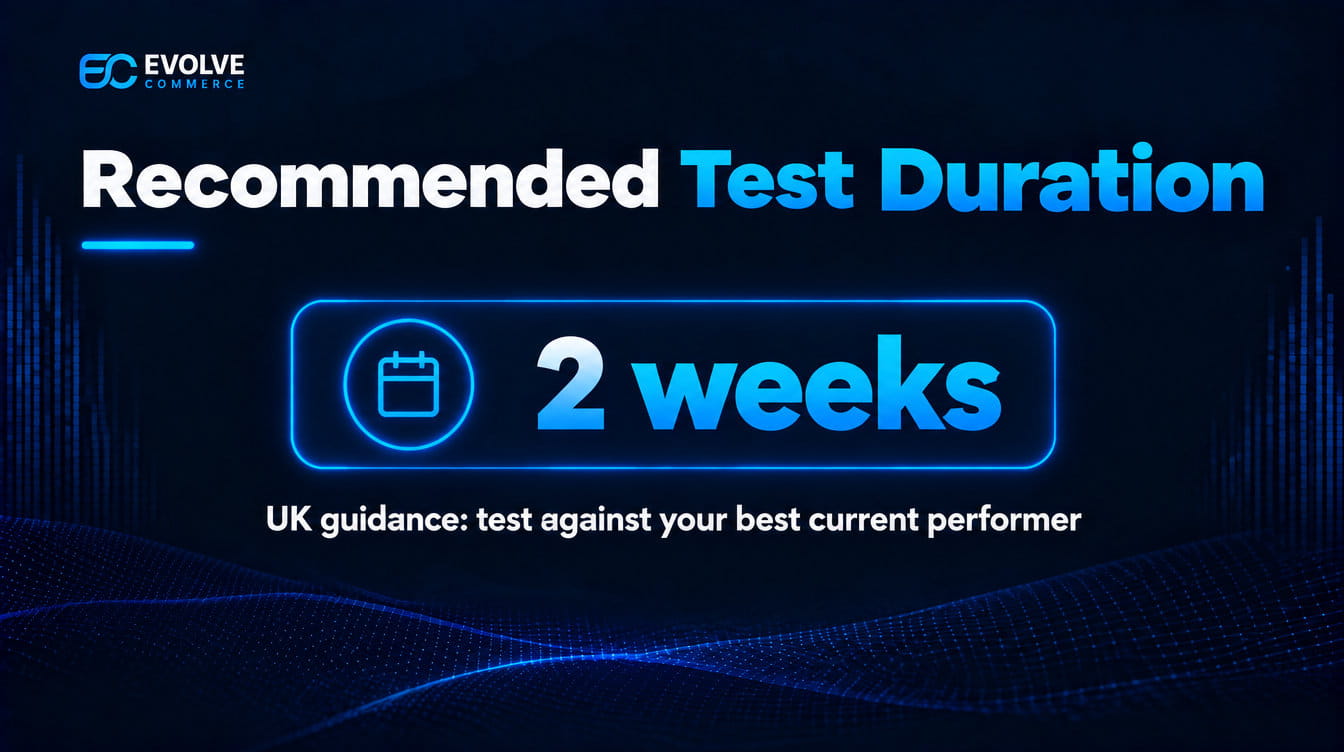
Omniconvert’s UK recommendation gives a realistic shape for an ecommerce test: pit a new format against your best current performer using the same audience and an even budget split for two weeks, judged on cost per purchase.
Use attention data sensibly
Attention measures are useful because they sit close to the outcome. A study from Dentsu, reported by Teads, based on a UK and US mobile panel of 3,005 users and a controlled test of 801, found attention was three times better than viewability at predicting outcomes. That supports putting attention metrics at the top of your hierarchy, as long as you confirm the effect on purchases downstream.
Turn results into the next round
A test is only finished when it changes the next brief. Record which family won, then test inside it: the same proof hook with a different first frame, a different first line or a different creator. Teams that run this loop build a library of what works for their category. For the testing method we use across channels, read our creative testing framework. The same logic applies to message relevance in your wider sales funnel, which these funnel management strategies cover from the sales side.
Common hook mistakes
- A hook the product cannot cash. If the opening promises a transformation the ad never shows, retention collapses in the second half.
- A slow brand intro. Opening on an animated logo spends the most valuable seconds on the least interesting content. Place the brand mark in the frame during the action instead.
- Testing too many variables. If the hook, the offer and the music all change, you have learned nothing about the hook.
- Reading cost per purchase too early. Judging on conversions after a few hundred impressions rewards luck.
- Treating a winner as permanent. Hooks fatigue as audiences see them repeatedly, so plan a steady supply of new openings rather than one big test.
- Skipping sound-off. Many viewers watch without sound, so the hook should work through picture and on-screen text, with the voiceover as a bonus.
Producing hooks at volume
The testing approach above only works if you can make enough distinct openings. That is a production problem as much as a strategy problem: each hook needs a shot list, a cut and a fresh export, ideally across several aspect ratios and platforms. If you are planning how to scale variants, our brief on AI video editing for agencies covers how to specify variant volume. For platform specifics, see our TikTok ads strategy guide for ecommerce.
Where Evolve Commerce fits
Our performance creative production covers video ads, brand content and AI-powered editing, and our paid media team manages campaigns across Google, Meta, TikTok, Microsoft, Snapchat, Reddit and other platforms. That means hooks are built, launched and read inside one system rather than passed between teams. AdWize, our analytics dashboard, brings server-side attribution and AI-powered performance insights together so you can see which opening drove revenue, not just views. AdWize plans are published at £49 per month (Starter), £149 per month (Accelerator) and £249 per month (Scale), and the managed services are scoped individually.
If you want a view of how your current creative and tracking are performing, start with the Evolve Commerce services overview, or look at AdWize plans.
Our perspective
Hooks are the cheapest lever in paid social, and the most often mismanaged. A new opening costs a fraction of a new campaign, yet many brands test them casually and then argue about the results.
We treat a hook as one part of a full-funnel system. The opening earns the view, the body earns the click, and the landing page and lifecycle flows earn the purchase and the second purchase. A hook that wins on attention but sends the wrong people to your site is not a win, which is why we read creative results against revenue and not against views alone.
That is the reasoning behind our approach: performance creative production, paid media management and analytics working together, so each test has a clear question, clean conditions and a result tied to sales. Our clients have achieved annual revenue growth between 130% and 450%, and disciplined creative testing is a central part of how we pursue that.
The practical advice is simple. Build hooks from different families, keep the rest of the ad fixed, decide your metrics before launch and give every variant a fair run. Then feed the winner into the next brief.
Evolve Commerce
FAQ
How long should a video ad hook be?
The hook is the opening few seconds, and the first three are the usual measurement window on Meta. The Toluna TikTok study found that 90% of ad recall is captured in the first six seconds, so make the opening land quickly and keep the promise running through that window.
How many hooks should I test at once?
Three to five hooks from different families is a manageable start for most ecommerce budgets. Run them against the same audience with the same budget split and keep everything after the opening identical. More variants need more spend to reach a reliable reading.
How do I know a hook has really won?
A hook has won when it beats the others on the metric you chose before launch, after every variant has reached the minimum impressions and the full test window. Check retention and click quality as well as hook rate, and confirm the result on cost per purchase.
Can I reuse a winning hook?
Yes, but audiences tire of repeated openings. Reuse the winning idea, not the exact clip: keep the hook family and the promise, then change the first frame, wording or creator and test again.
Sources
- Strategic storytelling: building brand success through effective hooks (Toluna)
- UK eCommerce Ads, Sept 2026: Top Hooks & Angles (Omniconvert)
- 5 UGC Hooks For Ecommerce Video Ads (Ecommerce Fastlane)
- Test and Optimize Ad Hooks Faster (NerdBot)
- Latest Results From dentsu’s Attention Economy Study (Teads)