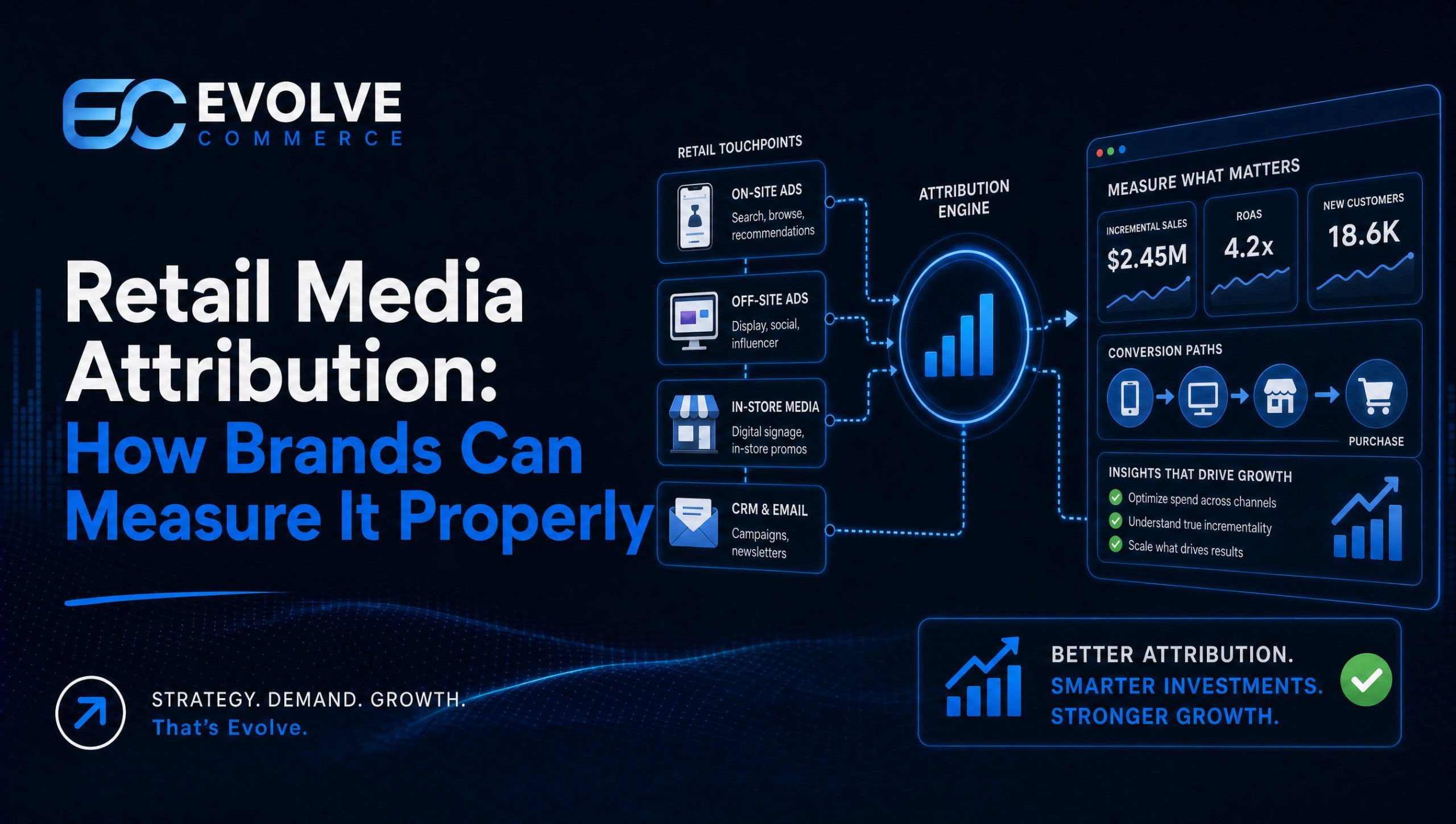
Retail media attribution links an advert shown on or through a retailer’s network to a sale recorded in that retailer’s own data. It is the main reason brands invest in retail media networks (RMNs), and it is also the part most often over-trusted. The numbers in a retailer’s dashboard describe what the retailer can see, on the retailer’s terms. They do not always describe what your advertising caused.
This guide explains how attribution works in retail media, where it misleads, and how a UK brand can build a measurement approach that holds up in a budget meeting. It also covers the questions people ask under the heading of retail media measurement: windows, incrementality, gross versus net sales and independent verification.
- Retail media attribution assigns credit for a purchase to the ad exposure that preceded it, using the retailer’s first-party data, often from a loyalty scheme.
- Attribution tells you a sale followed an ad. Incrementality tells you whether the sale would have happened anyway. You need both.
- Check the attribution window, the gross or net sales basis and the treatment of in-store sales before you compare ROAS between retailers.
- Retailer dashboards are one input. Pair them with your own analytics, a holdout test and a wider view of the marketing mix.
- Brands running several channels at once need one source of truth, not a stack of platform-reported figures that each claim the same sale.
Table of Contents
- What retail media attribution actually measures
- Why the numbers differ between retailers
- Attribution versus incrementality
- A measurement framework you can use this quarter
- In-store sales and the halo effect
- Retail media for brands that also sell direct
- Our view: attribution is a decision tool, not a verdict
- Where AdWize fits
- What to ask a retail media network before you spend
- FAQ
- Sources
What retail media attribution actually measures
Attribution is the process of deciding which marketing touchpoints deserve credit for an outcome such as a purchase. Retail media has a structural advantage here. The retailer owns the checkout, so it can connect an ad impression or click to a transaction without relying on third-party cookies.
In the UK, much of this rests on loyalty data. ITV’s Matchmaker solution, built with Tesco and Boots, matches registered audiences with loyalty databases so that FMCG advertisers can measure sales uplift from exposure. This is what people mean by closed-loop measurement: the ad, the audience and the sale all sit in one data environment.
That closed loop is genuinely valuable. It is also a closed loop in the other sense. You see what the retailer lets you see, calculated the way the retailer calculates it.
The building blocks
Every retail media attribution report is assembled from the same few decisions:
- The conversion event. A sale of the advertised product, a sale of any product from your brand, or a sale of any product in the basket.
- The attribution window. How many days after a click or a view a purchase still counts. A report using a 14-day window will show more sales than one using 7 days, from the same campaign.
- Click versus view credit. Whether a sale counts when the shopper only saw the ad, or only when they clicked it.
- The sales basis. Gross sales count a purchase at the point of transaction. Net sales remove returns, cancellations and refunds.
- The channel scope. Online only, or online plus in-store purchases matched through a loyalty ID.
Change any one of these and the same campaign produces a different ROAS. That is why comparing a figure from one network with a figure from another is rarely a like-for-like exercise.
Why the numbers differ between retailers
Brands that buy across several networks often meet what The Media Leader describes as a patchwork: metrics defined differently from one RMN to the next, attribution windows that vary without clear justification, and ROAS figures that may or may not account for returns and cancellations.
The gross versus net question deserves particular attention. The same trade coverage reports an average gap of around 20% between gross and net sales figures. If one network reports gross and another reports net, a ROAS of 5.0 on one is not equivalent to 5.0 on the other. Ask the question in writing before the campaign starts, not after the report arrives.
Standards are catching up
The industry knows this is a problem. The IAB Europe Retail Media Measurement Standards set out a common approach for European networks, and an explainer from IAB Europe clarifies that they cover on-site and off-site activations, including sponsored product, display and video ads and their attribution metrics. In the United States, the IAB and MRC guidelines deal with outcome metrics for online and offline ad activity.
The practical point for a UK brand is transparency. Under the second version of the European standards, retailers are expected to disclose how they extrapolate sales to users they cannot identify, including the metrics used and how cash or untraced transactions are handled, as The Media Leader reports. When a network cannot explain its extrapolation method, treat its in-store figures as an estimate, not a fact.
Tesco is one example of a network moving in this direction. It has presented a full-funnel measurement framework with incremental insight for advertisers, and said omnichannel attribution would follow in 2025. Whatever a network promises, the brand still owns the job of checking the output against its own numbers.
Attribution versus incrementality
This is the distinction that separates a useful measurement plan from a flattering one.
| Attribution | Incrementality | |
|---|---|---|
| Question answered | Did a sale follow an ad? | Would the sale have happened without the ad? |
| Typical method | Matching exposure to transactions | Test and control groups, geo splits, holdouts |
| Main risk | Credits sales that were already coming | Needs volume, time and careful design |
| Best used for | Daily optimisation and reporting | Budget decisions and channel comparison |
The IAB’s guidance on advanced measurement names incrementality as essential to measuring true marketing impact, particularly inside a retailer’s closed-loop environment. It also flags walled gardens and siloed data as obstacles to cross-channel measurement.
Here is why it matters. A shopper who already buys your cereal every week and then sees your sponsored product ad before checkout will be attributed to the ad. Did the ad change the outcome? Probably not. Branded and bottom-of-funnel placements are where this overcounting is most severe, and they are often the placements with the most impressive ROAS.
A worked example
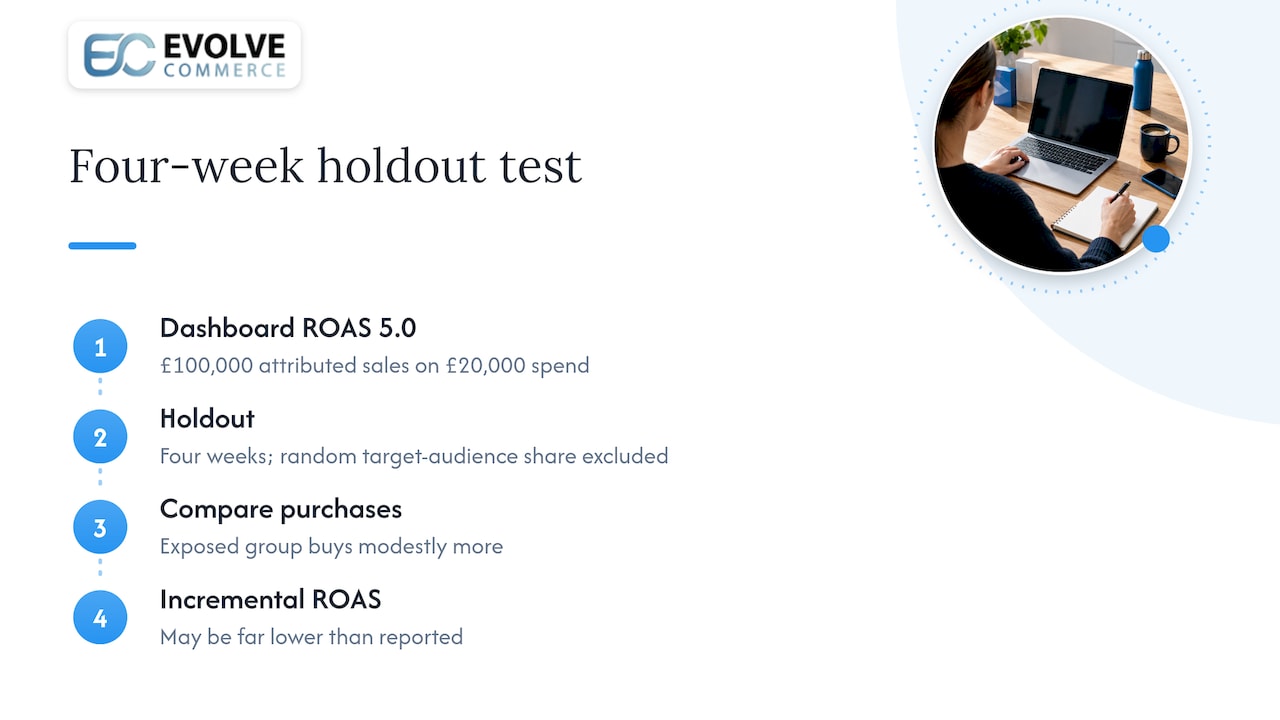
Imagine a brand spending £20,000 in a month on sponsored search inside a grocer’s network. The dashboard reports £100,000 in attributed sales, a ROAS of 5.0. That sounds excellent.
Now the brand runs a holdout: for four weeks, a randomly chosen share of its target audience is excluded from seeing the ads. If the exposed group buys only modestly more than the held-out group, most of those £100,000 in sales would have happened regardless. The true incremental ROAS might be far lower, perhaps still profitable, perhaps not. The numbers here are illustrative, but the pattern is common, and the only way to know your own figure is to test.
A measurement framework you can use this quarter
You do not need a data science team to improve on dashboard-only reporting. Work through these steps.
- Write down the definitions. For every network, record the attribution window, click and view rules, conversion scope and gross or net basis. Put them in one table. Differences will appear immediately.
- Normalise where you can. Ask each network to report on the same window and the same sales basis. Where they cannot, adjust your comparisons, not your assumptions.
- Separate new from existing customers. Where the retailer offers it, split attributed sales into new-to-brand and existing buyers. Growth budgets should chase the former.
- Run one incrementality test per major network each year. A geo split, a holdout audience or a time-based test, designed with the retailer and agreed in advance.
- Reconcile against your own revenue. If total attributed sales across all channels exceed the sales you actually recorded, someone is double counting.
- Review the mix, not just the channel. Retail media competes with search, social, email and marketplaces for the same budget, so judge it against them.
Do not rely on one dashboard
Marketing Week notes that brands relying only on internal retailer reporting risk a blinkered view, since retailers often control their own metrics and windows. The recommended remedy is a holistic, omnichannel approach, often with independent verification, to avoid over-trusting ROAS figures that ignore external variables and organic demand.
Organic demand is wider than it used to be. Shoppers now research products through AI assistants before they reach a retailer’s site, and that influence never appears in a retail media report. Brands building a fuller picture are starting to look at measuring AI visibility alongside paid performance, so that organic influence is not mistaken for ad impact.
In-store sales and the halo effect
Many retail media buyers are really buying store sales. Those are the hardest to attribute. Online exposure has to be matched to a loyalty card or payment identity at the till, and any purchase made without one, including cash, falls outside the identified group. That is exactly why disclosure of the extrapolation method matters.
Halo effects add another layer. An ad for one product may lift sales of another in your range, or lift sales in a different retailer entirely. Closed-loop reporting inside one network usually misses the second effect. A brand-level view, using marketing mix modelling or cross-channel analysis, is the better tool for it. Our guide to planning budgets without cookies using marketing mix modelling explains how that works for ecommerce brands.
Retail media for brands that also sell direct
If you sell through your own store as well as through retailers, attribution gets harder, because your channels now compete and cooperate at the same time. Paid social may create the demand that a retailer’s sponsored ad later captures. Email may bring back a customer who first met you on a marketplace.
For direct-to-consumer ecommerce brands, the same principles apply on your own site:
- Track on the server side so that browser restrictions do not remove conversions from your data.
- Compare platform-reported conversions with your actual orders every week.
- Use blended metrics, such as total revenue against total marketing spend, as a sanity check on channel-level claims.
We cover the approach in more detail in our piece on cross-channel attribution without individual tracking, and on the dashboard metrics that support better budget decisions.
Our view: attribution is a decision tool, not a verdict
We build growth systems for ecommerce and retail brands, and the pattern we see most often is not a lack of data. It is too many versions of the truth. Each platform reports its own conversions, each with its own window and its own idea of credit, and the sum is larger than the business actually earned.
Our position is simple. Retailer reporting is a valuable input, because closed-loop data is some of the best purchase evidence an advertiser can get. But it should be one layer in an integrated system, not the system itself. That means connecting paid media, creative, email and SMS, and search into a single view, with server-side attribution and independent checks so that budget moves are made on evidence the whole team trusts.
In practice we ask three questions of any channel before we scale it. What would have happened without this spend? Does the reported revenue reconcile with the revenue in the bank? And does the creative driving the result keep working as it scales? Attribution answers the second question well and the first one badly, which is why we pair it with testing.
— Evolve Commerce
Where AdWize fits
If your team is stitching together exports from several platforms to answer these questions, AdWize is our analytics platform for ecommerce brands, with server-side attribution and AI-powered performance insights. Plans are published at £49 per month (Starter), £149 per month (Accelerator) and £249 per month (Scale). For brands that want a partner to run the channels as well, our managed paid media, creative, email and SMS services are built around the same measurement approach, and our case studies show how that has worked for other brands.
What to ask a retail media network before you spend
Use this list in your next planning call. A good network will answer every item without hesitation.
- What are the click and view attribution windows, and can we change them?
- Are reported sales gross or net of returns and cancellations?
- How do you treat in-store sales, and how do you extrapolate to unidentified shoppers?
- Can we split new-to-brand from existing customers?
- Will you support a holdout or geo test, and who designs it?
- Are your metrics aligned with the IAB Europe standards?
- Can an independent third party verify the results?
The IAB Europe best practice guidance is a good reference when you write these requirements into a brief, as it recommends tracking impressions, viewability, attention and completion across formats, particularly in omnichannel environments.
FAQ
What is retail media attribution?
It is the practice of connecting an advert on a retailer’s network, such as a sponsored product listing or an off-site ad, to a purchase in that retailer’s data. Credit is given according to rules about windows and click or view exposure. It shows that a sale followed an ad, not necessarily that the ad caused it.
What is the difference between retail media attribution and measurement?
Attribution is one part of measurement. Measurement also includes incrementality testing, reach and frequency, new-to-brand analysis and checks against your own sales data. A sound retail media measurement plan uses all of these, not only the attribution report.
Which attribution window should I use?
Use the window that matches your normal purchase cycle, and use the same one across networks so results can be compared. A fast-moving grocery product has a shorter consideration period than a household appliance. Always confirm whether the figure you are shown is click-only or includes views.
Can I trust a retailer’s reported ROAS?
Trust it as a directional signal and verify it. Confirm the sales basis, since gross and net figures can differ by around 20% on average according to The Media Leader, and back the report with an incrementality test and reconciliation against your own revenue.
Sources
- Measurement in retail media: Why getting it right matters more than ever, The Media Leader
- The Media Leader UK
- Tesco expands retail media offering with new measurement framework, Marketing Week
- ITV AdLabs and Matchmaker with Tesco and Boots, LBB
- IAB Europe Retail Media Measurement Standards
- IAB Europe Retail Media Measurement Standards explainer
- IAB Europe retail media best practices
- IAB/MRC Retail Media Measurement Guidelines
- IAB Retail Media Advanced Measurement and Data Collaboration