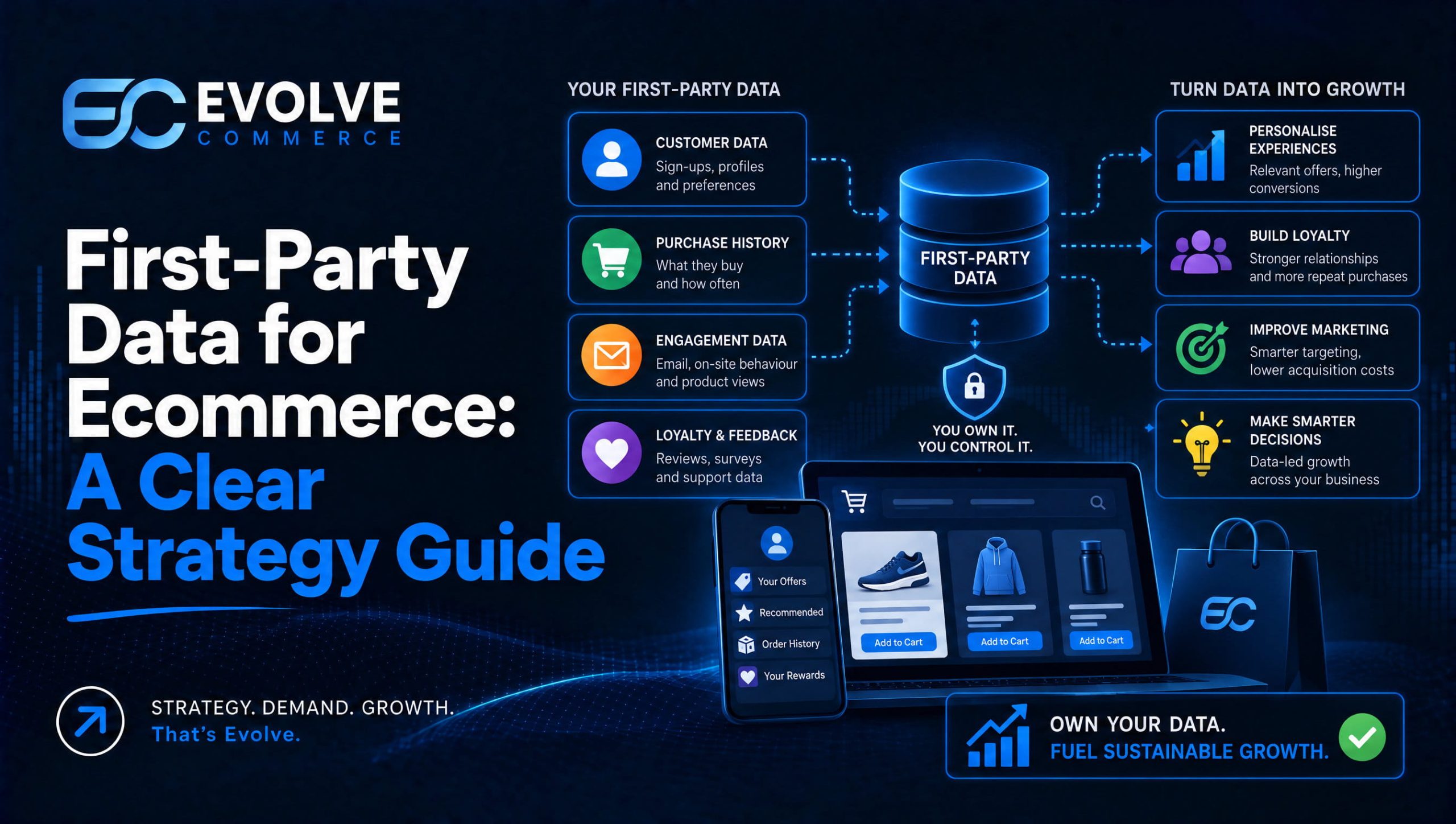
First-party data is the information your customers share with you directly: purchases, email sign-ups, browsing on your own site and responses to your messages. For a UK ecommerce brand it is the most reliable input for targeting, personalisation and forecasting, and it is the one asset a platform or browser change cannot take away. This guide covers what counts as first-party data, how to collect it lawfully, how to turn it into a working strategy, and how predictive lifetime value (LTV) models use it to guide spend.
- First-party data is information collected directly from your customers through channels you own, such as your store, email, apps and forms. It is unique to your business.
- In the UK, UK GDPR sets the lawful basis for processing and PECR sets the consent rules for cookies, tracking and marketing messages. Plan both before you collect anything.
- Start with the commercial decisions you need to make, then work out which data supports them. Do not start with software.
- Predictive LTV models use purchase history to estimate future value, so you can invest more in your best customers and win back the ones slipping away.
- Prove the strategy with holdout tests and incremental revenue, not attributed conversions alone.
Table of Contents
- What first-party data means in ecommerce
- Why it matters more every year
- Collecting first-party data within UK rules
- Building a first-party data strategy that supports growth
- Predictive LTV: turning purchase history into a forecast
- Measuring whether it works
- Our perspective
- Working with us on your data and growth stack
- FAQ
- Sources
What first-party data means in ecommerce
Google’s advertising policies define first-party data as customer information shared directly with a business, gathered from websites, apps, physical shops or other places where customers interact with it. In practice, for an online retailer, that covers a few core sources:
- Transactions: what was bought, when, at what value, with which discount and how it was delivered or returned.
- Onsite behaviour: pages viewed, searches, products added to basket and checkout drop-off.
- Email and SMS engagement: opens, clicks, replies and unsubscribes.
- Customer service and feedback: questions, complaints, reviews and survey answers.
- Loyalty and account activity: sign-ups, points, preferences and wishlists.
Modern Retail’s UK guide for retailers lists similar examples: demographic information, email lists, website time and clicks, customer feedback and purchase history. Shopify’s enterprise blog adds that the data comes from resources the business owns, such as its store, newsletter, apps, social channels and form fills.
How it differs from zero-party, second-party and third-party data
The labels matter because they tell you how much you can trust a data point and how much control you have over it.
| Type | Where it comes from | What it means for you |
|---|---|---|
| First-party | Your own channels and customer interactions | Unique to you, reflects real behaviour |
| Zero-party | Information customers deliberately share, such as preferences or quiz answers | A subset of first-party data, and often the clearest signal of intent |
| Second-party | Another business’s first-party data, shared by agreement | Useful for reach, but you rely on the partner |
| Third-party | Aggregated by external companies with no direct customer relationship | Broad but less precise, and increasingly fragile |
Shopify describes first-party data as more accurate and reliable than other forms of data, while third-party data is aggregated and zero-party data is information customers choose to share. BCG’s research on responsible marketing adds that first-party data is proprietary, relevant and consistent, which is why more mature marketers treat it as a differentiating asset.
Why it matters more every year
The reason to invest is not only accuracy. Rokt argues that the shift is structural, driven by the permanent erosion of third-party signal infrastructure, including browser changes and privacy legislation. Whatever happens to any single platform’s targeting, the customer file you hold is yours.
There is a commercial argument too. Every ad platform you buy from (Google, Meta, TikTok and others) performs better when it receives clean, consented signals from your store. A brand with a tidy purchase history can build lookalike audiences from its best customers, suppress people who have just bought, and send the right email at the right time. A brand without one pays to reach the same people repeatedly and cannot tell which ones were worth reaching.
Collecting first-party data within UK rules
Getting this wrong is expensive, so build the legal groundwork before the collection points. Two pieces of law do most of the work.
- UK GDPR requires a lawful basis for processing personal data. Consent is only one of several, and it is not always required.
- PECR (the Privacy and Electronic Communications Regulations) governs marketing messages, cookies and similar technologies.
The ICO explains that consent is one of several UK GDPR lawful bases, but that where PECR requires consent for a marketing message, consent is in practice the appropriate basis. A UK-focused practitioner guide makes the same split: UK GDPR needs a lawful basis for processing, while PECR requires consent for most non-essential storage and access technologies whatever basis applies to the wider processing.
Cookies and tracking on your own site
A common assumption is that “first-party” means “exempt”. It does not. The ICO says the labels have no inherent meaning in UK GDPR or PECR. What counts is the technology, the organisation responsible and the purpose, and in particular whether information is stored on or read from the visitor’s device. Its cookie compliance material is explicit that non-essential advertising cookies need valid consent before they are used.
For your store, that means your cookie banner must give a genuine choice, and your analytics and ad tags should respect it. Server-side tracking can improve data quality, but it does not remove the need for a valid legal basis and, where PECR applies, consent.
Email, SMS and online advertising
When you use customer data for direct marketing through online advertising, the ICO advises that you must provide clear, concise privacy information, given how many parties are involved. The same guidance warns that inferred information, such as predictions about a person’s interests, can become special category data, for example if it reveals a health condition. If you sell products tied to health, be careful about the segments you build.
UK email teams are also adjusting to a changing data protection landscape. This overview of UK GDPR and EU GDPR differences is useful if you send to both UK and EEA customers and need to know where the rules diverge.
A written data map comes first
The same practitioner guide advises that a robust strategy begins with a written data map, defined lawful bases and specific retention rules, rather than relying on technology alone. A one-page version is enough to start:
- List every place you collect data (checkout, newsletter pop-up, account area, reviews, support inbox, SMS keyword).
- For each, note what you collect and why.
- Record the lawful basis and, where needed, the consent wording.
- Set how long you keep it and who can access it.
Building a first-party data strategy that supports growth
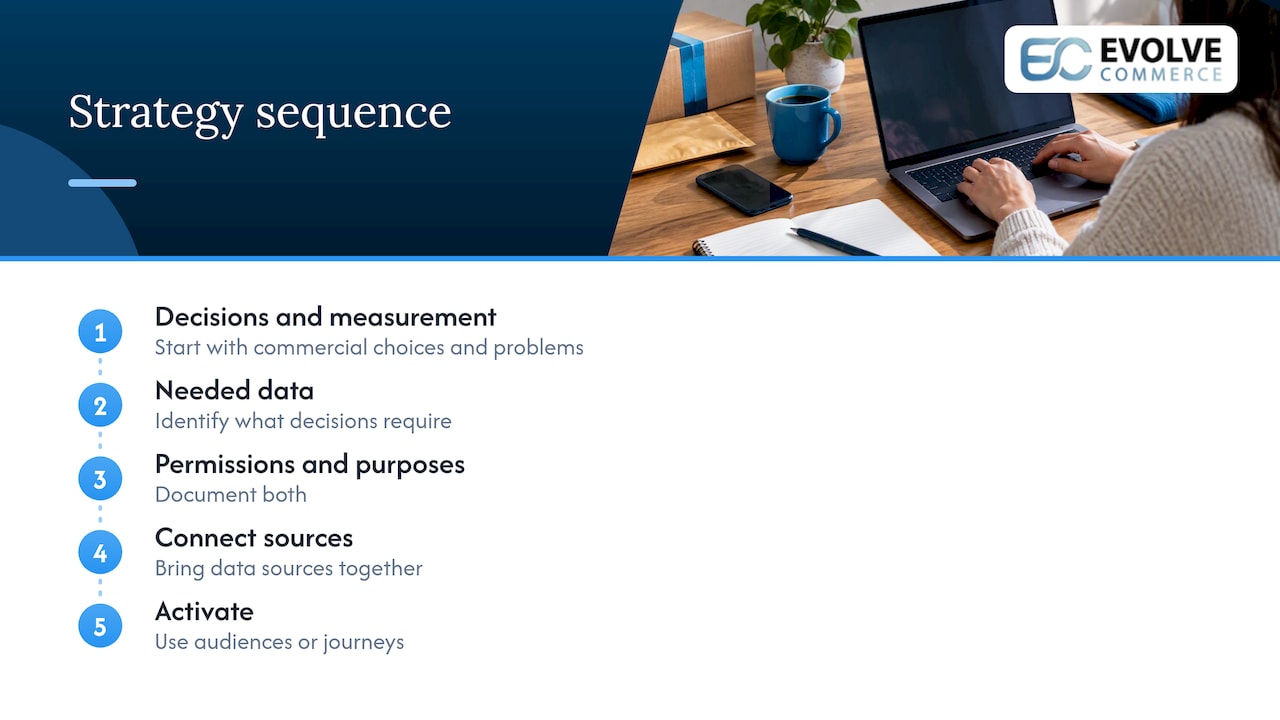
Most ranking guides on this topic walk through definitions, then collection tactics. The step that separates a strategy from a data pile is the order of work. KPMG’s retail guidance recommends beginning with commercial decisions and measurement problems, then identifying the data you need, documenting permissions and purposes, connecting sources and activating audiences or journeys. A UK practitioner view agrees that strategy should precede software: define the decisions and purposes before choosing a customer data platform (CDP).
Step 1: Name the decisions
Write down three to five decisions the data should improve. For example:
- Which customers should we spend more to acquire, and which should we stop chasing?
- When should a first-time buyer receive a second-purchase prompt?
- Which products lead to repeat orders?
- Which channels deserve more budget next quarter?
Step 2: Prioritise the signals that get used
Outra’s UK marketer guide, drawing on Klaviyo, suggests that brands prioritise high-value signals like purchase history, email engagement and onsite behaviour and deprioritise data that is never used. This is also the best guard against over-collection. Every extra field adds legal and operational weight, so collect it only if a named decision depends on it.
A practical way to apply this is to ask zero-party questions where they help the customer. A short quiz on skin type, size or gift occasion gives you a clear, consented preference and gives the customer better recommendations in return.
Step 3: Connect the sources
Shopify and Klaviyo both stress that unifying data in a central system, such as a CRM or CDP, avoids silos and gives a 360-degree view of the customer. For many UK brands, a well-configured ecommerce platform plus an email and SMS platform is enough to start. The crucial work is consistent identifiers (one customer, one record across store, email and support) and clean product and order data.
Step 4: Activate it in the channels that pay
The data only earns its keep when it changes what customers see. The highest-return activations for most ecommerce brands are:
- Lifecycle email and SMS: welcome, post-purchase, replenishment and win-back flows driven by purchase behaviour. See our guide to a three-email win-back flow and our post-purchase experience guide.
- Paid media audiences: customer lists and purchase events fed back to ad platforms, with recent buyers suppressed.
- Segmentation: grouping customers by recency, frequency and monetary value. We cover this in UK ecommerce segmentation with RFM.
- Onsite personalisation: recommendations and messaging by segment or behaviour.
Predictive LTV: turning purchase history into a forecast
This is where first-party data becomes a planning tool. IBM defines customer lifetime value (CLV, also called LTV) as the total worth or profit a customer brings over the full relationship. Historical LTV records what a customer has already spent. Predictive LTV estimates future spend using historical data and an algorithmic model, and can draw on relationship length, purchase frequency and acquisition cost.
How the models work
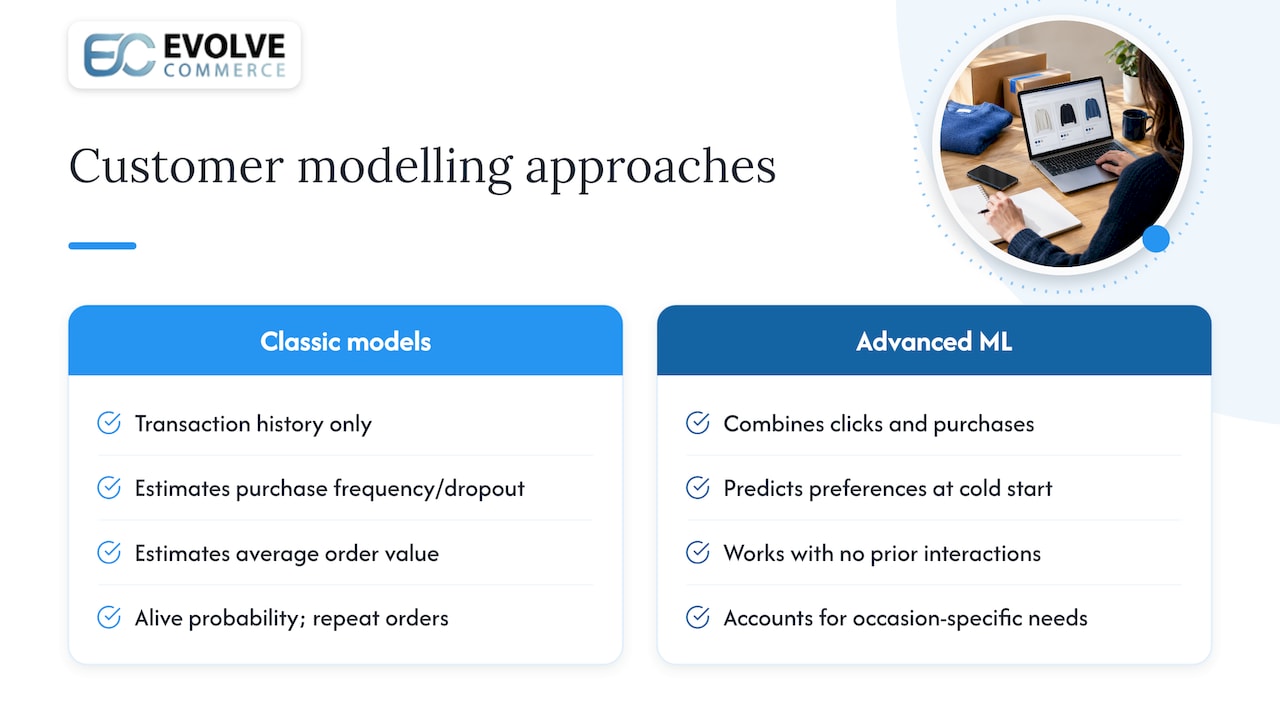
The common approach for non-contractual retail, where customers can buy or leave without telling you, uses transaction history only. Open-source examples pair the BG/NBD model, which estimates purchase frequency and the chance a customer has dropped out, with the Gamma-Gamma model, which estimates average order value. A practitioner write-up describes how these use recency, frequency and monetary value to model purchasing behaviour and dropout. Another worked example explains that these models can estimate a customer’s probability of being alive and predict repeat orders. Treat these write-ups as worked illustrations of the method rather than benchmarks for your own store.
More advanced research goes further. A probabilistic machine-learning model from Padilla, Ascarza and Netzer at London Business School combines click-stream and purchase data to address the cold start problem, predicting preferences even for customers with no prior interactions. The authors also argue that cross-journey data matters because a customer’s needs often differ from one purchase occasion to the next.
What data you need
For a basic model you need a customer identifier, order dates and order values, ideally across at least a year or more of orders. The more repeat purchasing your category has, the better the model works. If most customers buy once, a simpler rule-based view may serve you better until volume builds up.
How to use the predictions
A forecast is only useful if it triggers an action. The most common applications are:
- Champions: high current and high predicted value. Offer early access, loyalty rewards and referral prompts, and protect them from heavy discounting.
- Rising stars: low spend so far but strong predicted value. Invest in second and third purchase journeys.
- At-risk customers: high past value but falling probability of returning. Trigger win-back flows before they lapse.
- Low-value, low-potential: keep contact cheap and avoid high-cost acquisition lookalikes.
The practitioner write-ups describe a 2×2 view that maps simple RFM-based value against predictive value to separate these groups. A case study on UK ecommerce data reports that predictive models can identify high-value tiers whose lifetime value is well above the average, which supports targeted retargeting. Use predicted LTV to set a sensible acquisition cost ceiling per segment, and feed high-value customer lists back into your ad platforms.
Measuring whether it works
The risk with any data programme is declaring success from the dashboard. KPMG advises measuring data quality and operational outcomes, but using holdouts or other causal tests for incremental revenue, rather than treating attributed conversions or ROAS alone as proof of impact.
A workable scorecard has three layers:
- Data health: share of orders linked to a customer record, email and SMS consent rate, duplicate rate, and how many fields are actually used.
- Operational outcomes: repeat purchase rate, time to second order, flow revenue per recipient, and win-back rate for at-risk segments.
- Incremental impact: hold back a random slice of a segment (for example, 10% of an at-risk list) from a campaign and compare revenue per customer with the group that received it.
For the predictive model itself, check it against reality. Train it on older orders, then compare predicted and actual spend for the following months. If the top predicted decile does not out-spend the rest, the model needs more data or a simpler design.
If you want to go further on measurement without relying on individual tracking, see our guides to cross-channel attribution and marketing mix modelling, plus the marketing dashboard metrics we track.
Our perspective
We see the same pattern across ecommerce brands: the ones that scale well treat first-party data as a growth system, not a compliance project or a software purchase. Paid media, creative, email and SMS, and search all feed on the same customer signals, and they perform best when analytics connects them rather than leaving each channel to report on its own.
That is why we build around integrated measurement. Our AdWize analytics platform brings server-side attribution and AI-powered insights into one place so teams can see which channels create customers and which create repeat revenue. Our view is simple: collect less, connect more, and test everything that claims to drive revenue. A smaller set of well-governed signals, activated across channels, beats a large warehouse nobody uses.
— Evolve Commerce
Working with us on your data and growth stack
If you want a partner to connect your analytics, lifecycle messaging and paid media, we can help. Our AdWize analytics plans start at £49 per month for Starter, with Accelerator at £149 per month and Scale at £249 per month. Our managed services cover paid media, performance creative, email and SMS, and SEO, and you can see them on our main site. For examples of what integrated growth looks like, read our case studies.
FAQ
Is first-party data the same as zero-party data?
No, but they are closely linked. Zero-party data is information a customer deliberately shares, such as preferences or quiz answers, and it is a subset of first-party data. First-party data also includes what you observe, such as purchases and browsing behaviour.
Do I need consent to use first-party data in the UK?
Not always for every use, but often for the collection method. UK GDPR requires a lawful basis, and consent is only one option. PECR, however, generally requires consent for non-essential cookies and tracking, and for many marketing messages. Check your specific uses with a data protection adviser.
How much data do I need for predictive LTV?
There is no universal threshold, but you need a customer identifier plus order dates and values over a meaningful period, with enough repeat buyers to show a pattern. If most of your customers buy once, begin with RFM segmentation and move to predictive models as repeat purchasing grows.
What should I do first if my data is scattered?
Write a one-page data map of where you collect data, why, and on what lawful basis. Then name the three or four decisions you want the data to improve, and connect only the sources those decisions need.
Sources
- Customer data policies, Google Advertising Policies Help
- A retailer’s guide to first-party data, Modern Retail
- First Party Data: Definition, Examples, and Uses, Shopify
- Responsible Marketing with First-Party Data, BCG
- Why First-Party Data is the Foundation of the Modern Retail Business, Rokt
- When is consent appropriate?, ICO
- What are storage and access technologies?, ICO
- Cookie compliance letter template, ICO
- Plan direct marketing, ICO
- First-party data strategy for UK marketers, Privacy Measurement
- From data overload to data-driven decisions in retail, KPMG
- Data for Marketing: A UK Marketer’s Guide, Outra
- What is Customer Lifetime Value (CLV)?, IBM
- Customer lifetime value README, Morrelli
- Predictive CLV with the BG/NBD model, Chen
- Padilla, Ascarza and Netzer, LBS Research Online
- UK GDPR vs EU GDPR, Digistrat