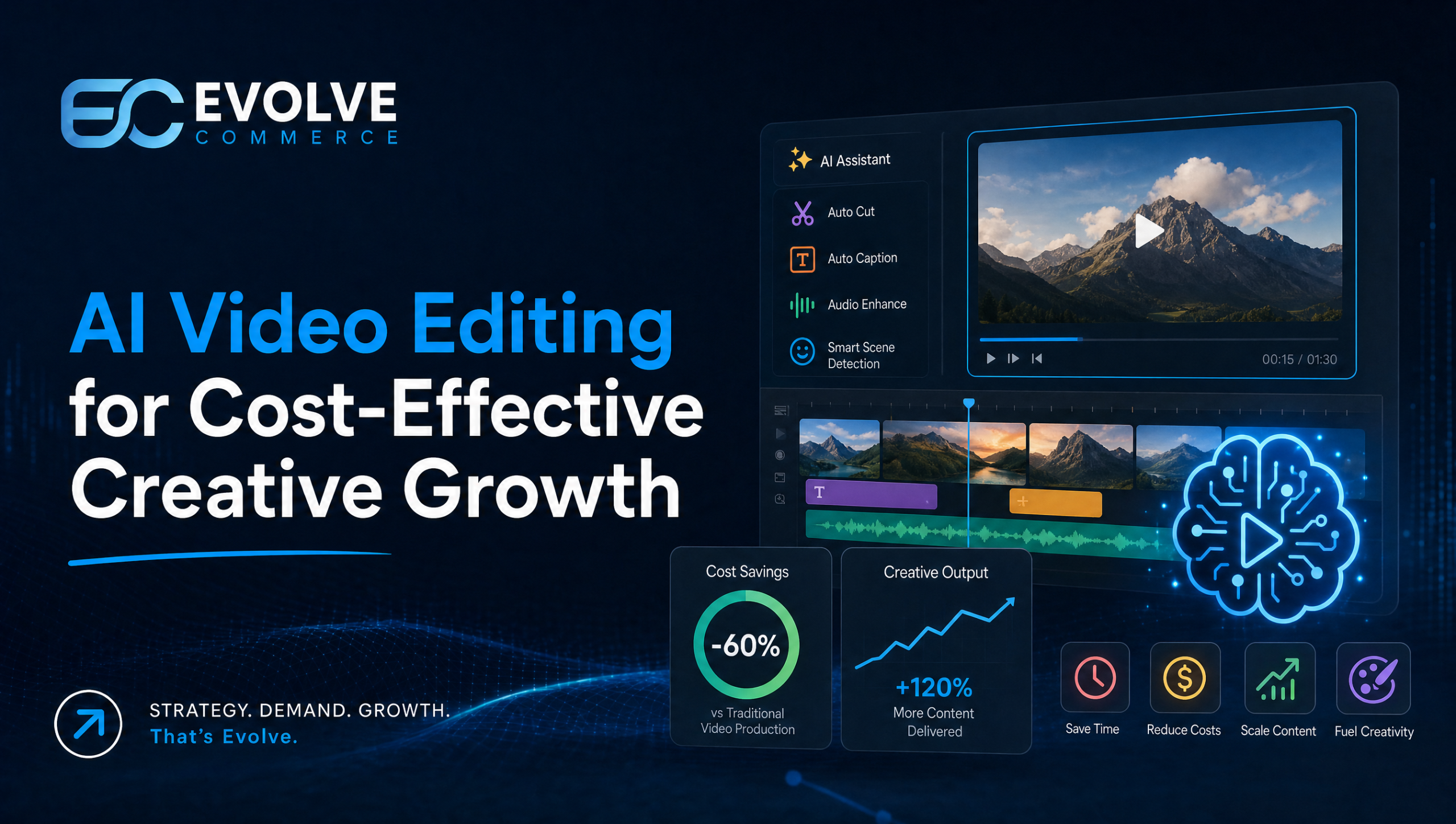
For growth brands that need high-volume, testable ad creative, agency-managed AI video editing is the fastest, most cost-effective route to producing variants at scale. It combines faster output with test-driven optimisation, so a brand can run more hooks against a live audience and let hook rate and ROAS decide what survives. The right time to use it is when your paid-media spend outpaces your creative team’s capacity to feed it fresh assets. This process can be built into full-funnel campaigns rather than treated as a one-off production job.
- Outsourcing AI video editing significantly reduces costs, with providers delivering 40 to 80 variants monthly at four to eight times lower cost per variant than in-house teams.
- A successful system requires thorough research and a detailed brief to ensure varied, on-brand outputs that prevent audience fatigue.
- A hybrid approach, combining an in-house creative director with an outsourced batch provider, offers consistent brand voice and high-volume testing efficiency.
- Turnaround times are typically 5 to 10 business days, with rush options available for urgent campaigns, making it suitable for fast-paced testing cycles.
- The most critical metrics to monitor are hook rate, retention, and ROAS, with performance data integrated into dashboards like AdWize to optimize ad rotation.
Table of Contents
- What is AI video editing as a managed ad-creative service?
- Should you outsource, keep creative in-house, or run a hybrid model?
- How does the AI video editing production system actually work?
- What does AI video editing cost, and what should you expect back?
- How do you choose and onboard an AI video editing agency?
- How Evolve Commerce runs agency-managed AI video editing
- Where scale and brand control genuinely conflict
- Ready to pilot agency-managed AI video editing?
- Sources
- FAQ
What is AI video editing as a managed ad-creative service?
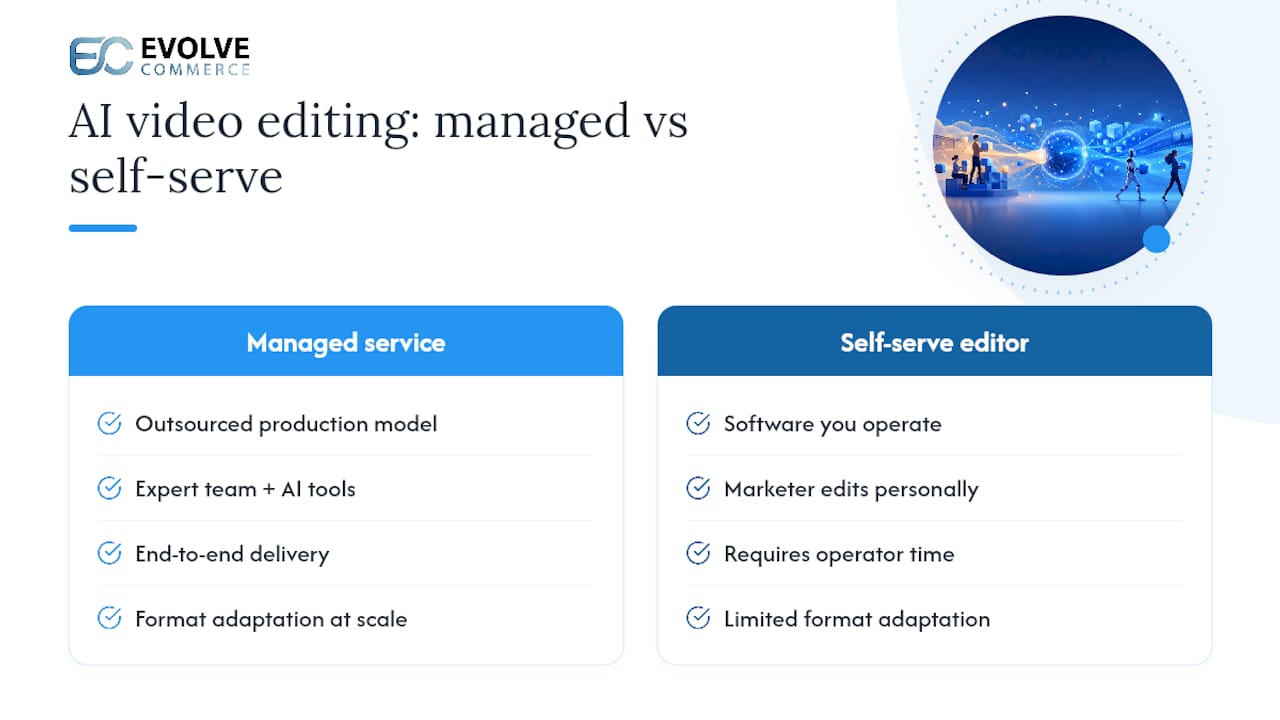
Agency-managed AI video editing is a production model, not a piece of software you buy and operate yourself; it relies on expert teams delivering comprehensive services de production audiovisuelle including scripting, editing, and format adaptation. A specialist team uses AI-assisted tools to script, edit, adapt and rotate video ad creative on a client’s behalf, then hands back finished assets ready to run on Meta, TikTok or Google. That’s a different proposition to self-serve AI editors, where a marketer does the editing personally. This guide is about the former: outsourced production, managed end to end.
The value shows up in three places. Speed, because AI-assisted workflows cut the time between brief and finished cut. Format adaptation, because one hero concept can be reworked into a dozen aspect ratios and lengths without reshooting. And testable volume, because a brand running 40 variants a month finds winners faster than one running four.
None of that matters without the right measurement. Track hook rate (how many viewers stay past the first three seconds), retention or hold rate through the mid-roll, click-through rate, and ultimately ROAS. A batch of creative that scores well on hook rate but collapses on retention tells you the concept works but the pacing doesn’t. That distinction shapes the next brief.
Should you outsource, keep creative in-house, or run a hybrid model?
The decision usually comes down to volume and speed, not budget alone. If your media buyers need more than 15 to 20 fresh variants a month to keep testing velocity up, an in-house team of one or two editors will struggle to keep pace, however talented they are.
A fully loaded in-house creative hire, salary, software, kit, management time, typically costs more per variant than a specialist batch provider once you account for downtime between briefs. Batch video services generally deliver 40 to 80 ad variants a month at four to eight times lower cost per variant, with turnaround running 5 to 10 business days against 21 to 45 days for an internal team building from scratch.
That doesn’t mean everything should leave the building. Some work stays in-house or with a specialist production partner regardless of scale:
- Hero brand films and flagship campaign launches that need deep creative direction and a single authorial voice.
- Anything tied to a physical shoot, packaging reveal, or talent contract that a remote team can’t manage.
- Sensitive claims work requiring legal sign-off before any edit begins.
The model that tends to win on ROAS is hybrid: one in-house creative director who owns brand voice and strategy, paired with an outsourced batch provider who executes variants against that direction. You get consistency at the top and volume at the bottom, without paying full-time salaries for either.
How does the AI video editing production system actually work?
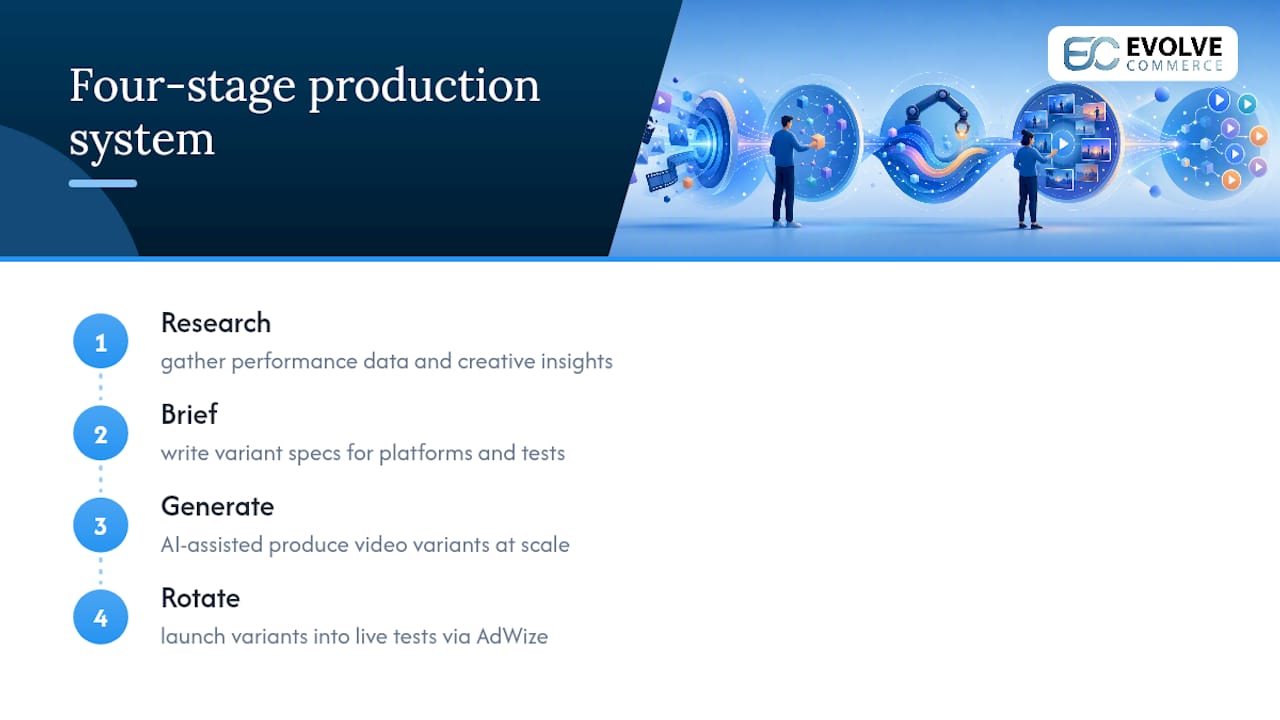
A production-ready system runs on four stages, and skipping the first one is the most common reason AI creative goes flat. Ad libraries and competitor research feed the brief; without that layer, outputs default to generic patterns that fatigue quickly once an audience has seen a few.
- Research. Pull winning hooks, competitor angles and platform trends before a single script is written.
- Briefing. Convert research into a document the production team can act on without follow-up questions.
- Generation and editing. AI-assisted tools handle scripting, rough cuts and format variations; a human editor finishes pacing, captions and sound design.
- Rotation. New variants replace fatigued ones on a schedule tied to performance data, not a calendar.
A brief that actually works covers six things: brand voice and tone, target persona, colour palette and brand assets, two or three example ads to reference, explicit do’s and don’ts, and the specific performance goal (hook rate versus conversion versus retention). Building the brief this thoroughly is what cuts revision cycles by roughly 40 to 60%, because the production team isn’t guessing at what “on brand” means.
Format adaptation deserves its own line item in the brief. Request a master cut plus its 9:16, 1:1 and 16:9 derivatives up front, rather than treating vertical-to-horizontal conversion as an afterthought once the ad is already live. For catalogue-heavy brands, standardising prompts and batch-processing assets against your product feed turns AI editing into an operations layer rather than a one-off project.
Feedback needs structure too. Timestamped comments on the actual cut, not vague notes, train an external team to make performance-driven choices rather than aesthetic ones. Agree a cadence for sharing performance data back to the production team, weekly at minimum, so rotation decisions are based on numbers rather than gut feel.
Pro Tip: Keep one shared document with every brief, revision note and performance result in date order. When a new editor joins the account, that history teaches them your brand faster than any onboarding call.
What does AI video editing cost, and what should you expect back?
Pricing in this category tends to follow four shapes rather than one flat rate. A pilot package tests the relationship over a fixed number of variants before either side commits further. A monthly retainer buys a set output volume, often with a rollover allowance for unused variants. Per-variant pricing suits brands with lumpy, seasonal needs. Rush fees apply when you need a turnaround inside the standard window.
Batch providers typically turn around new variants in 5 to 10 business days as standard, with rush tiers delivering in 2 to 5 business days, against 21 to 45 days for an in-house team starting from a blank brief.
Judge cost-effectiveness on two numbers, not one. Cost-per-winning-ad matters more than cost-per-variant, since a cheap batch of creative that never produces a scaler is more expensive than a pricier batch that does. Variants-per-pound tells you how much testing surface your budget actually buys.
- A brand spending £3,000 to £6,000 a month on paid social typically needs 15 to 30 fresh variants monthly to keep fatigue at bay.
- Break-even against in-house hiring usually arrives once you need more than one dedicated editor’s worth of output.
- Rush fees are worth budgeting for around major sale periods, when standard turnaround windows don’t fit the calendar.
How do you choose and onboard an AI video editing agency?
Ask to see case studies with actual performance numbers attached, hook rate, retention, ROAS, not just finished reels. Ask which platforms they’ve produced for and how recently. Ask what happens to unused revisions and who owns the final files once the contract ends.
- Request a sample brief-to-delivery timeline so you know what “turnaround” actually means for your account.
- Confirm the revision policy in writing: how many rounds are included per variant before extra charges apply.
- Ask how they report performance data back, and whether that integrates with your own analytics stack.
- Check that final brand claims and legal sign-off stay with your team, not theirs, as sound outsourcing practice requires.
Onboarding should follow a predictable sequence: a pilot brief, a round of approved concepts, a first full batch of variants, then a reporting handover that shows what won and why. Build hook rate, retention and time-to-first-variant into the scope document as service levels, not just as vague ambitions.
Treat vague answers about past results, no named metrics, no willingness to share a sample brief, as a red flag rather than a formality to skip past.
How Evolve Commerce runs agency-managed AI video editing
AI-assisted video production can be integrated into full-funnel growth engineering, not as a bolt-on service. Creative can be coordinated alongside paid media management across platforms like Meta, TikTok, Google and Snapchat, enabling new variants to launch straight into live testing rather than sitting idle.
The four-stage system, research, brief, generate, rotate, runs against performance data reported through the AdWize dashboard, giving clients server-side attribution on which variants actually drove revenue. Various brands have used this approach as part of broader growth engagements. Readers can review documented outcomes in Evolve Commerce’s case studies before requesting a pilot batch of their own.
Where scale and brand control genuinely conflict
Outsourcing creative production works right up until nobody owns the brand voice. A batch provider can generate volume, but only one person, ideally an in-house creative lead, should hold final say on tone, claims and visual identity. Pair that person with an outsourced batch team rather than trying to replace them, and ROAS tends to hold up as volume increases.
— Evolve Commerce
Ready to pilot agency-managed AI video editing?
If you’ve been weighing an in-house hire against outsourcing, there’s a lower-risk middle step: a pilot. Evolve Commerce runs new accounts through a brief, a batch of 10 to 20 variants, then a full performance report tied to hook rate, retention and ROAS, before anyone commits to a monthly retainer. That structure lets you see cost-per-winning-ad on your own campaigns rather than trusting a sales pitch.
Creative sits inside the same account as your paid-media management, so winning variants move straight into scaled spend without a handover delay between teams. If you’re ready to see what a pilot batch looks like against your own catalogue, get in touch through the Evolve Commerce site or browse recent case studies first to see the numbers behind the claims.
Sources
- How to Outsource Video Ads Without Losing Quality – Video Ads Top
- AI Ad Creation for Ecommerce: Build a Production-Ready Creative System
- Batch Video Ads vs In-House Creative Team: Conversion Rates and Cost Comparison 2026 — Prestyj
- How to Outsource Ad Creative Production Without Losing Brand Control
FAQ
What is agency-managed AI video editing?
It’s a production service where a specialist team uses AI-assisted tools to script, edit and adapt video ad creative on a brand’s behalf, delivering finished assets rather than software the client operates itself.
How much does AI video editing for ads typically cost?
Pricing follows retainer, per-variant or pilot structures, with batch providers delivering 40 to 80 variants monthly at four to eight times lower cost per variant than a fully loaded in-house team.
What turnaround time should I expect?
Standard turnaround runs 5 to 10 business days, with rush tiers available in 2 to 5 business days for time-sensitive campaigns.
Should I keep any creative work in-house?
Yes, hero brand films, flagship launches and anything requiring legal sign-off on claims should stay with an in-house lead, while high-volume variant production suits an outsourced batch model.
What metrics matter most for AI-edited ad creative?
Hook rate, retention or hold rate, click-through rate and ROAS together show whether a variant earns attention and converts it, and Evolve Commerce reports these through its AdWize dashboard for client campaigns.