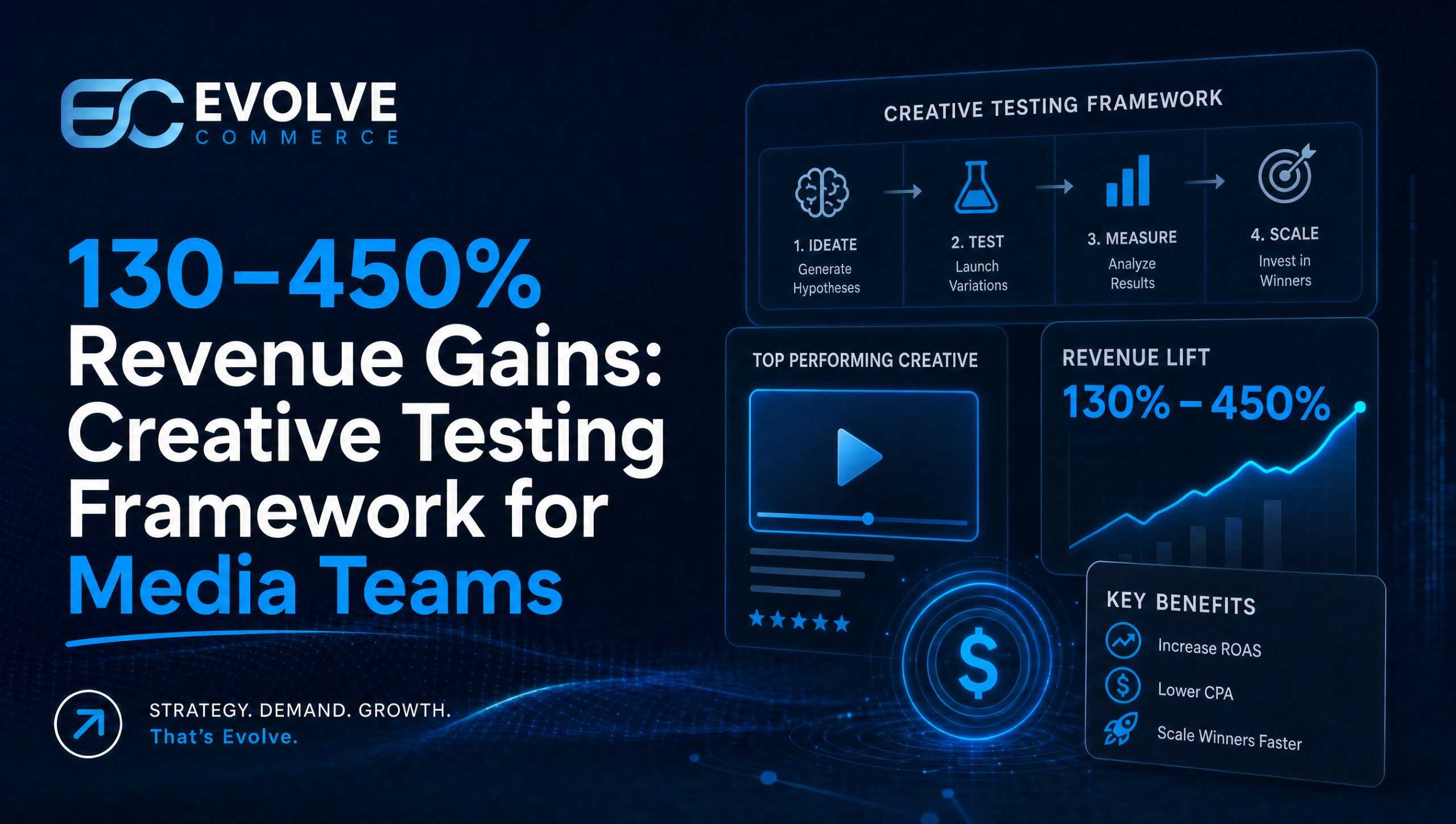
A creative testing framework is a documented set of rules that turns hunches into repeatable, measurable experiments. Size your variant count to the conversions you can actually generate, pre-commit your decision rules before launch, and run separate calendars per channel. Do those three things and you get compounding wins instead of noisy, one-off guesses.
- Most testing failures result from inadequate structure in production speed, channel-specific methodologies, evaluation rules, and feedback logging processes.
- Matching the number of variants to the expected conversion volume is crucial, with four to five variants suitable for channels generating 50 to 80 conversions within the test period.
- Separate calendars and reporting rhythms are necessary for each platform since Meta, Amazon, and TikTok have distinct learning mechanics that impact testing timelines.
- A sequential, layered approach like 3-3-3, 3-2-1, or 3-Phase should be chosen based on production capacity, not sophistication, with integrated systems improving consistency and learning.
- Logging every test detail and decision, then feeding lessons into future briefs, creates a repeatable testing playbook that accelerates growth and avoids repeating past mistakes.
Table of Contents
- What is a creative testing framework, exactly?
- The four-layer model behind reliable creative testing
- Which creative testing framework should you use: 3-3-3, 3-2-1, or 3-Phase?
- How do you size a creative test correctly?
- How do testing rules differ by channel?
- How do you read creative test results without misreading them?
- How do you turn test results into a repeatable playbook?
- Evolve Commerce in practice: running the loop end to end
- Operator maxims from running these tests
- How Evolve Commerce implements creative testing for you
- Sources
- FAQ
What is a creative testing framework, exactly?
Ad-hoc testing fails in predictable ways. A media buyer checks a dashboard on day two, likes what they see, and pauses the “losing” variant before the algorithm has finished learning. Someone in a Monday meeting declares a creative “clearly stronger” based on a gut reaction, not a pre-agreed metric. Sample sizes get ignored entirely, so a result that’s really just weekend noise gets treated as a verdict.
A structured framework replaces those habits with rules everyone agrees to before the test goes live. That’s the entire point: the decision gets made in advance, not in the heat of a dashboard refresh.
The failure modes worth naming:
- Reading results before the platform has exited its learning phase
- Changing more than one variable at a time, so you can’t attribute the lift
- Comparing creatives across different budgets, audiences, or date ranges
- Killing a variant on a single bad day instead of a full weekly cycle
- No record of what was learned, so the next brief repeats the same test
The benefits run the other way: repeatable methodology means every test adds to a body of knowledge rather than sitting in isolation, and clearer thresholds mean ROAS conversations stop being arguments about opinion. There’s a structural reason for this too. Research from the University of Exeter found that structured, data-driven evaluation reduces subjective bias, and that Chain-of-Thought prompting with large language models can improve alignment between machine and human assessments of novelty and usefulness. Standardised scoring beats gut feel, whether the scorer is human or machine.
The four-layer model behind reliable creative testing
Most testing programmes that stall aren’t missing ideas. They’re missing structure in one of four layers.
- Production. This is the supply chain for your test: programmatic assembly tools, format readiness for each platform, and firm delivery SLAs so every planned variant actually exists inside the test window. Production speed (plan-to-ship time) is worth tracking as its own KPI, because a brilliant framework with a slow production team never gets to run.
- Channel methodology. Meta, Amazon, and TikTok all have different learning mechanics, so each needs its own calendar and its own rules rather than one blanket testing schedule.
- Evaluation rules. Every test needs a written hypothesis, one isolated variable, a sample size the platform can realistically deliver, a fixed duration, and a pre-agreed threshold for what counts as a win. This is the backbone of a defensible creative testing framework: it must define the hypothesis, the isolated variable, the achievable sample, the review duration, and the decision threshold for scaling, revising, or retiring each variant.
- Feedback loop. Every test result gets logged, along with the decision made and why. Those decision records feed directly back into the next round of briefs, so the strategy team isn’t relearning the same lesson every quarter.
Pro Tip: Audit your current process against these four layers before you touch a new framework. Most teams find they’re strong on production and weak on the feedback loop, which quietly caps how much they ever learn.
Which creative testing framework should you use: 3-3-3, 3-2-1, or 3-Phase?
The right framework depends entirely on how much creative you can produce in a given window, not on which one sounds more sophisticated.
- 3-3-3 tests 3 concepts, 3 body variations, and 3 hooks, generating 27 permutations. It delivers a genuinely wide read on what’s working, but only if you have programmatic assembly or a production team that can turn around dozens of assets fast. Without that capacity, the matrix collapses under its own weight before the test window closes.
- 3-2-1 scales the same logic down to 3 hooks, 2 body variations, and a single call to action, producing 6 permutations. This method concentrates testing energy on attention and message sustainment, which makes it the sensible default for teams without heavy production support or a large enough audience to feed 27 variants.
- 3-Phase is a staged operational flow rather than a matrix. Pre-Flight validates a small batch of new concepts in a sandbox, New vs BAU compares fresh winners against the current best-in-class asset, and Scaling pushes a proven winner into wider budget without disturbing the tests still running.
The practical rule most teams miss: these aren’t mutually exclusive. Run 3-3-3 inside the Pre-Flight stage of a 3-Phase structure when you have the budget and production bandwidth for a wide net, then fall back to 3-2-1 for smaller, faster iteration cycles once you’ve identified a working concept. Trying to run one giant framework for every test, regardless of budget, is how most testing programmes quietly grind to a halt.
How do you size a creative test correctly?
Sizing is where most testing programmes lose credibility before they even start. Running nine variants against an audience that converts twice a week guarantees a result nobody can trust.
A workable heuristic: match your maximum variant count to your expected conversion volume for the test window, not the other way around. If your channel and budget will realistically generate 50 to 80 conversion events across the test period, four or five variants is a defensible ceiling. Beyond that, each variant gets too thin a slice of data to draw a decision from.
Before any test launches, work through this checklist:
- Write the hypothesis in one sentence: what you expect to happen, and why.
- Confirm exactly one variable is being isolated. Two changes at once means an unattributable result.
- Check the sample size against realistic conversion volume for the channel and budget.
- Set the duration in advance, covering full weekly cycles rather than a fixed number of days.
- Name the primary metric and the exact threshold that will trigger a scale, revise, or retire decision.
Stop rules matter as much as start rules. Operators do well to pre-commit to spend or impression thresholds before launch, rather than deciding mid-flight whether a variant has “seen enough”. Reading across full weekly cycles, rather than day three or day four, avoids the day-of-week bias that skews so many premature calls: weekend behaviour on a DTC fashion account looks nothing like a Tuesday afternoon.
Pro Tip: If you can’t yet state your stop rule in one sentence before launch, the test isn’t ready to go live. Write it down first, then build the creative.
How do testing rules differ by channel?
A single testing calendar across every platform is one of the more common ways a testing programme quietly falls apart, because the underlying mechanics of each channel are genuinely different.
- Meta ad sets need to exit the learning phase before results mean anything, and the widely used heuristic is roughly 50 optimisation events per ad set per week before a read is reliable. Plan separate ad sets for each variant rather than folding tests into an existing, already-optimised set.
- Amazon and retail media experiments typically run as two-arm comparisons rather than wide matrices, and lower-traffic ASINs often need four to ten weeks to reach a reliable read. ASIN eligibility rules and retailer-specific experiment timelines add another layer most social-first teams don’t expect.
- TikTok and other short-form platforms move fast, so thumb-stop metrics dominate the early read and production cycles need to keep pace with a feed that refreshes attention constantly.
The operating rule that ties all three together: run separate calendars and separate reporting rhythms per channel, rather than one report that averages Meta, Amazon, and TikTok results into a single misleading number.
How do you read creative test results without misreading them?
The order in which you check metrics matters more than most testing programmes admit. Jumping straight to CPA or ROAS before checking whether the ad even earned attention is how good creative gets killed for the wrong reason.
- Thumb-stop or hook rate first: did the opening seconds actually stop the scroll?
- Hold rate next: once stopped, did viewers stay?
- CTR after that: did the message translate into a click?
- CPA, once the funnel above checks out: is the cost of acquisition efficient?
- ROAS last: is the whole thing actually profitable at scale?
This diagnostic sequence tells you where in the funnel a creative is actually failing, rather than lumping every problem under one disappointing ROAS number.
The pitfalls that undo good frameworks are almost always operational, not strategic: killing a test on day two before the learning phase settles, mixing brand-new sandbox creatives into the same ad set as proven BAU performers, and skipping the pre-defined threshold in favour of “let’s just see how it goes”. Mixing sandbox and BAU is a particularly costly habit, because isolating new creative in a sandbox until it clears its threshold protects both the variable you’re testing and the delivery of the assets already working.
Scaling a winner safely means graduating it into BAU budget deliberately, briefing fresh variations around the winning concept before fatigue sets in, and watching frequency and hold-rate metrics for the early signs that the format is wearing out.
Pro Tip: If ROAS looks weak but hook rate is strong, the problem is almost certainly in the offer or the CTA, not the creative concept itself. Don’t retire a good hook because of a broken landing page.
How do you turn test results into a repeatable playbook?
A test that isn’t logged might as well not have happened because the next brief will make the same mistake.
- Store the hypothesis, the isolated variable, the sample achieved, the result, and the decision made for every test, not just the winners.
- Feed each decision record directly into the next round of briefs, so strategists start from what’s already proven rather than a blank page.
- Use winning hooks or concepts as seed hypotheses on adjacent channels: a hook that stopped the scroll on TikTok is a reasonable starting point for a Meta Reels test, even if the execution needs adapting.
- Set a refresh cadence for winning assets, and define the fatigue signals (falling hold rate, rising frequency) that trigger retirement before performance actually collapses.
Evolve Commerce in practice: running the loop end to end
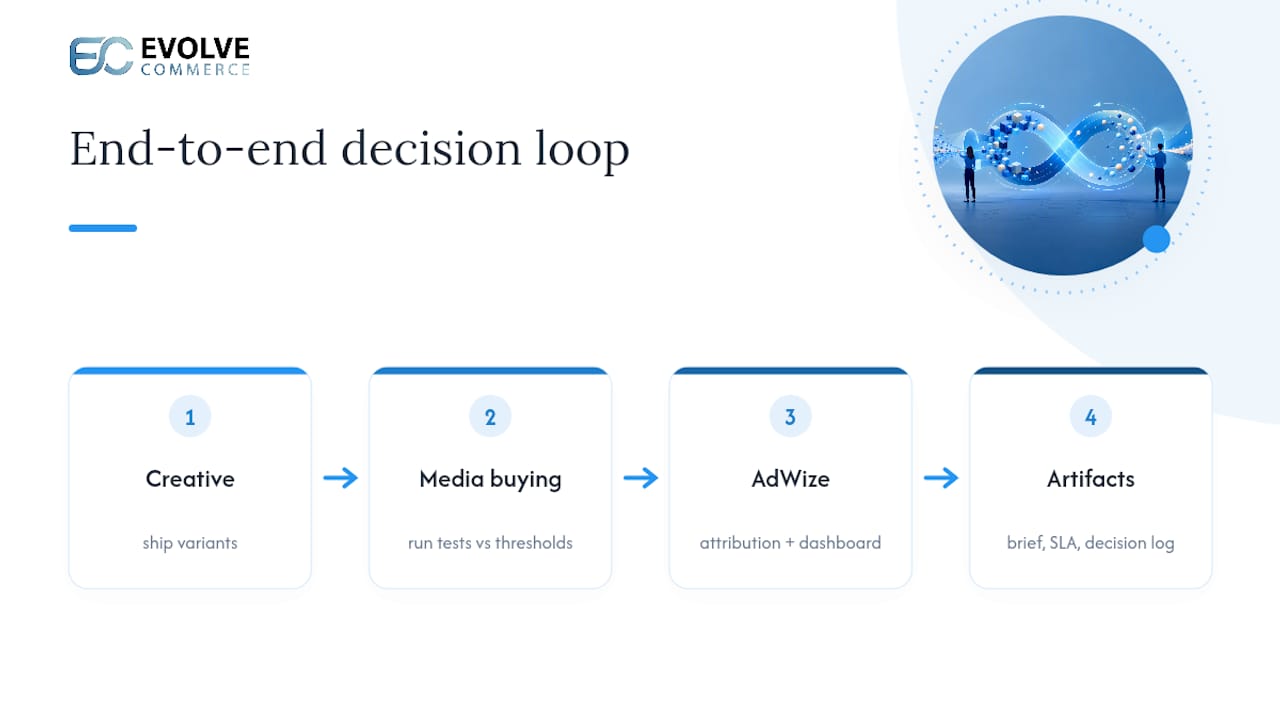
Evolve Commerce builds this loop as one connected system rather than three separate teams working from different spreadsheets. Creative production, paid media management, and the AdWize analytics platform feed into a single decision cycle: production ships the variants, media buying runs the test against pre-agreed thresholds, and AdWize’s server-side attribution surfaces the hook-rate-through-ROAS sequence in one dashboard rather than three exports stitched together manually.
Clients working with this model, including Hunter, Juicy Couture, Light Mirrors, and FILA, have seen annual revenue growth in the range of 130% to 450% through combined paid media, creative production, and lifecycle marketing programmes. The artefacts worth porting into your own process, framework or not: a written brief checklist, a production SLA with a firm plan-to-ship deadline, and a decision log that never lets a test result disappear into someone’s inbox.
Operator maxims from running these tests
Size to conversions, not ambition. Pre-commit your stop rule before you commit budget. Never mix sandbox creative into a BAU ad set. Read full weeks, not exciting days. A framework only compounds if you log the loss as carefully as the win.
— Evolve Commerce
How Evolve Commerce implements creative testing for you
Most marketing teams know the theory in this guide already. What breaks it in practice is production capacity, fragmented reporting across channels, and nobody owning the decision log once the excitement of a launch wears off. An alternative to hiring and coordinating separate production, media, and analytics teams is one connected system that runs the brief, ships the variants, and reads the result through a single dashboard instead of three disconnected exports.
That system pairs performance creative production, paid media management across Meta, TikTok, Google, and other channels, and the AdWize platform’s server-side attribution, so the metric hierarchy in this guide, hook rate through ROAS, sits in one place rather than scattered across ad manager exports and spreadsheets. Clients including Hunter, Juicy Couture, Light Mirrors, and FILA have worked with this model to build compounding creative programmes rather than one-off test batches. If your current process is producing tests faster than you can log the lessons, get in touch with Evolve Commerce to talk through what a managed testing loop would look like for your channels and budget.
Sources
The Rocketium Academy framework shaped the five-rule definition and channel-timeline detail. The eonik explainer on 3-3-3 and its creative testing maths piece informed the framework comparison and sizing sections. Admove’s post-Andromeda guide supplied the metric hierarchy. The University of Exeter’s research backed the bias-reduction claims throughout.
- Creative testing framework for consumer brands (Rocketium Academy)
- The 3-3-3 Meta Ads Creative Testing Framework | eonik
- Creative Testing Framework: How to Build a Post-Andromeda Testing System (Admove)
- AI found to boost individual creativity but results in less varied content (University of Exeter)
FAQ
What are examples of testing frameworks?
The main practitioner frameworks are 3-3-3 (3 concepts × 3 bodies × 3 hooks, 27 permutations), 3-2-1 (3 hooks × 2 bodies × 1 CTA, 6 permutations), and the 3-Phase flow (Pre-Flight, New vs BAU, Scaling), which structures testing as stages rather than a fixed matrix.
What is the 3-2-1 method for ad testing?
The 3-2-1 method tests 3 hooks against 2 body variations with a single call to action, producing 6 permutations, and it’s the practical choice for teams without the production capacity a wider matrix like 3-3-3 demands.
How do you do creative testing properly?
Write a single hypothesis, isolate one variable, size your variant count to realistic conversion volume, set the duration and threshold before launch, and read results across a full weekly cycle rather than the first few days.
Which creative testing framework is best?
There’s no universally best framework: 3-3-3 suits teams with strong programmatic production and volume, 3-2-1 suits smaller budgets, and a 3-Phase structure works well for organising either matrix into a repeatable operational cycle, which is the approach Evolve Commerce builds around for clients.