A social commerce strategy means enabling purchases where people discover products, either through native in-app checkout or through a social-led click to your site. The single best first step for any brand starting out is to make one platform-native buying journey flawless before adding a second. Social commerce revenue continues to climb according to Statista, and Industry experience across paid social and creative production shows what disciplined execution can achieve.
- Focusing on in-app checkout works best for impulse products under approximately £150, while higher-value items benefit from a full site experience.
- Inventory synchronization must be maintained in near real time to prevent overselling and maintain trust across all social platforms.
- Creative testing should prioritize sequence and format variations, with a strong emphasis on user-generated content to increase purchase likelihood.
- Social media audiences respond better to behavioral signals and smaller, engaged creators than large influencers for conversion.
- Integrating social commerce with core systems like inventory, CRM, and analytics is critical to avoid reliance on disconnected tools and ensure accurate measurement.
Table of Contents
- What is a social commerce strategy and why does it matter?
- Which platform commerce features should you prioritise?
- How do you map the social commerce customer journey?
- What creative and content strategy actually converts?
- How should you structure your creator and influencer roster?
- Which KPIs and attribution methods actually work?
- What operational systems does social commerce actually need?
- How do you roll out social commerce in 30, 90, and 180 days?
- How does Evolve Commerce approach social commerce growth?
- What legal and privacy rules apply to social commerce?
- How do you segment and target buyers within social platforms?
- How should social commerce connect to your existing systems?
- What’s next for social commerce?
- What do successful social commerce case studies have in common?
- What’s the biggest mistake I’ve seen in social commerce programmes?
- How can Evolve Commerce help you scale social commerce?
- Sources
What is a social commerce strategy and why does it matter?
A social commerce strategy is the deliberate plan for turning social platforms into revenue channels, not just awareness channels. It splits into two distinct transaction types, and confusing them is where most brands go wrong.
In-app checkout means the customer discovers, decides, and pays without ever leaving TikTok, Instagram, or Pinterest. Social-led site conversion means the platform drives discovery and intent, but the sale closes on your own website or Shopify store. Both count as social commerce. Only one of them puts the platform in control of the payment relationship, and that distinction shapes your entire measurement setup later.
This differs from ordinary social media marketing in one crucial way: the objective is a completed transaction, not a click, a follow, or a like. Statista’s tracking of shopper behaviour shows a steady rise in the share of people who both discover and purchase products through social platforms, which confirms buyer habits have shifted well past casual browsing.
Certain product categories consistently outperform others in this environment:
- Beauty and personal care, where demonstration and texture matter more than specification sheets.
- Fashion and apparel, where fit content and styling videos shorten the decision cycle.
- Home and lifestyle goods, where “in situ” content builds desire faster than studio photography.
- Food and beverage, where impulse-driven, low-price-point purchases suit in-app checkout well.
Brands with a strong visual identity and a genuine reason for people to stop scrolling tend to win here. Brands relying purely on discount messaging tend to plateau quickly.
Which platform commerce features should you prioritise?
Not every shoppable feature deserves equal investment, and the right mix depends on how considered the purchase is. A £15 lip gloss and a £400 mattress topper need entirely different formats.
The main commerce tools worth knowing:
- Shoppable posts and product tagging — the baseline for discovery-to-product-page linking on Instagram and Pinterest.
- Native in-app checkout — TikTok Shop and Instagram Shop both support this; ideal for low-consideration, impulse-driven products.
- Live shopping — real-time demonstration and Q&A, effective for launches, restocks, and limited drops.
- AR try-on — reduces return rates for categories like eyewear, cosmetics, and footwear by letting people preview fit or shade.
- Saved collections and wishlists — support considered purchases where a buyer needs several days between discovery and decision.
Impulse categories benefit most from native checkout because every extra tap loses buyers. Considered purchases, think furniture, electronics, or anything over roughly £150, convert better when the social platform hands off to a full site experience with reviews, sizing guides, and financing options visible.
Operationally, none of this works without a clean product feed. Platforms enforce strict catalogue requirements: accurate pricing, correct availability status, and policy-compliant imagery. TikTok Shop in particular audits listing quality and will suppress underperforming or non-compliant catalogues from its discovery surfaces, so feed hygiene is not a one-off task but an ongoing operational commitment.
How do you map the social commerce customer journey?
The journey rarely runs in a straight line. A shopper might see a product in a TikTok video on Monday, save it, watch a creator review on Wednesday, and finally buy through a retargeted Instagram ad on Friday, sometimes in-app, sometimes on your website. Mapping that path matters more than optimising any single touchpoint in isolation.
Four points in that journey consistently kill conversions:
- Slow or multi-step checkout. Every additional field or redirect between “I want this” and “paid” costs you buyers, particularly on mobile.
- Inventory mismatch. A shopper taps through to a product shown as available that sold out three hours earlier.
- Unclear returns policy. Considered purchases stall when shipping costs or return windows aren’t visible before checkout.
- Slow direct message replies. A third of consumers expect a reply to a purchase-related DM within an hour, and slower response times correlate directly with abandoned intent, according to Emplifi’s research.
Fixing these doesn’t require a rebuild. Enable single-click or saved-payment checkout wherever the platform supports it. Sync your feed in near real time rather than nightly. Put shipping and returns information directly in the product description, not buried in a linked policy page. Set DM triage rules so purchase-intent messages get flagged and answered ahead of general enquiries.
Pro Tip: Tag every inbound DM with a simple “hot, warm, cold” intent label before routing it. A message asking “does this come in medium?” is a near-certain sale sitting in your queue; treat it with the urgency of an abandoned cart, not a general enquiry.

What creative and content strategy actually converts?
Format matters less than sequence. The short-form video structure that consistently converts follows a simple pattern: hook in the first two seconds, a genuine demonstration or value point in the middle, then a direct call to action, not a soft “link in bio” but a specific instruction to tap the product tag.
Testing discipline separates brands that scale from brands that plateau. Run variants on:
- Hook style: question versus bold claim versus visual surprise.
- Thumbnail or cover frame: product-in-use versus close-up detail shot.
- CTA placement: spoken mid-video versus text overlay at the end.
- Demo length: a six-second cut versus a fifteen-second version of the same clip.
User-generated content deserves a bigger share of your creative mix than most brands allocate. Consumers who interact with UGC are 2.4 times more likely to purchase and spend 11% more per transaction, according to Emplifi’s data, a gap too large to ignore. The practical move is treating UGC as a systematic asset rather than an occasional repost: build a rights-management process so strong customer content can be pushed into paid ads and embedded directly on product pages, not left stranded in comments.
Pro Tip: Run your creative tests in pairs, not singles. Testing a new hook against your current best-performer, rather than against a random control, tells you whether you’ve actually improved or just found a different way to perform the same.
How should you structure your creator and influencer roster?
Roster composition is one of the most misunderstood levers in social commerce, and most brands get the ratio backwards. This mix consistently outperforms rosters weighted towards larger accounts on conversion rate, because audience trust runs higher with smaller, more engaged followings than with mega-influencers whose endorsements read as paid placements by default.
Partnership models should match the goal, not default to one structure:
- Affiliate or commission-only, best for testing a new creator relationship at low risk, paying only on proven sales.
- Flat fee, appropriate for guaranteed deliverables like a launch video or a live shopping event where reach matters more than direct attribution.
- Revenue share, suited to long-term ambassadors where the creator effectively becomes a co-owner of the product’s performance.
Practitioners with direct roster-operations experience, such as Naomi Lennon, tend to reinforce a simple rule: treat creator selection as a performance decision, not a reach decision.
Measurement should go beyond vanity engagement numbers. Unique discount codes and individually tracked links tell you which creators actually drive sales rather than impressions. Holdout or incrementality testing, running a campaign with and without a given creator’s activity live, reveals whether the sales would have happened anyway. Post-purchase surveys asking “how did you hear about us?” catch the influence that tracked links miss entirely, particularly when a buyer saw a creator’s content days before purchasing through a different path.
Which KPIs and attribution methods actually work?
Vanity metrics still get too much airtime in social commerce reporting. Followers and likes tell you almost nothing about revenue, and treating them as success indicators wastes budget on the wrong optimisation targets.
The KPIs worth building a dashboard around:
- Conversion rate by platform — TikTok, Instagram, and Pinterest each convert differently by product category, so blending them into one number hides the signal.
- Revenue attributed to social, split between in-app checkout revenue and social-referred site revenue.
- ROAS on shoppable content specifically, separated from general brand-awareness spend.
- Average order value from social-acquired customers versus other channels.
- Retention and repeat purchase rate among social-acquired customers, the number that tells you whether you’re buying one-off sales or building actual customers.
Attribution gets genuinely difficult once a shopper touches three or four surfaces before buying. Platform-tracked, in-app conversion data is reliable for pure in-app checkout, since the platform owns the entire transaction. Server-side modelling becomes necessary once purchases route through your own site, because browser-based tracking increasingly undercounts mobile app traffic and cross-device journeys. A unified dashboard, such as Evolve Commerce’s AdWize platform, matters here precisely because it reconciles platform-reported numbers against your own site data rather than trusting either source in isolation.
A weekly cadence for creative and spend decisions, paired with a monthly cadence for roster and platform-mix decisions, keeps optimisation responsive without causing whiplash from short-term noise.
What operational systems does social commerce actually need?
Marketing gets the attention, but the systems behind it decide whether social commerce builds trust or destroys it. A brilliant campaign that sends buyers to a sold-out product is worse than no campaign at all.
Three priorities matter most:
- Unified inventory and catalogue sync. Update stock levels in near real time, not on a nightly batch job, and build an automatic rule to pull sold-out SKUs from shoppable tags immediately rather than relying on someone noticing manually.
- Commerce stack fundamentals. Multiple payment options, a clearly stated returns policy visible before checkout, active fraud screening, and ongoing compliance with each platform’s commerce policies, which change often enough to need a monthly review.
- Social customer care with defined response SLAs. Emplifi’s research on consumer expectations around DM response times underlines why this belongs in operations, not just community management. Building the commerce-to-care loop, where inventory, service, and analytics share one system, is what separates a mature programme from a collection of disconnected tools.
Pro Tip: Set an automated triage rule that flags any DM containing words like “size,” “stock,” or “order” for priority response. These almost always signal purchase intent, and a slow reply on one of these messages is a lost sale, not just a service lapse.
Escalation paths matter too. Any query that could block a purchase, a payment failure, a shipping delay, a wrong item, needs a route to a human within minutes, not a queue shared with general brand mentions.
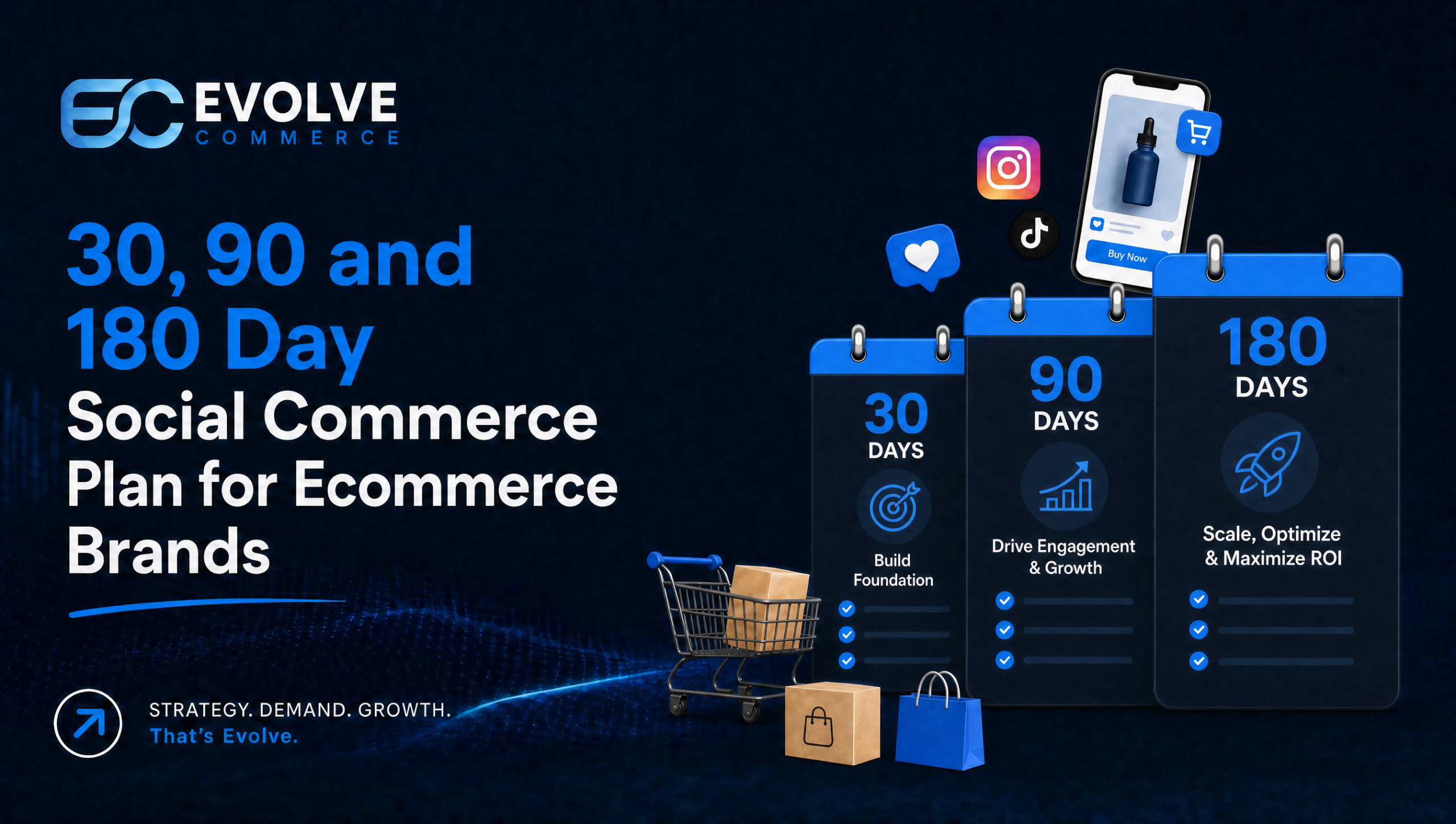
How do you roll out social commerce in 30, 90, and 180 days?
A staged rollout beats a big-bang launch every time, because it lets you fix mistakes while they’re still cheap. Ecommerce marketing guidance consistently recommends nailing owned-channel foundations, like email automation and abandoned-cart flows, before layering on paid social scale, and that sequencing holds for social commerce too.
Days 1 to 30: build the foundation.
- Audit your product feed for accuracy and platform compliance.
- Pick one platform pilot based on audience fit and product type.
- Produce a small batch of pilot creative following the hook, demo, CTA structure.
- Recruit a short roster test, five to eight micro-creators, to validate messaging before scaling.
Days 31 to 90: iterate and amplify.
- Kill underperforming creative variants and double down on winners with paid amplification.
- Fix any inventory sync gaps the pilot exposed.
- Automate first-line social care triage so response times hold as volume grows.
- Expand from one product category to two or three based on pilot conversion data.
Days 91 to 180: scale with discipline.
- Increase paid budgets behind proven creative and platform combinations.
- Expand the creator roster while holding the 80/20 micro-to-mid-tier ratio.
- Integrate cross-channel analytics so social revenue sits alongside email, paid search, and site data in one view.
- Refine attribution modelling as transaction volume gives you enough data for confidence.
Evolve Commerce’s own approach to social advertising strategy follows this staged logic: prove a narrow pilot works, then scale spend behind what the data actually supports.
How does Evolve Commerce approach social commerce growth?
Evolve Commerce runs full-funnel programmes that map directly onto every stage above. Paid media management across Meta, TikTok, Google, and other channels drives the discovery and retargeting layer. In-house creative production, including video ads and AI-powered editing, supplies the testing volume that a serious content cadence demands. Lifecycle email and SMS, built on platforms like Klaviyo, catch the buyers who don’t convert on first touch.
Sitting underneath all of it, the AdWize analytics platform gives clients server-side attribution and AI-powered performance insights, so social revenue gets measured against real business outcomes rather than platform-reported vanity numbers.
Full breakdowns of that work sit in Evolve Commerce’s case studies.
What legal and privacy rules apply to social commerce?
Social commerce sits squarely inside existing data protection and advertising law, it doesn’t get a lighter regulatory touch just because the transaction happens inside an app. Any brand collecting customer data through social checkout, retargeting pixels, or DM-based sales needs a clear lawful basis for processing that data, consent mechanisms that meet UK data protection standards, and a privacy notice that actually reflects what happens to customer information once it leaves the platform.
Advertising content faces scrutiny too. Paid social posts, including those run through creators, must comply with advertising standards on clear disclosure of paid partnerships. A creator video that promotes a product without a visible ad or partnership label risks non-compliance, and platforms increasingly enforce this themselves by flagging or restricting undisclosed commercial content.
Pricing and claims discipline matters just as much in social formats as on a website. A shoppable post making a specific product claim, a health benefit, a performance figure, a comparison to a competitor, needs to be substantiated exactly as it would in any other advertising format. The informal, fast-paced tone of social content doesn’t lower the bar for accuracy.
Data collected through live shopping events and DM-based sales deserves particular attention, since these formats often capture personal information, names, sizes, addresses, in a conversational context where formal consent flows are easy to skip. Building consent capture into your DM triage process, rather than treating it as an afterthought, keeps your social commerce programme compliant without slowing down the buying experience.
How do you segment and target buyers within social platforms?
Effective segmentation in social commerce goes beyond basic demographics. Platform ad managers let you build audiences from genuinely commercial signals: people who’ve engaged with a shoppable post, viewed a product page linked from social, added to cart without completing checkout, or watched a set percentage of a product demo video.
Behavioural segments consistently outperform interest-based ones for social commerce specifically, because they capture intent rather than assumed affinity.
Lookalike or similar audiences built from your highest-value existing customers, rather than from all customers indiscriminately, tend to produce stronger return on ad spend, since they replicate the traits of people who actually spend well rather than people who simply converted once.
Retargeting sequences should differ by drop-off point. Someone who viewed a product but didn’t add to cart needs a different message, likely another angle on the product itself, than someone who added to cart but didn’t check out, who usually needs a shipping, pricing, or trust-signal nudge instead. Treating both groups identically wastes budget on the wrong message.
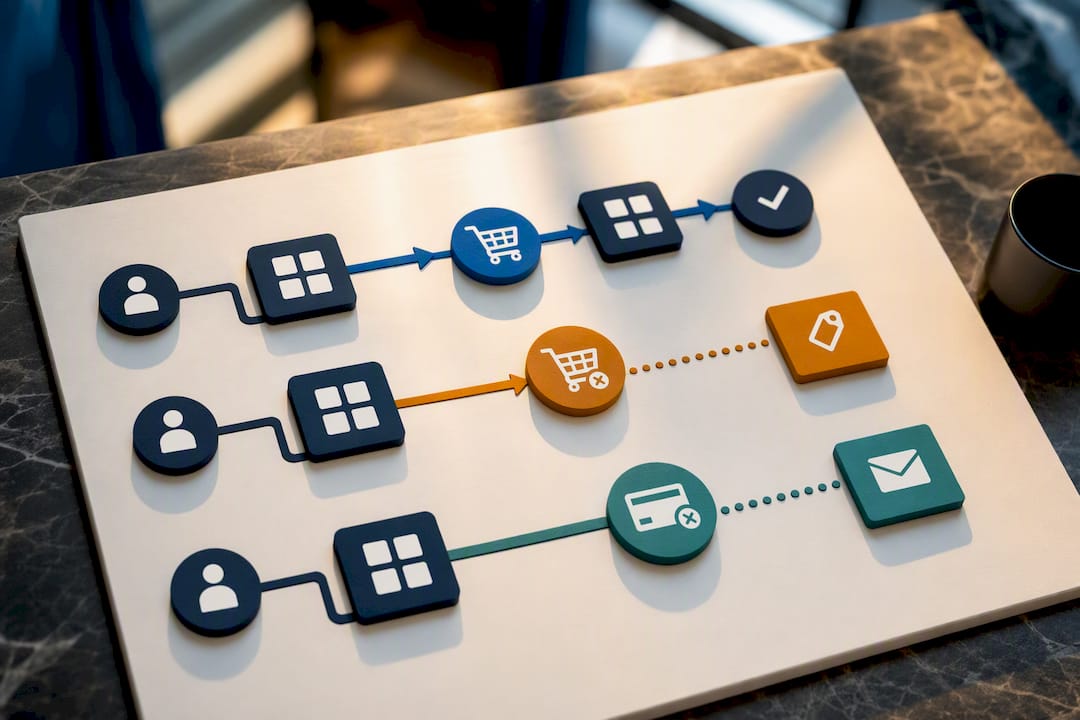
Seasonal and lifecycle segmentation matters too. A first-time social buyer and a repeat customer respond to different creative: new buyers need proof and reassurance, repeat buyers respond better to new product news and loyalty-style offers. Building that distinction into your targeting structure from the outset saves considerable rework later.
How should social commerce connect to your existing systems?
Social commerce fails quietly when it operates as a bolt-on rather than an integrated channel. The most common failure point is a shoppable catalogue that exists separately from the core e-commerce platform, creating exactly the inventory mismatches covered earlier.
Integration priorities, in rough order of impact:
Product feed synchronisation between your e-commerce platform, whether Shopify, WooCommerce, or a custom build, and every social channel’s commerce catalogue needs to run through a single source of truth. Manual updates across multiple platforms are where stock errors creep in.
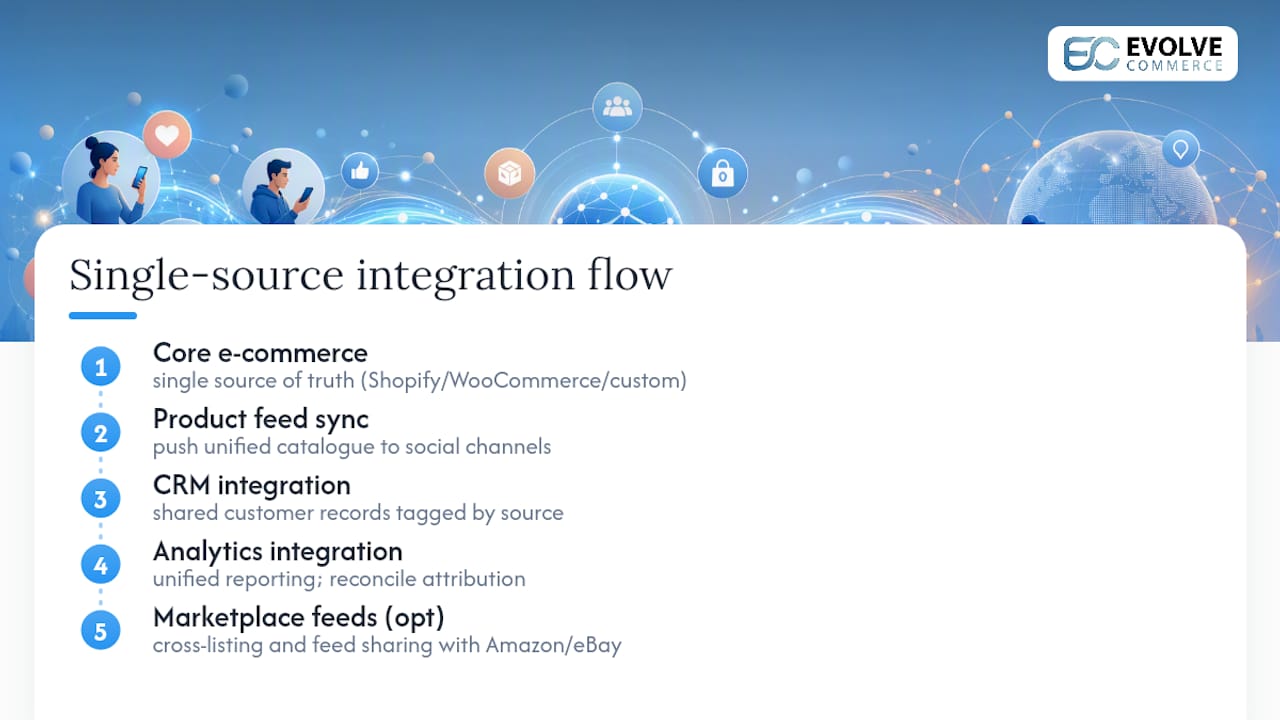
CRM integration matters just as much, though it gets less attention. Social-acquired customers should flow into the same customer record as site-acquired ones, tagged by acquisition source, so lifecycle email and SMS campaigns can treat them appropriately rather than starting every social buyer at zero. A customer who bought through a TikTok Shop impulse purchase needs different nurture messaging than one who spent three weeks researching on your site.
Analytics integration closes the loop. Platform-reported metrics, site analytics, and CRM data need to sit in one reporting environment, otherwise every team ends up working from a different version of the truth. This is precisely the gap tools like AdWize are built to close, reconciling attribution across channels rather than trusting any single platform’s self-reported numbers.
Marketplace integrations deserve consideration too, particularly for brands already running Amazon or eBay alongside their own site; marketplace selling strategies increasingly overlap with social commerce as platforms add cross-listing and feed-sharing capabilities.
What’s next for social commerce?
Live shopping is moving from novelty to standard practice, particularly on TikTok, where creator-led live sessions increasingly outperform static product listings for engagement and conversion during launch windows. Expect more brands to build a recurring live shopping calendar rather than treating it as a one-off event.
AR try-on is expanding beyond beauty and eyewear into apparel and home goods, driven by improving computer vision and lower implementation costs. Categories with historically high return rates stand to benefit most, since previewing fit or scale before purchase directly reduces the returns that erode margin.
Platform consolidation of commerce tools is accelerating too. Instagram and TikTok continue building out native checkout, product tagging, and creator commerce features that reduce friction between discovery and purchase, and platform commerce revenue reflects that investment: Instagram generated an estimated $37.2 billion and TikTok Shop reached $33.2 billion in GMV, according to Emplifi’s figures. That concentration means brands ignoring these two platforms are increasingly ignoring where the money already sits.
Expect attribution to keep getting harder before it gets easier, as privacy changes continue to erode third-party tracking accuracy. Brands investing now in server-side and first-party data infrastructure will be better positioned than those still relying purely on platform-reported numbers when that squeeze tightens further.
What do successful social commerce case studies have in common?
Across categories, the brands that make social commerce work share a pattern more than they share a channel. They pick one platform and one format, prove it converts, and only then expand, rather than spreading thin creative budget across every shoppable feature simultaneously.
Fashion and lifestyle brands running structured, staged programmes, defining a pilot, measuring conversion and cost to acquire, then expanding, consistently reach proof of concept faster than brands launching broad multi-platform campaigns from day one. Some brands have followed this exact logic: concentrated paid media and creative investment behind proven formats, rather than diluted spend across every available channel.
The common thread in underperforming social commerce launches, by contrast, is usually operational rather than creative. Brands with strong content but poor inventory sync or slow DM response consistently underconvert relative to their content quality, because the friction points covered earlier in this playbook, not the campaigns themselves, are what block the sale.
What’s the biggest mistake I’ve seen in social commerce programmes?
The biggest recurring failure isn’t creative, it’s inventory sync. Brands pour budget into a beautiful TikTok campaign, then send excited buyers to a product page showing stock that sold out hours earlier. That single gap does more damage to trust than a mediocre video ever could.
Two fixes consistently pay off. First, moving catalogue updates from nightly batches to near real time cuts oversell complaints sharply within weeks. Second, adding a DM triage rule for purchase-intent language turns slow, generic replies into same-hour responses, which measurably reduces abandoned intent.
If you do one thing this week, run an inventory-sync audit across every platform you sell on. It’s unglamorous work, but it protects every pound you spend on the creative and creator strategy covered throughout this piece.
— Evolve Commerce
How can Evolve Commerce help you scale social commerce?
Evolve Commerce is the direct alternative to piecing together a social commerce programme from freelancers and disconnected tools; one team runs your paid media, creative production, and attribution under a single, accountable system instead of three separate vendors passing blame when results dip. That matters most in social commerce, where inventory sync, creative testing, and platform-level attribution all need to move together, not in isolation.

The service maps directly onto the playbook above: managed paid social across Meta, TikTok, and Google; performance creative production built for the hook, demo, CTA structure that converts; and the AdWize dashboard, which reconciles platform-reported numbers against real revenue so you’re optimising against truth, not vanity metrics.
If you’re ready to see what a structured, staged social commerce programme could do for your brand, explore the full range of services or review detailed case studies to see the results behind the numbers.
Sources
- How to build a social commerce strategy that converts in 2026
- Social commerce strategy: What marketing leaders need to prioritize in 2026 | Emplifi
- Social commerce — Statista