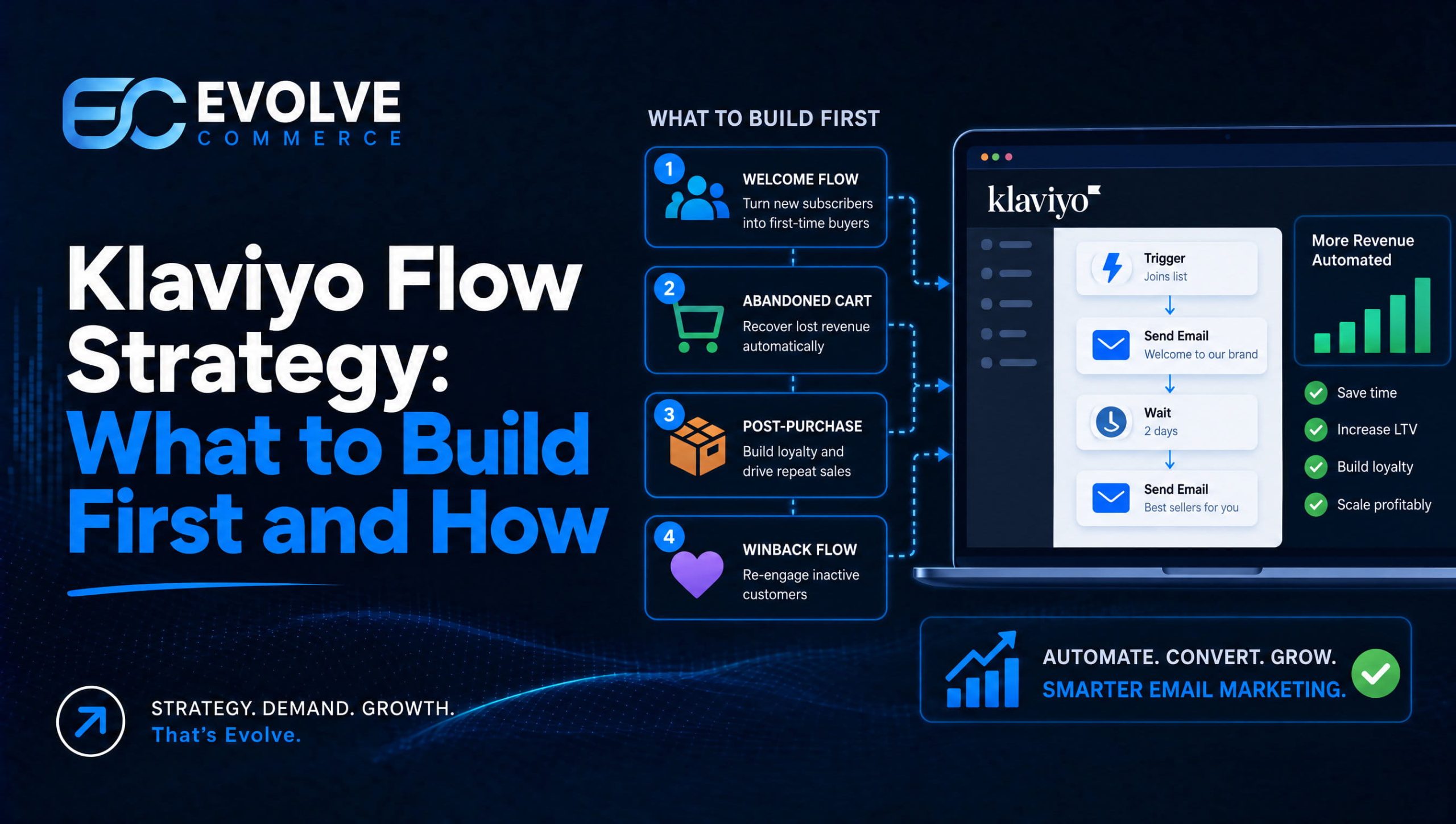
A good Klaviyo flow strategy is about sequence and depth, not volume. Build the four flows that capture existing intent first (abandoned cart, welcome, browse abandonment and post-purchase), give each one enough emails to do its job, then add winback and segmentation once those are earning. This guide sets out the order, the timing, the logic and the UK compliance points that decide whether your flows grow revenue or just add noise.
- Build in order of intent: abandoned cart, welcome, browse abandonment, post-purchase, then winback. Build order matters more than build count.
- Go deep on the foundations. Four to seven well-planned emails per core flow beat a wide spread of one-email automations.
- Protect list health with sensible spacing and Smart Sending left on, and treat SMS as a separately consented channel under PECR.
- Move from discount-led messaging to segmented, value-led journeys once the basics run, and measure flows by revenue per recipient, not opens.
Table of Contents
- Flows and campaigns do different jobs
- The build order that earns fastest
- Abandoned cart: where most brands should start
- Welcome series: the first impression you only get once
- Browse abandonment: catching interest early
- Post-purchase: the flow most brands underbuild
- Depth beats breadth
- Spacing, Smart Sending and list health
- Segmentation: from generic to relevant
- Winback: the fifth flow
- Adding SMS without breaking UK rules
- How to measure whether the strategy works
- Our perspective: flows are one part of a revenue system
- When to bring in a specialist team
- FAQ
- Sources
Flows and campaigns do different jobs
A campaign is a one-off send you schedule by hand, such as a flash sale. A flow is an automated sequence that starts when a customer does something: joins a list, starts checkout, places an order. Klaviyo’s own guidance draws this line, and it matters strategically. Brands that try to replace automation with frequent manual campaigns tend to lose revenue and push frequency in ways that irritate subscribers.
Think of campaigns as your calendar (launches, seasonal moments, clearance) and flows as your always-on sales team. The flows answer the question “what should this person hear next, given what they just did?” Campaigns answer “what does the whole audience need to hear this week?” A strong programme needs both, but flows should be built first because they work every day without anyone pressing send.
Flows are a small share of what most brands send, but a large share of what email earns. Klaviyo’s 2026 benchmark data shows flows account for roughly 5% of email sends but around 41% of email revenue, and earn about 18 times more revenue per recipient than campaigns.
Yet most teams spend the bulk of their email time on campaigns: planning the weekly send, writing it, designing it. Flows are often built once and left untouched. If that sounds familiar, the quickest win in your programme is probably sitting in an automation you haven’t looked at for a year.
The build order that earns fastest
Beginners often try to switch on every possible flow in one go. The research we reviewed points the other way: a store that ships abandoned cart, welcome, browse abandonment and post-purchase in week one will out-earn a store that spends that week perfecting a single sequence. The same source reports that, for Shopify brands, these four typically generate the large majority of automated revenue, with abandoned cart often the single biggest contributor.
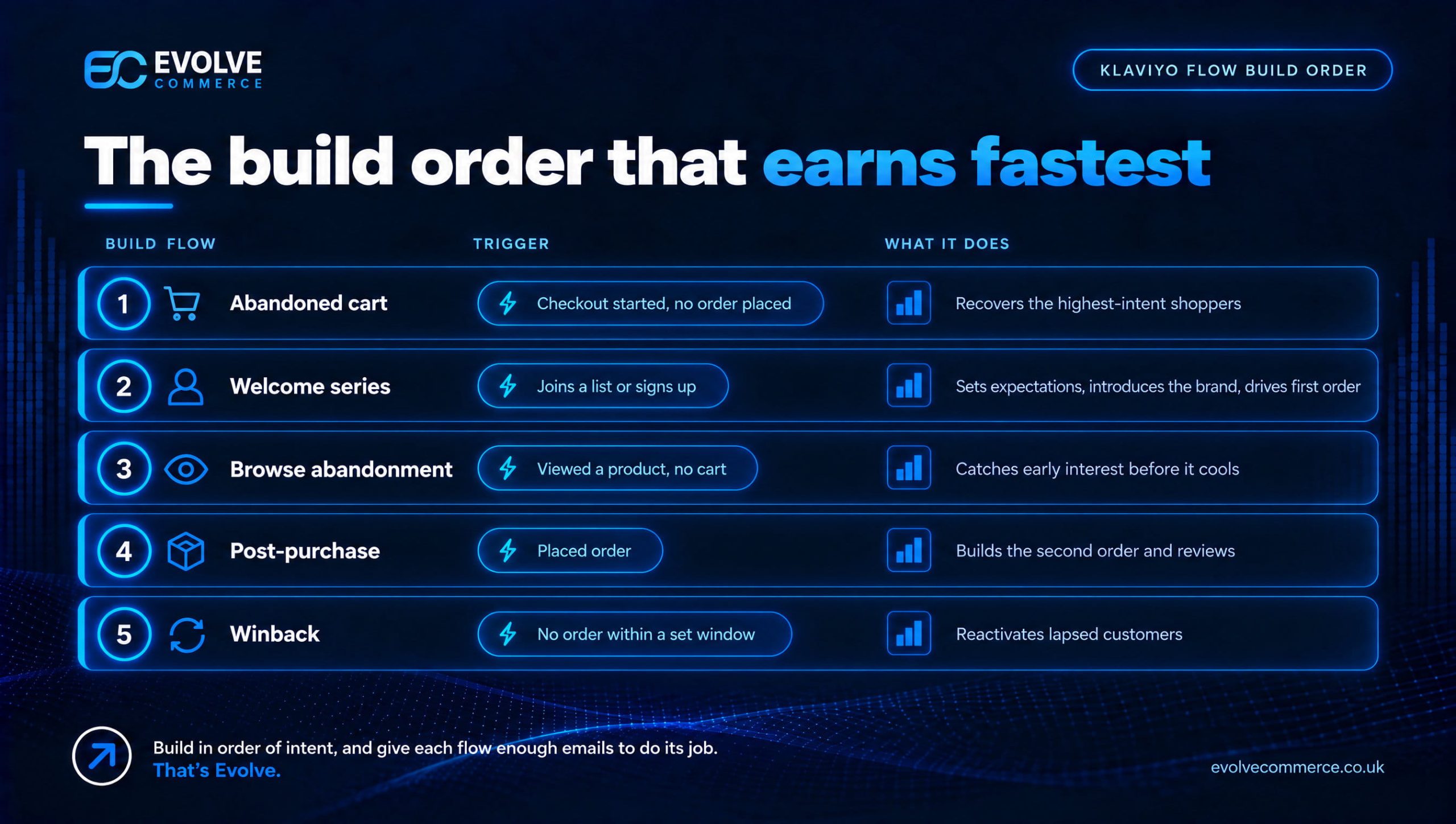
The ordering follows intent. Someone who started checkout is closer to buying than someone who viewed a product, and someone who has just bought is more receptive than a customer who lapsed a year ago.
Abandoned cart: where most brands should start
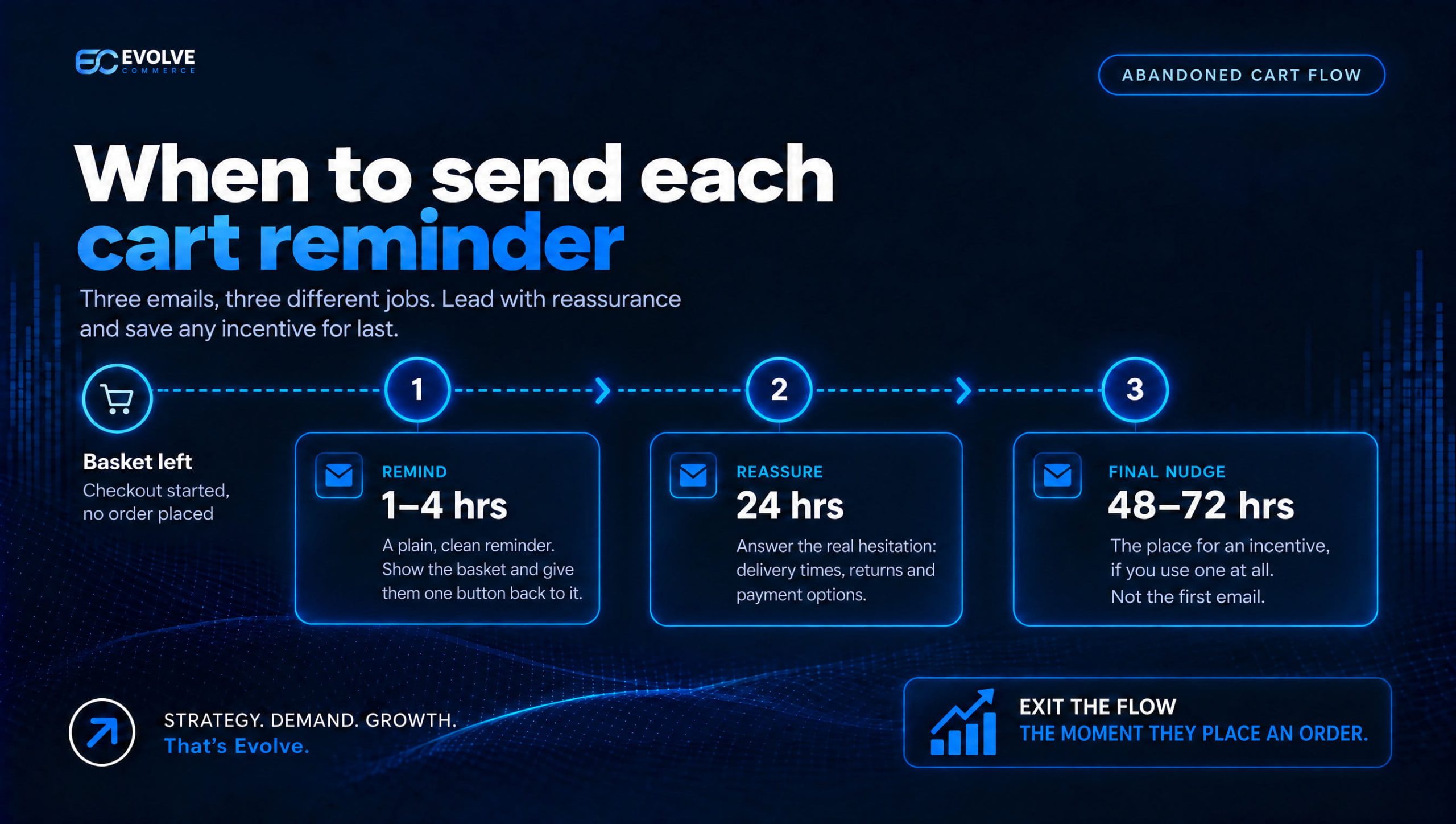
The abandoned cart flow is the easiest to justify, because the shopper has already told you what they wanted. A common pattern, described by one ecommerce practitioner, is a first reminder within one to four hours, a second at around 24 hours that addresses objections such as delivery or returns, and a third at 48 to 72 hours.
What we would change for a UK brand:
- Lead with reassurance, not a code. Delivery times, returns policy and payment options answer the real hesitation. Save any incentive for the final email, or for a defined segment.
- Keep the first email plain. A clean reminder with the basket contents and a single button usually does the job.
- Exclude people who bought. Make sure the flow exits on Placed Order, otherwise you will email customers about items they have already received.
We have published a full walkthrough with timings and three templates in our UK abandoned cart flow guide.
Shopify users: check you’re not sending two reminders. Turning on a Klaviyo abandoned cart flow doesn’t switch off Shopify’s own abandoned checkout email. If both are live, customers get two reminders for the same basket. Klaviyo recommends disabling the Shopify email right before you enable the Klaviyo flow, so there’s no gap in sending.
Welcome series: the first impression you only get once
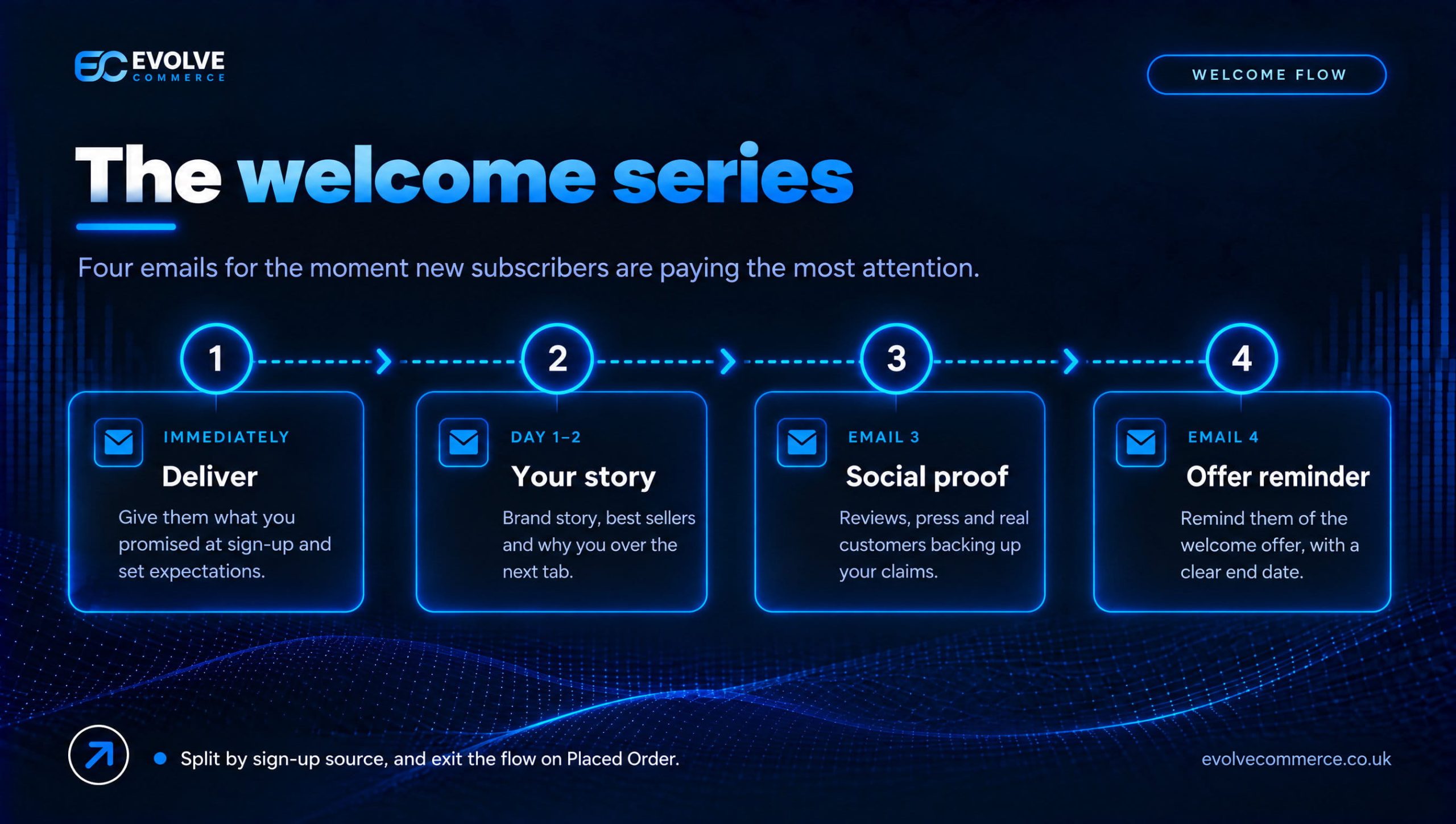
The welcome flow meets people at their most attentive. A sensible structure is:
- Email one, immediately: deliver whatever was promised at sign-up and set out what the subscriber will receive.
- Email two, a day or two later: your brand story, best sellers and the reason someone should choose you over the next tab.
- Email three: social proof, such as reviews and press.
- Email four: a reminder of any welcome offer, with a clear end date.
Split the flow by sign-up source. Someone who joined at checkout needs a different message from someone who joined through a pop-up on a category page. Keeping the same email for both is the most common reason welcome flows underperform.
The same logic applies to the other lifecycle journeys. If you are thinking about how these sequences connect with the wider operational workflow behind them, this overview of automating and delegating work across marketing and sales is a useful companion read.
Set the flow to exit on Placed Order. Someone who buys after the first email should move straight into your post-purchase journey, not keep receiving reminders about a welcome discount they’ve already used.
Browse abandonment: catching interest early
Browse abandonment has a lower intent than cart abandonment, so it should be lighter and less frequent. One to three emails is typical. Show the product or category viewed, add related products, and avoid discounting this early, because you would be paying for sales that might have happened anyway.
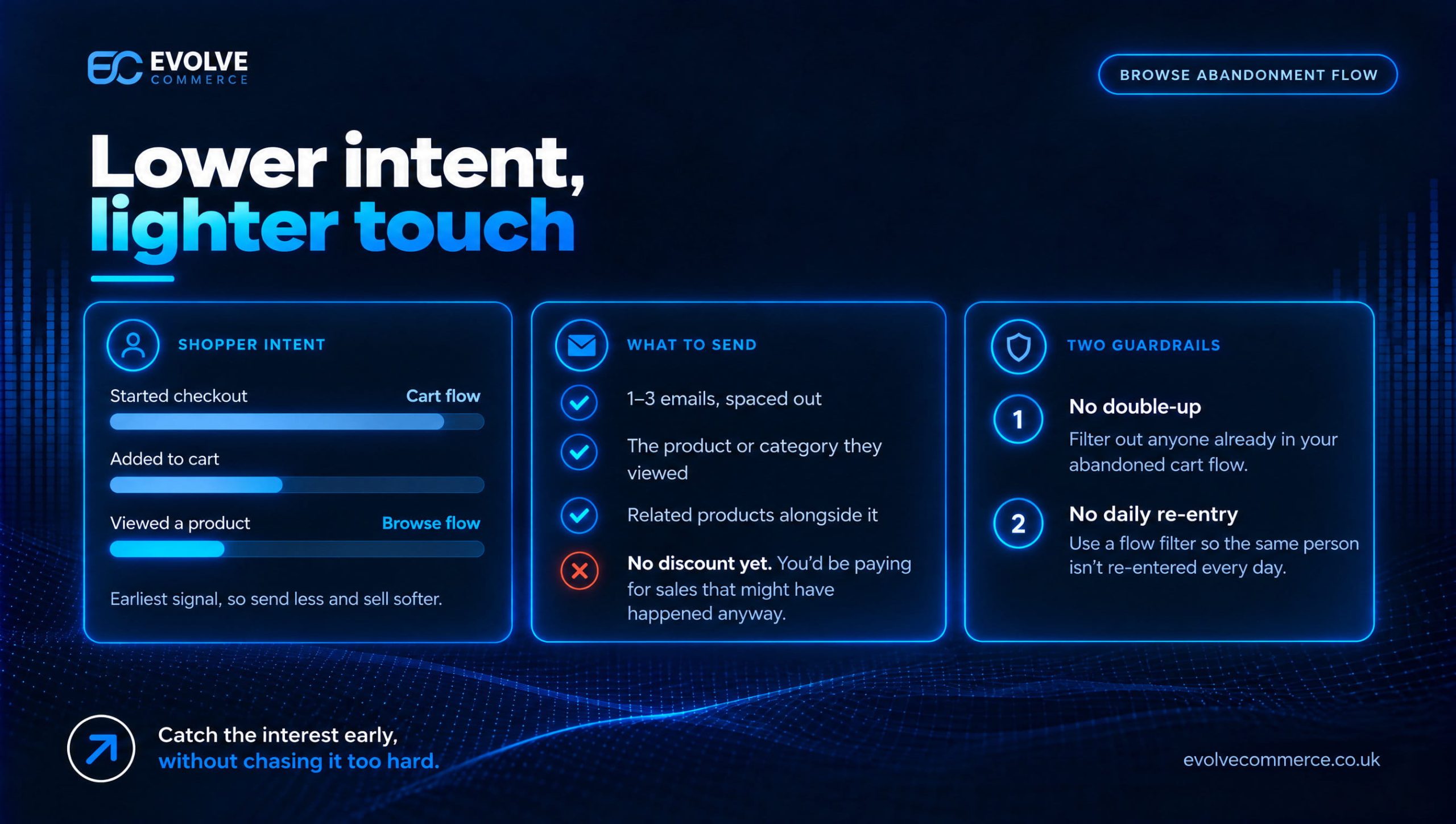
Two guardrails keep this flow healthy. Add a filter so people already in the abandoned cart flow do not also receive browse emails, and use a flow filter so the same person is not re-entered every day. Our three-email browse abandonment guide covers templates, set-up and the analytics to watch.
Post-purchase: the flow most brands underbuild
A first purchase is the beginning of the relationship. Post-purchase is where you protect margin, because a repeat customer costs less to win than a new one. A strong sequence includes:
- Order confirmation and shipping updates, which are transactional and should be clear and calm.
- A usage or care email timed for after delivery, not after dispatch.
- A review request once the customer has had time to use the product.
- A cross-sell timed to the product’s natural replenishment or complement cycle.
Branch by what was bought. A first-time buyer of a consumable and a repeat buyer of a premium item should not get identical follow-ups. See our guide on the post-purchase experience for ecommerce brands for how we structure it.
Depth beats breadth
The most useful finding for planning is that top-performing brands focus on four to seven emails per core flow rather than launching every flow at once with one email each. In practice that means writing each sequence with a clear job for every message: remind, reassure, prove, incentivise. If two emails in a flow do the same job, one of them is probably unnecessary.
A simple test for each flow before launch:
- What is the one action the flow wants?
- What does each email add that the previous one did not?
- When should the person leave the flow?
- What happens if they qualify for another flow at the same time?
Spacing, Smart Sending and list health
Flows can quietly overwhelm subscribers, because several can fire at once. Klaviyo’s guidance on flow frequency is to send often enough to keep people engaged while spacing messages out gradually. Smart Sending limits how many messages a person receives in a set window, and we would keep it on for new flow messages rather than switching it off by default. Reserve exceptions for genuinely time-critical messages such as shipping confirmations.
Practical rules we apply:
- Give each flow a priority and make sure lower-priority flows do not stack on top of higher-priority ones.
- Review subscribers who receive messages from three or more flows in a week.
- Sunset unengaged profiles instead of mailing them indefinitely, which protects deliverability.
Segmentation: from generic to relevant
Once the foundations run, segmentation is the next lever. Practitioners consistently find that conditional splits and purchase-history logic are the steepest part of the learning curve, and also where high-performing brands move away from generic discounting towards personalised, value-led education.
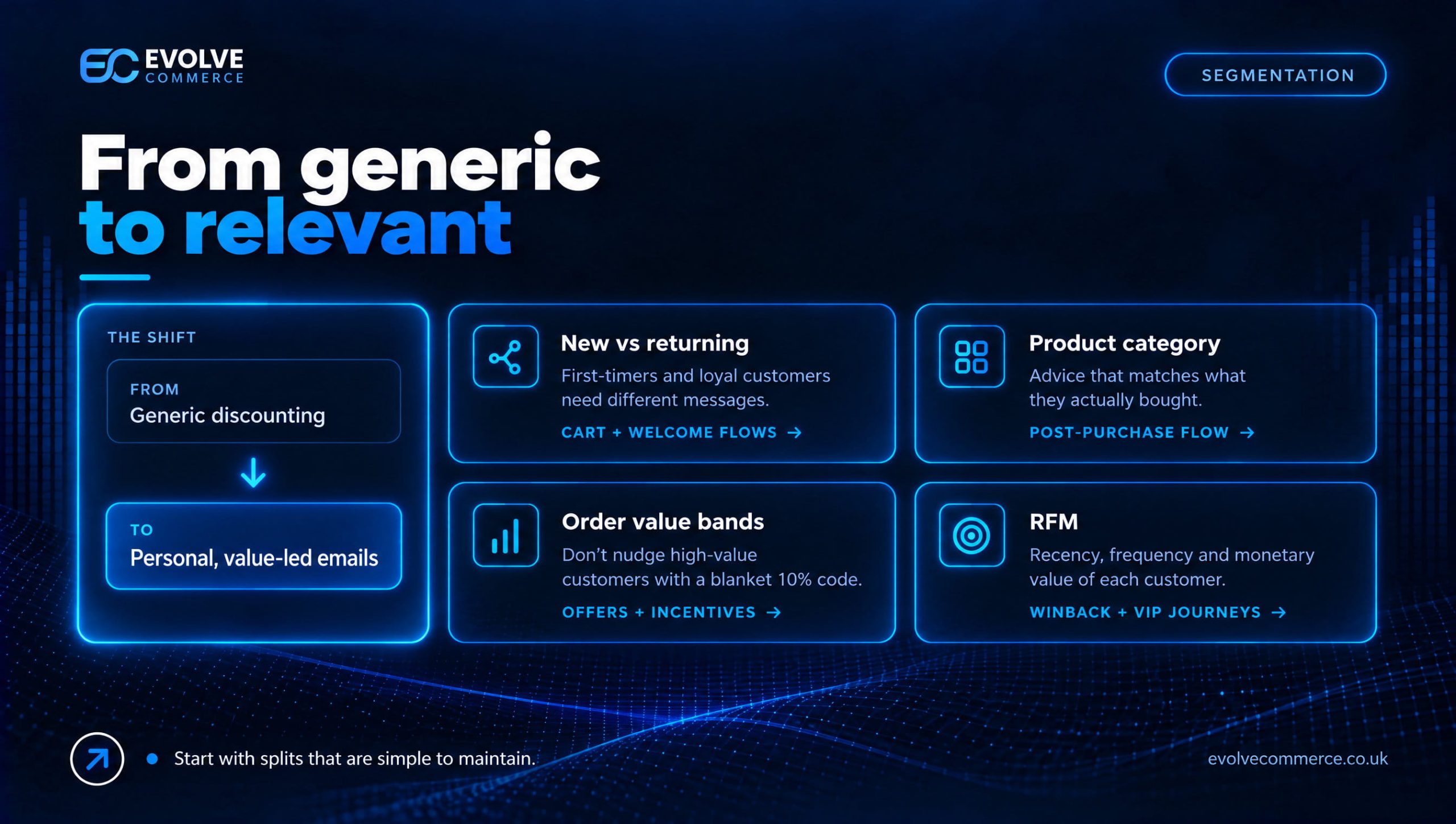
Start with splits that are simple to maintain:
- New versus returning customers in the cart and welcome flows.
- Product category in post-purchase, so advice matches what was bought.
- Order value bands, so that high-value customers are not nudged with a blanket 10% code.
- Recency, frequency and monetary value (RFM) for winback and VIP journeys. Our guide to UK ecommerce segmentation with RFM shows how to build it.
Winback: the fifth flow
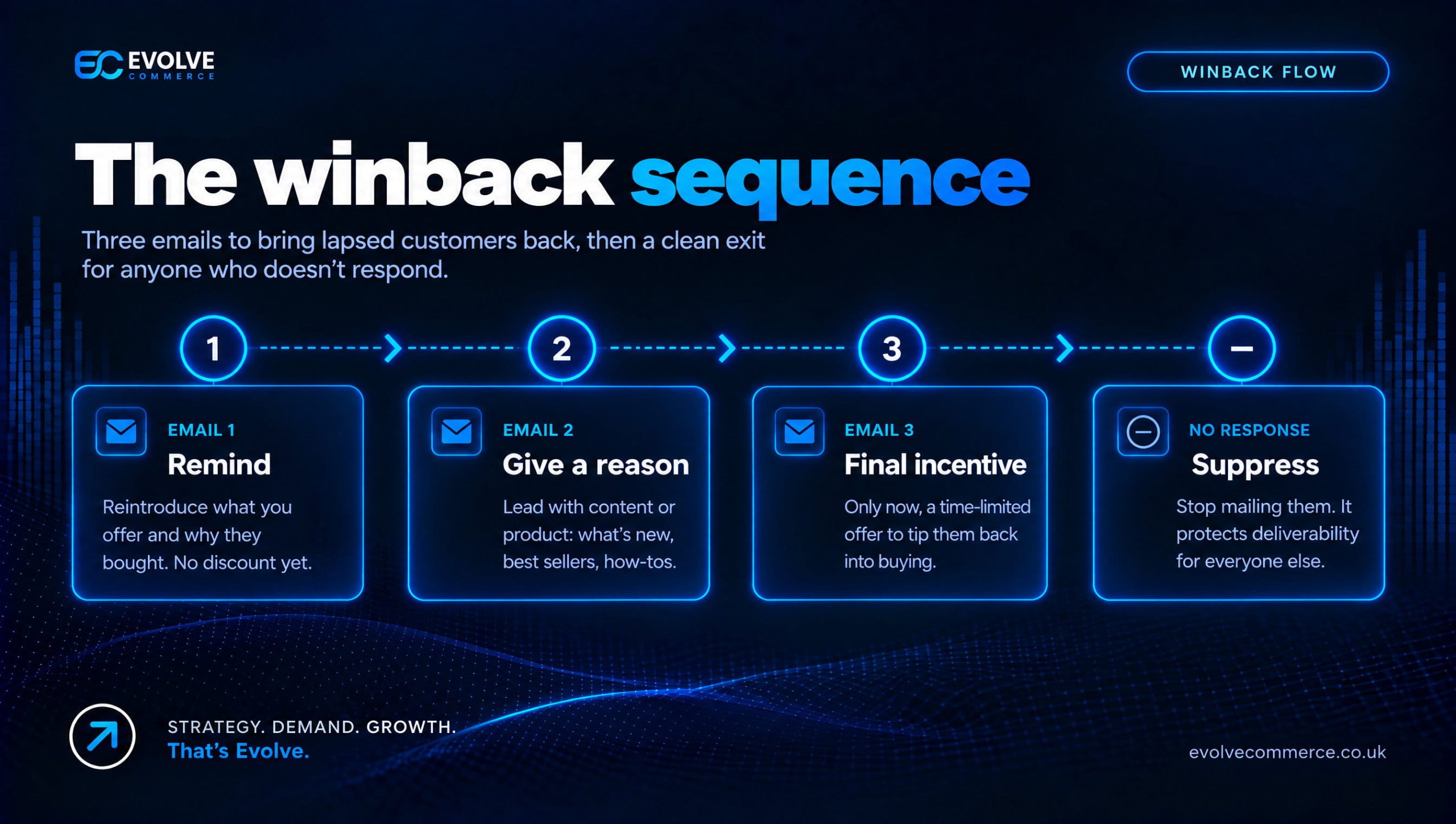
Winback targets customers who have bought before and gone quiet. Define “quiet” using your own repurchase cycle: a skincare brand and a furniture retailer will not share a window. A three-email sequence works well: a reminder of what you offer, a content or product-led email, and a final incentive. Anyone who still does not engage is a candidate for suppression. Details are in our winback campaign playbook.
Sunset: the flow that protects all other flows
A sunset flow is built to remove people from your list. When a subscriber hasn’t clicked or bought for an extended period (set the window against your own purchase cycle), send two or three short emails asking whether they still want to hear from you. If they don’t engage, suppress them.
It feels counterintuitive to shrink a list you’ve paid to build. But mailbox providers watch how recipients engage, and continuing to mail people who ignore you can push more of your email towards spam, including the emails sent to your best customers. A smaller, engaged list will usually earn more than a larger, disengaged one.
Base the trigger on clicks and orders rather than opens, which privacy features in email clients have made unreliable.
Adding SMS without breaking UK rules
SMS can lift a flow, particularly cart recovery, but in the UK it needs its own consent. Under PECR you must collect specific, affirmative opt-in for SMS marketing, and an email address or phone number collected at checkout does not automatically cover it. The ICO explains that marketing emails or texts to individuals need specific consent, with a limited exception for existing customers known as the soft opt-in. That exception requires a clear chance to opt out when details are collected and in every message. If you are unsure how it applies to your sign-up journey, take advice from your data protection lead or a solicitor.
On frequency, the guidance we reviewed suggests keeping SMS to roughly four to six messages a month per subscriber. Use SMS for the moments where speed matters: a cart reminder, a back-in-stock alert, a delivery update. Our SMS marketing plan for ecommerce sets out a 30/60/90-day rollout.
How to measure whether the strategy works
Open rates are a weak guide, especially after privacy changes to email clients. Better measures for flows are:
- Revenue per recipient for each flow and each email within it.
- Placed order rate from each message.
- Unsubscribe and spam complaint rate, as an early warning of over-messaging.
- Share of total revenue from flows against campaigns.
What good looks like. Klaviyo’s analysis of more than 110,000 customers found abandoned cart flows deliver the highest average revenue per recipient of any flow, at $6.77 for email and $4.48 for SMS. Benchmarks vary by order value and sector, so use them as a guide rather than a target.
A five-minute audit. If your flows are already live, open Klaviyo, list revenue per recipient for each flow, and rank them. Your weakest flow isn’t your worst asset. It’s your biggest opportunity, and usually the cheapest revenue you can unlock before spending more on acquisition.
Run A/B tests on one variable at a time, such as subject line, delay or offer, and give each test enough volume to mean something. Keep a changelog so you know which edit moved the result. Reliable attribution also depends on consistent tagging, which is why we recommend enforceable UTM naming conventions.
Our perspective: flows are one part of a revenue system
We approach lifecycle as a piece of a wider growth system, not a standalone email project. Paid media brings people in, creative gives them a reason to care, and flows convert that attention into first and repeat orders. If the flows are built in isolation, the paid and organic teams cannot see what happens after the click, and decisions are made on partial data.
That is why we connect email and SMS to analytics and acquisition from the start. The questions we ask first are about economics: which flows recover revenue the brand is already paying to attract, and where is the next pound of spend best used? Typically the answer is to fix abandoned cart and post-purchase before spending more on top-of-funnel traffic.
Our advice to brand managers is to resist the temptation to automate everything and to fix the foundations first. Build the four core flows properly, protect the list, segment where the data justifies it, and judge each flow by revenue, not activity.
Black Friday and Christmas bring the highest traffic of the year, which means more abandoned baskets, more new subscribers and more first-time buyers. Every gap in your core flows costs more in November than at any other point. If you only have time to fix one thing before peak, make it abandoned cart and post-purchase.
— Evolve Commerce
When to bring in a specialist team
If your flows are live but flat, the problem is rarely that one email needs a better subject line. Usually it’s a mix of things: the wrong build order, thin sequences, generic creative, and reporting that can’t tell you which flow is actually leaking revenue. Fixing that takes Klaviyo expertise, design and data working together.
As a Klaviyo partner, Evolve Commerce builds and manages lifecycle programmes for ecommerce brands from end to end:
- Flow strategy and build. We plan the right flows in the right order, give each one enough emails to do its job, and add segmentation where the data justifies it.
- World-class email design and content. Our in-house creative team designs on-brand, mobile-first emails, and writes copy that reassures, educates and sells rather than defaulting to a discount.
- Tracking you can trust. AdWize, our proprietary analytics and server-side tracking platform, connects email and SMS performance to the revenue it actually drives across your store and ad channels, so you aren’t relying on Klaviyo’s attribution alone.
- AI-powered insight. AdWize’s AI agents analyse performance across every flow and point to where you’re losing money: the email where clicks drop off, the split that isn’t earning its place, the flow that’s underperforming against the rest of your account.
Because email is managed alongside your paid media, creative and SEO, the customers you pay to acquire are the same ones your flows convert and bring back. Nothing is built in isolation.
AdWize plans start at £49 per month for Starter, £149 per month for Accelerator and £249 per month for Scale. You can compare them on the AdWize page.
Not sure where to start? Our 360° Marketing Audit shows where revenue is leaking across your email, paid and on-site channels, and which fixes will pay back fastest.
[Book your 360° Marketing Audit →]
FAQ’s
What is a flow in Klaviyo?
A flow is an automated sequence of emails or texts that starts when someone meets a trigger, such as joining a list, starting checkout or placing an order. You can add delays, filters and conditional splits to shape the journey. Flows run continuously without manual sending.
What is the difference between Klaviyo campaigns and flows?
Campaigns are one-time sends that you schedule manually, such as a sale announcement. Flows are automated and behaviour-triggered, such as a cart reminder. Most strong programmes use flows for always-on revenue and campaigns for planned moments.
Which Klaviyo flows should an ecommerce brand build first?
Start with abandoned cart, welcome, browse abandonment and post-purchase, in that order of priority. Add winback once they are running. Build each with several purposeful emails rather than launching many flows with a single message.
What is a sunset flow in Klaviyo?
An automated sequence that asks long-term unengaged subscribers whether they want to keep hearing from you, then suppresses those who don’t respond. It protects deliverability for the rest of your list.
What is a good revenue per recipient for a Klaviyo flow?
It varies by sector and order value, but abandoned cart flows typically lead. Klaviyo’s 2026 data puts the average at $6.77 per email recipient. Compare each of your flows against your own account average as well as industry figures.
Should I turn off Shopify’s abandoned checkout email if I use Klaviyo?
Yes, if Klaviyo is handling cart recovery. Otherwise customers receive duplicate reminders.
Is Klaviyo difficult to learn?
Basic flows are quick to launch from templates. The steeper part is advanced segmentation and conditional logic, which takes practice and clean data. Many brands launch the foundations in-house and bring in help for segmentation, testing and reporting.
Sources
- The best Klaviyo flows, ranked: all 11 worth building in 2026
- How to create and send an SMS campaign, Klaviyo Help Center
- How to optimise your flow sending frequency, Klaviyo Help Center
- Klaviyo Review 2026, Dashly Tools
- UK SMS marketing compliance and regulations guide, Klaviyo UK
- Electronic mail marketing, ICO
- The Complete Guide to Klaviyo Email Flows Setup for Ecommerce Success, ReferralCandy